
BuddhistCatholicContemplativeEvangelicalGeneral ChristianHinduJewishLatter-day SaintMuslimNew VisionsProgressive Christian
Beliefs
- Buddhist
- Catholic
- Contemplative
- Evangelical
- General Christian
- Hindu
- Jewish
- Latter-day Saint
- More Voices
- Muslim
- New Visions
- Pagan
- Progressive Christian
Topics
- Religion News
- Food and Religion
- Sports and Religion
- Religious Art
- Religious Music and Entertainment
- Religious Events
- History and Religion
- Style and Religion
- Politics and Religion
- Women in Religion
- Recreation Outdoors and Religion
- Business Finance and Religion
- Careers Workplace and Religion
- Education and Religion
- Family Parenting and Religion
- Health Fitness and Religion
- Home and Religion
- Relationships and Religion
- Technology and Religion
- Travel and Religion
Columnists
- Buddhist Columnists
- Business Finance and Religion Columnists
- Careers Workplace and Religion Columnists
- Catholic Columnists
- Contemplative Columnists
- Education and Religion Columnists
- Evangelists Columnists
- Family Parenting and Religion Columnists
- General Christian Columnists
- Health Fitness and Religion Columnists
- Hindu Columnists
- History and Religion Columnists
- Home and Religion Columnists
- Jewish Columnists
- More Voices Columnists
- Latter Day Columnists
- Muslim Columnists
- New Visions Columnists
- Nonreligious Columnists
- Pagan Columnists
- Politics and Religion Columnists
- Progressive Columnists
- Recreation Outdoors and Religion Columnists
- Relationships and Religion Columnists
- Religion News Columnists
- Religious Art Columnists
- Religious Events Columnists
- Religious Music and Entertainment Columnists
- Sports and Religion Columnists
- Style and Religion Columnists
- Technology and Religion Columnists
- Travel and Religion Columnists
- Women in Religion Columnists
Resource Library
- 2026 Calendar
- Library of World Religions
- The 100 Most Holy Places on Earth
- Patheos Answers
- Podcasts
- Videos
- Faith Leaders Database
- Anglican Episcopalian
- Bahai
- Baptist
- Buddhism
- Christianity
- Confucianism
- Eastern Orthodoxy
- Hinduism
- Holiness and Pentecostal
- ISKCON
- Islam
- Judaism
- Lutheran
- Methodist
- The Church of Jesus Christ of Latter-day Saints
- New Age
- Paganism
- Presbytarian and Reformed
- Protestantism
- Religion Behind the Scenes
- Roman Catholic
- Scientology
- Shia Islam
- Sikhism
- Sufism
- Sunni Islam
- Taoism
- Zen
- See all religions
Research Tools
 Ad-Free & Subscriber Log-In Subscription Support
Ad-Free & Subscriber Log-In Subscription Support
Follow Patheos 

- Trending:
- Forgiveness
- |
- Marriage
- |
- Consciousness
- |
- Death Penalty
- |
- Election
- |
- Halloween
Patheos answers the question:
What is the Trinity?
by Kathleen Mulhern, Ph.D.
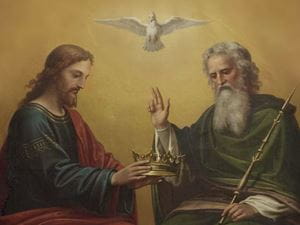
Public Domain
The Christian doctrine of the Trinity is the belief that there is one true and living God who exists as three coeternal Persons—the Father, Son, and Holy Spirit. They are distinct Persons but not separate; they all share one essence. The Bible does not contain the word “Trinity.” This word was first coined by a second-century Christian scholar, Tertullian, who used it to describe this unique teaching of Three-in-One. Early Christians began to understand the nature of God as a relational Being.
The early disciples of Jesus were Jews, and therefore monotheists. They believed there was only one true God. When they encountered Jesus, listened to his teachings, watched his miracles, and witnessed his resurrection, they felt compelled to worship him. Somehow, this Jesus was God too, but they did not believe that there were two Gods. Rather, they sensed that there was some intrinsic oneness between Jesus and the Father. They also came to experience the Holy Spirit as God. The early years of the church were rich in discussion about the nature of God that included a Father who sends his Son and who pours out his Spirit.
The gospels all supported this conversation. For example, John 3:16 says that the Father sent the Son into the world. In Matthew 17.5, the Father from heaven speaks about Jesus as his Son. In John 14-16, Jesus makes numerous references to all three of the Persons: he was leaving and was returning to the Father; when he left, the Father would send the Spirit who would teach them; the Father and Jesus would come to the believer and make a home with him or her. In Luke 3.22, Jesus is being baptized when a voice from heaven acknowledges him as God’s Son, and the Spirit descends on him as a dove. These and many other gospel references show three persons in relationship with each other. And yet they are, as Jesus insisted, one (John 10.30). Many scholars point out that without the Trinity, the gospel makes no sense. Only in a Trinitarian structure could God send a divine Son and pour out a divine Spirit.
While the New Testament writers had not yet developed the language to explain Trinitarian ideas, they clearly embraced this reality. Many of Paul’s epistles begin with a brief preface that builds his arguments on this tripled experience of God: God our Father, Jesus Christ our Lord and the Son of God, and the Spirit of holiness (e.g., Romans 1.1-7). He concludes his second letter to the Corinthian Christians with this: “May the grace of the Lord Jesus Christ, and the love of God, and the fellowship of the Holy Spirit be with you all” (2 Corinthians 13.14).
In the centuries after Jesus’s life, his followers worked hard to understand this Three-in-One relationship. Over the years, theologians proposed a variety of explanations that jeopardized the unique character of this teaching, some by making them different gods, some by lowering Jesus’s status to a secondary divine being, some by conflating the three persons into one who played different roles. Though some of these explanations were compelling to a lot of Christians, ultimately the church rejected them as inadequate understandings of what was going on in the gospels. At the Council of Nicaea in A.D. 325, Christian leaders first hammered out a creedal summary of the Three-in-One God who created all things, who redeemed the world through Jesus, and who sanctified the world in the Spirit. Christians call this summary the Nicene Creed and it has become the universally accepted statement of faith in traditional Christianity.
Read more about Christian teaching on the Trinity here.
3/23/2021 6:32:41 PM
About About Kathleen Mulhern, Ph.D.
Kathleen Mulhern is a writer, editor, historian, speaker, and professor. She teaches courses in world history, European history, and history of Christianity. She has taught at Colorado School of Mines and Regis University, and is currently an adjunct professor at Denver Seminary in the areas of Church History and Spiritual Formation. Kathleen graduated with a B.A. from Wheaton College, earned an M.A. in French Literature from the University of Denver, an M.A. degree in Church History from Denver Seminary, and a Ph.D. in History from the University of Colorado.
More From Patheos About the Christian Doctrine of the Trinity
How Important is the Doctrine of the Trinity?
What is the Trinity? What Does the Bible Teach?
How The Trinity Works In Our Salvation
Top 7 Bible Verses About the Trinity
The Trinity: Not From the Bible Alone
Monotheism & Trinity—Doctrine Develops
Most Popular

General Christian
When Halloween Unmasks Married Hearts

Evangelical

Evangelical
The REST of Your Life: A Creative Wrestles With Sabbath

#107: Cast of Character(s): This Weeks Episode of The...
Progressive Christian
BONUS SHOW: Autism and RFK Jr.'s Cameo

57th Dove Awards Honor Dolly Parton, Crown New Voices

General Christian
A Biblical Vision of Success in Christian Life and...

General Christian
What a Stop Sign Can Teach Us About God’s Will

Catholic

The Real AI Story Is Adoption Without Trust

The First Eucharistic Controversy: Christ’s Real Presence

General Christian
Archdiocese Hosts Military Marriage Retreat in Germany
Patheos Explore the world's faith through different perspectives on religion and spirituality! Patheos has the views of the prevalent religions and spiritualities of the world.
Ad-Free & Subscriber Log-In Subscription Support
- About Us
- 2026 Calendar
- Videos
- Podcasts
- Library of World Religions
- Faith In Media Tracker
- Advertise With Us
- Write for Us
- Privacy Policy
- Terms of Service
- Do Not Sell My Data
- Contact Us
- Radiant Digital
- Manage Newsletter Subscriptions
- Unsubscribe From Notifications
- Sitemap
Copyright 2008-2026, Patheos. All rights reserved.
Subscription Support Ad-Free & Subscriber Log-In
Follow Patheos