
BuddhistCatholicContemplativeEvangelicalGeneral ChristianHinduJewishLatter-day SaintMuslimNew VisionsProgressive Christian
Beliefs
- Buddhist
- Catholic
- Contemplative
- Evangelical
- General Christian
- Hindu
- Jewish
- Latter-day Saint
- More Voices
- Muslim
- New Visions
- Pagan
- Progressive Christian
Topics
- Religion News
- Food and Religion
- Sports and Religion
- Religious Art
- Religious Music and Entertainment
- Religious Events
- History and Religion
- Style and Religion
- Politics and Religion
- Women in Religion
- Recreation Outdoors and Religion
- Business Finance and Religion
- Careers Workplace and Religion
- Education and Religion
- Family Parenting and Religion
- Health Fitness and Religion
- Home and Religion
- Relationships and Religion
- Technology and Religion
- Travel and Religion
Columnists
- Buddhist Columnists
- Business Finance and Religion Columnists
- Careers Workplace and Religion Columnists
- Catholic Columnists
- Contemplative Columnists
- Education and Religion Columnists
- Evangelists Columnists
- Family Parenting and Religion Columnists
- General Christian Columnists
- Health Fitness and Religion Columnists
- Hindu Columnists
- History and Religion Columnists
- Home and Religion Columnists
- Jewish Columnists
- More Voices Columnists
- Latter Day Columnists
- Muslim Columnists
- New Visions Columnists
- Nonreligious Columnists
- Pagan Columnists
- Politics and Religion Columnists
- Progressive Columnists
- Recreation Outdoors and Religion Columnists
- Relationships and Religion Columnists
- Religion News Columnists
- Religious Art Columnists
- Religious Events Columnists
- Religious Music and Entertainment Columnists
- Sports and Religion Columnists
- Style and Religion Columnists
- Technology and Religion Columnists
- Travel and Religion Columnists
- Women in Religion Columnists
Resource Library
- 2026 Calendar
- Library of World Religions
- The 100 Most Holy Places on Earth
- Patheos Answers
- Podcasts
- Videos
- Faith Leaders Database
- Anglican Episcopalian
- Bahai
- Baptist
- Buddhism
- Christianity
- Confucianism
- Eastern Orthodoxy
- Hinduism
- Holiness and Pentecostal
- ISKCON
- Islam
- Judaism
- Lutheran
- Methodist
- The Church of Jesus Christ of Latter-day Saints
- New Age
- Paganism
- Presbytarian and Reformed
- Protestantism
- Religion Behind the Scenes
- Roman Catholic
- Scientology
- Shia Islam
- Sikhism
- Sufism
- Sunni Islam
- Taoism
- Zen
- See all religions
Research Tools
 Ad-Free & Subscriber Log-In Subscription Support
Follow Patheos 

- Trending:
- Advent
- |
- Forgiveness
- |
- Thanksgiving
- |
- Election
- |
- Seasonal Holidays
- |
- Marriage
- Home
- General Christian
- History and Religion
- Answers
- What is the Leviathan According to the Bible
Patheos answers the question:
What is the Leviathan According to the Bible?
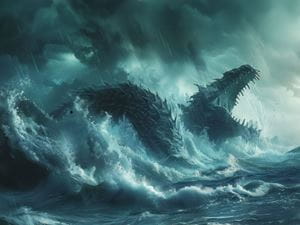
Adobe Stock
Five different times in the Hebrew Bible it speaks of “leviathan” (Job 3:7 & 41:1, Psalm 74:14 & 104:26, Isaiah 27:1). In each case, the Hebrew word employed is the same, and essential means as sea monster, crocodile, serpent, dragon, or other large aquatic (or semi-aquatic) animal. Etymologically speaking, leviathan means the “twisting one,” which could suggest that an “aquatic serpent” might be the best description of this mythological creature.
However, in Job’s account, he gives more details than the Hebrew name leviathan implies:
“What powerful legs, what a stout body this monster possesses! Who could strip off its armor or bring it under control with a harness? Who would try to open its jaws, full of fearsome teeth?... When this monster sneezes, lightning flashes, and its eyes glow like the dawn. Sparks and fiery flames explode from its mouth. And smoke spews from its nose like steam from a boiling pot, while its blazing breath scorches everything in sight. Its neck is so tremendous that everyone trembles, the weakest parts of its body are harder than iron… When this noisy monster appears, even the most powerful turn and run in fear. No sword or spear can harm it, and weapons of bronze or iron are as useless as straw or rotten wood. Rocks thrown from a sling cause it no more harm than husks of grain. This monster fears no arrows, it simply smiles at spears, and striking it with a stick is like slapping it with straw. As it crawls through the mud, its sharp and spiny hide tears the ground apart.” (CEV Job 41:12-14, 18-30)
If we add to Job’s description the following words of the psalmist, an additional layer appears: God “crushed the heads [in the plural] of the monster Leviathan” (CEV Psalm 74:14). Thus, we’re told that leviathan has multiple heads, which correlates with Ugaritic texts wherein leviathan is said to have “seven heads.”
So, the Book of Psalms coupled with Job’s added details, gives us the picture of leviathan as a beast with powerful legs and sharp teeth, having glowing eyes, the ability to breath fire, exhaling steam from its nostrils, and having a noteworthy or lengthy neck. We’re informed that the beast is also fearsomely noisy with iron-like skin and sharp spiny hide—all suggesting that this mythological creature of antiquity is a traditional dragon.
Indeed, if leviathan means “twisting one,” then this epitaph would apply as well to a dragon as it does to a snake. (And snakes certainly don’t breathe fire, have necks or legs, shoot steam from their nostrils, or make loud sounds. Nor are they invincible in the face of “weapons of bronze and iron” or arrows and spears.) Thus, our monster appears to be some kind of semi-aquatic dragon that can swim in the water and walk upon the land. While we now have a good picture of what leviathan looks like, we must ask ourselves what the actual message behind the monster is.
In each of the biblical passages where leviathan appears, it is employed in clearly metaphorical ways. For example, Job describes the beast’s power, only to go on to contrast it with the declaration that God is “king over all” things (Job 41:34). Thus, if Job cannot defeat leviathan, he should know that he most assuredly cannot defeat the omnipotent Yahweh. In the 74th Psalm, on the other hand, Asaph (a Levite) sings of God “breaking the heads” of the monster, contrasting the weakness of evil (represented by leviathan) with God’s power, which will ultimately triumph over all wickedness and evil influences.
Similarly, in the Book of Isaiah we’re told that, at the Lord’s second coming, “leviathan that crooked serpent” or “dragon that is in the sea” shall be “punished” and “slain” (Isaiah 26:21-27:1). Each of these passages use the mythical beast as a symbol of evil, contrasting it with the good and power which flows from God.
The last of the five Hebrew Bible passages in which leviathan appears is the 104th Psalm. In that, leviathan is still used metaphorically, but in a different way than in our other verses. Whereas Asaph uses the monster in the traditional seemingly negative way, King David (who is said to have written the 104th Psalm) uses it to represent one of God’s creatures—in a psalm that praises God’s diversity of creation (e.g., humans, birds, land animals, sea creatures like leviathan, etc.). And yet, once again, the mysterious creature is a symbol—not to be taken literally.
Many commentators still see this chapter as highlighting God’s power. However, unlike the other passages we’ve examined—which focus on God as the creator of order and leviathan as the source of chaos or disorder—Psalm 104:26 highlights that all God has created has a place and purpose in His divine “plan.”
There are a handful of symbols for which leviathan is representative in the Bible. When Yahweh defeats the beast (in Psalm 74), that destruction of the monster comes in the context of the creation. (See Vv:12-17). Thus, leviathan is associated with chaos—and may be a symbol of the reversal (or destruction) of chaos when the cosmos was organized, and the creation was begun. In this context, the creation brings order, and the monster is anti-order, anti-cosmos, or counter-order. On the other hand, the “crushing” of leviathan’s “heads” (in Psalm 74), or “seven heads” in Ugaritic texts, suggests that God will destroy “all” chaos, evil, or opposition at the end of time—seven being the Hebrew number that implies “completion.”
There are also echoes in Psalm 74 and Isaiah 27 (in their Hebrew texts) with Genesis 3:15, where it speaks of the “crushing” the “serpent’s head.” There are clear messianic connotations to this destruction of the “dragon” or “serpent” known as “leviathan.” When Job curses the day on which he was born (in Job 3:8), he draws a parallel (not present in all translations) between his desire to be dead and the darkness of leviathan (which parallels the darkness and chaos of death).
Thus the “monster” almost universally feared (i.e., the unknown we call “death”) is represented by something equally scary (i.e., leviathan, the fearful “monster”).
Leviathan is consistently used in antiquity as a symbol for the powers that oppose God—the former often being associated with chaos, the devil, the untamed nature, etc. In rare exceptions, it is employed as a representation for God’s powers (in a more generic way).
Nonetheless, the message is consistent: God is over all, more powerful than all, and to be feared above all—because of His greatness, His power over chaos and disorder, and His unopposable will. Thus, He is the reverse of leviathan, even if He is the source of the “great monster” that He and only He can defeat.
9/17/2024 8:46:57 PM
Most Popular
- Home
- General Christian
- History and Religion
- Answers
- What is the Leviathan According to the Bible
Advent Begins in the Waiting: Preparing for Jesus
- Home
- General Christian
- History and Religion
- Answers
- What is the Leviathan According to the Bible
Catholic
When The Letter Of The Law Misses Its Purpose
- Home
- General Christian
- History and Religion
- Answers
- What is the Leviathan According to the Bible
Latter-day Saint
- Home
- General Christian
- History and Religion
- Answers
- What is the Leviathan According to the Bible
Latter-day Saint
- Home
- General Christian
- History and Religion
- Answers
- What is the Leviathan According to the Bible
Progressive Christian
Personal Devotion After Deconstruction
- Home
- General Christian
- History and Religion
- Answers
- What is the Leviathan According to the Bible
General Christian
"Why Do Churches Talk So Much About Money?"
- Home
- General Christian
- History and Religion
- Answers
- What is the Leviathan According to the Bible
Progressive Christian
Watch and Pray: On Mark 13:33-37
- Home
- General Christian
- History and Religion
- Answers
- What is the Leviathan According to the Bible
Catholic
Debate on Purgatory & Biblical Evidences for It
- Home
- General Christian
- History and Religion
- Answers
- What is the Leviathan According to the Bible
Catholic
Set the table for the coming King
- Home
- General Christian
- History and Religion
- Answers
- What is the Leviathan According to the Bible
A Modest Proposal for President Trump
- Home
- General Christian
- History and Religion
- Answers
- What is the Leviathan According to the Bible
Catholic
Praise and Thanks As Natural as Breathing
- Home
- General Christian
- History and Religion
- Answers
- What is the Leviathan According to the Bible
Buddhist
If I Stop Becoming, Will I Disappear?
Patheos Explore the world's faith through different perspectives on religion and spirituality! Patheos has the views of the prevalent religions and spiritualities of the world.
Ad-Free & Subscriber Log-In Subscription Support
- About Us
- 2026 Calendar
- Videos
- Podcasts
- Library of World Religions
- Faith In Media Tracker
- Advertise With Us
- Write for Us
- Privacy Policy
- Terms of Service
- Do Not Sell My Data
- Contact Us
- Radiant Digital
- Manage Newsletter Subscriptions
- Unsubscribe From Notifications
- Sitemap
Copyright 2008-2026, Patheos, part of the Radiant Digital network of media brands. All rights reserved.
Subscription Support Ad-Free & Subscriber Log-In
Follow Patheos