
BuddhistCatholicContemplativeEvangelicalGeneral ChristianHinduJewishLatter-day SaintMuslimNew VisionsProgressive Christian
Beliefs
- Buddhist
- Catholic
- Contemplative
- Evangelical
- General Christian
- Hindu
- Jewish
- Latter-day Saint
- More Voices
- Muslim
- New Visions
- Pagan
- Progressive Christian
Topics
- Religion News
- Food and Religion
- Sports and Religion
- Religious Art
- Religious Music and Entertainment
- Religious Events
- History and Religion
- Style and Religion
- Politics and Religion
- Women in Religion
- Recreation Outdoors and Religion
- Business Finance and Religion
- Careers Workplace and Religion
- Education and Religion
- Family Parenting and Religion
- Health Fitness and Religion
- Home and Religion
- Relationships and Religion
- Technology and Religion
- Travel and Religion
Columnists
- Buddhist Columnists
- Business Finance and Religion Columnists
- Careers Workplace and Religion Columnists
- Catholic Columnists
- Contemplative Columnists
- Education and Religion Columnists
- Evangelists Columnists
- Family Parenting and Religion Columnists
- General Christian Columnists
- Health Fitness and Religion Columnists
- Hindu Columnists
- History and Religion Columnists
- Home and Religion Columnists
- Jewish Columnists
- More Voices Columnists
- Latter Day Columnists
- Muslim Columnists
- New Visions Columnists
- Nonreligious Columnists
- Pagan Columnists
- Politics and Religion Columnists
- Progressive Columnists
- Recreation Outdoors and Religion Columnists
- Relationships and Religion Columnists
- Religion News Columnists
- Religious Art Columnists
- Religious Events Columnists
- Religious Music and Entertainment Columnists
- Sports and Religion Columnists
- Style and Religion Columnists
- Technology and Religion Columnists
- Travel and Religion Columnists
- Women in Religion Columnists
Resource Library
- 2026 Calendar
- Library of World Religions
- The 100 Most Holy Places on Earth
- Patheos Answers
- Podcasts
- Videos
- Faith Leaders Database
- Anglican Episcopalian
- Bahai
- Baptist
- Buddhism
- Christianity
- Confucianism
- Eastern Orthodoxy
- Hinduism
- Holiness and Pentecostal
- ISKCON
- Islam
- Judaism
- Lutheran
- Methodist
- The Church of Jesus Christ of Latter-day Saints
- New Age
- Paganism
- Presbytarian and Reformed
- Protestantism
- Religion Behind the Scenes
- Roman Catholic
- Scientology
- Shia Islam
- Sikhism
- Sufism
- Sunni Islam
- Taoism
- Zen
- See all religions
Research Tools
 Ad-Free & Subscriber Log-In Subscription Support
Ad-Free & Subscriber Log-In Subscription Support
Follow Patheos 

- Trending:
- Forgiveness
- |
- Marriage
- |
- Consciousness
- |
- Death Penalty
- |
- Election
- |
- Halloween
Patheos answers the question:
What is the Hindu Festival of Navaratri and How do Hindus Celebrate It?
by Alonzo L. Gaskill
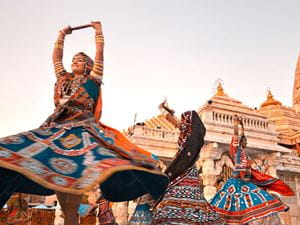
Anurag Agnihotri/Flickr.com
While many non-Hindus are at least vaguely familiar with Diwali, the Hindu “festival of lights” (in which practitioners illuminate their homes with lights, exchange gifts, don festive clothing, and celebrate in ways which feel significantly like Christmas), very few Westerners are familiar with Navaratri—even though the latter of these two holidays is a much more important holiday in Hinduism.
Technically, there are four Navaratri seasonal festivals (Ashada, Chaitra, Magha, and Sharada), though, when Hindus speak of “Navaratri,” that typically has reference to “Sharada Navaratri”—the post-monsoonal ten-day and nine-night festival which is commemorated each fall (usually in September or October).
Sharada Navaratri primarily honors the Hindu goddess (or devī), called Durga—one of the most popular of female Hindu deities, commonly associated with motherhood, but also with protection, and combating anything which risks disrupting prosperity and peace (including demonic forces and darkness). According to one version of the legend, the goddess Durga is said to have participated in a battle against the demon of egotism—a battle which lasted nine days and nights. Durga won the battle and evil was banished. Thus, on this auspicious occasion, practitioners commemorate that great battle and their anticipation of the day when all evil will ultimately cease.
This holiday is sometimes called “Durga Puja,” which basically means the “worship [or ‘puja’] of Durga.” During this nine-night holiday, the various avatars of the goddess Durga (i.e., Shailaputri, Brahmacharini, Chandraghanta, Kushmanda, Skandamata, Katyayani, Kaalratri, Mahagauri, and Siddhidatri.) are individually honored or venerated—each day focusing on the worship of a different avatar.
While Durga is the traditional focus of this holiday, other Hindu goddesses (e.g., Lakshmi, Parvati, and Saraswati) and other gods (e.g., Ganesha, Kartikeya, and Shiva) are also venerated during this annual celebration—and in various regions of India and in diverse parts of the world.
What this holiday focuses on, and even the way in which it is commemorated, really depends on what part of the world the celebrant lives in. While the battle between good and evil is traditionally the focus, how that struggle (and the ultimate triumph of good) is commemorated is not consistent. Local cultures and traditions vary greatly.
One common rite of commemoration, performed in certain areas during this holiday, is to have nine unmarried and virgin girls (who are 9-years of age or less) dress up as the nine avatars of Durga, and then be “worshiped” or treated as manifestations or incarnations of the goddess’s avatars.
The display of certain symbolic colors is common during this nine-day holiday, as well. In decorations and clothing, celebrants will don specific colors on specific days of the festival: Grey (representing vigorous action and the strength of transformation), Orange (associated with energy, happiness, and tranquility), White (implying purity, peace and the value of mediation), Red (highlighting beauty and fearlessness, but sometimes creative power as well), Royal Blue (as a figure of prosperity as well as good health), Yellow (representing happiness, brightness, and sometimes courage), Green (standing for positivity, growth, and new beginnings or reincarnation), Purple (emphasizing the power of the intellect, peace, and the admiration of nature’s beauty), and Peacock Green (standing for the fulfillment of wants or desires of devoted practitioners).
Among Shakti Hindus, animal sacrifices (or symbolic sacrifices and/or vegetable offerings) are sometimes performed on this occasion. This rite is performed, believing that it will inspire Durga to act aggressively toward Mahishasura, the evil, shape-shifting buffalo demon—who wages war on the devas (or celestial beings).
In various Indian states and other countries, commemorations of Navaratri sometimes include fasting (and then feasting), the chanting of mantras (and sacred Hindu texts), recitations of popular legends about the battle between good and evil, engaging in folkdances around a fire or flame (symbolic of the light of the celestial beings), the washing of statues of deities and the destruction of images representing evil. These are but a few of the many rituals and festive acts engaged in (during Navratri) in various parts of the world.
As all, from time to time, will feel the tension of good versus evil in their personal lives, Navratri reminds the practicing Hindu that such challenges are temporary—and God will ultimately overcome all evil, all darkness, and all opposition, in the world and in the lives of those who believe.
3/10/2023 6:18:45 PM
About ABOUT ALONZO L. GASKILL, PH.D.
Alonzo L. Gaskill is an author, editor, theologian, lecturer, and professor of World Religions. He holds degrees in philosophy, theology/comparative religion, and biblical studies. He has authored more than two-dozen books and numerous articles on various aspects of religion; with topics ranging from world religions and interfaith dialogue, to scriptural commentaries, texts on symbolism, sacred space, and ritual, and even devotional literature.
More from Patheos About Hindu Holidays and Traditions
Faith in the Public Square: Inclusive or Exclusive?
Happy Ugadi - A Hindu New Year for a Telugu from Troy
Watching Marshall, Lighting the Diwali Lamp for Dharma
Ganesha Chaturdhi and the Start of the Academic Year
Most Popular

Catholic
The Sermon on the Mount, Part I: Matthew 4:12-5:12

Catholic
Janie Learns the Way of the Cross: A Catholic Review

Entertainment

Evangelical
How the author of the world's best hymn became a Christian

Catholic
Looking For Good Catholic Writing - October 2026


INNER CIRCLE: Profound Mystery (Of Christ In All Of Us)

General Christian
What Does Gêvâh Mean For Kimberley Guifoyle & Pete...
General Christian

Evangelical
Do Not Rejoice When Your Enemy Falls: The Cheers for Death

Progressive Christian
The purpose-driven labor priest
The Golden Rule Demands More than We Think
Patheos Explore the world's faith through different perspectives on religion and spirituality! Patheos has the views of the prevalent religions and spiritualities of the world.
Ad-Free & Subscriber Log-In Subscription Support
- About Us
- 2026 Calendar
- Videos
- Podcasts
- Library of World Religions
- Faith In Media Tracker
- Advertise With Us
- Write for Us
- Privacy Policy
- Terms of Service
- Do Not Sell My Data
- Contact Us
- Radiant Digital
- Manage Newsletter Subscriptions
- Unsubscribe From Notifications
- Sitemap
Copyright 2008-2026, Patheos. All rights reserved.
Subscription Support Ad-Free & Subscriber Log-In
Follow Patheos