
BuddhistCatholicContemplativeEvangelicalGeneral ChristianHinduJewishLatter-day SaintMuslimNew VisionsProgressive Christian
Beliefs
- Buddhist
- Catholic
- Contemplative
- Evangelical
- General Christian
- Hindu
- Jewish
- Latter-day Saint
- More Voices
- Muslim
- New Visions
- Pagan
- Progressive Christian
Topics
- Religion News
- Food and Religion
- Sports and Religion
- Religious Art
- Religious Music and Entertainment
- Religious Events
- History and Religion
- Style and Religion
- Politics and Religion
- Women in Religion
- Recreation Outdoors and Religion
- Business Finance and Religion
- Careers Workplace and Religion
- Education and Religion
- Family Parenting and Religion
- Health Fitness and Religion
- Home and Religion
- Relationships and Religion
- Technology and Religion
- Travel and Religion
Columnists
- Buddhist Columnists
- Business Finance and Religion Columnists
- Careers Workplace and Religion Columnists
- Catholic Columnists
- Contemplative Columnists
- Education and Religion Columnists
- Evangelists Columnists
- Family Parenting and Religion Columnists
- General Christian Columnists
- Health Fitness and Religion Columnists
- Hindu Columnists
- History and Religion Columnists
- Home and Religion Columnists
- Jewish Columnists
- More Voices Columnists
- Latter Day Columnists
- Muslim Columnists
- New Visions Columnists
- Nonreligious Columnists
- Pagan Columnists
- Politics and Religion Columnists
- Progressive Columnists
- Recreation Outdoors and Religion Columnists
- Relationships and Religion Columnists
- Religion News Columnists
- Religious Art Columnists
- Religious Events Columnists
- Religious Music and Entertainment Columnists
- Sports and Religion Columnists
- Style and Religion Columnists
- Technology and Religion Columnists
- Travel and Religion Columnists
- Women in Religion Columnists
Resource Library
- 2026 Calendar
- Library of World Religions
- The 100 Most Holy Places on Earth
- Patheos Answers
- Podcasts
- Videos
- Faith Leaders Database
- Anglican Episcopalian
- Bahai
- Baptist
- Buddhism
- Christianity
- Confucianism
- Eastern Orthodoxy
- Hinduism
- Holiness and Pentecostal
- ISKCON
- Islam
- Judaism
- Lutheran
- Methodist
- The Church of Jesus Christ of Latter-day Saints
- New Age
- Paganism
- Presbytarian and Reformed
- Protestantism
- Religion Behind the Scenes
- Roman Catholic
- Scientology
- Shia Islam
- Sikhism
- Sufism
- Sunni Islam
- Taoism
- Zen
- See all religions
Research Tools
 Ad-Free & Subscriber Log-In Subscription Support
Follow Patheos 

- Trending:
- Advent
- |
- Forgiveness
- |
- Thanksgiving
- |
- Election
- |
- Seasonal Holidays
- |
- Marriage
Patheos answers the question:
What is a Church According to the Bible?
by Kathleen Mulhern, Ph.D.
shutterstock.com
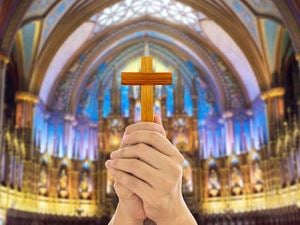
When people use the word “church” today, they are most likely talking about either a building or a worship service. A non-Christian is most likely to think of a “church” as the building where Christian services are held, whereas Christians usually have both meanings in mind. Christians also have a third meaning in mind: the church as a community of fellow believers.
Modern understandings of “church” as a building or a worship service are not how the word was originally used in the Bible. The Greek word from the New Testament that is translated “church” is ekklesia, which means “out-calling” or “assembly of called-out ones.” The word ekklesia or “church” first appears in Matthew 16.18. In this chapter, Jesus had brought his disciples outside Jerusalem and had had a conversation with them about what the people were saying about him. He then asked them, “Who do you say I am?” Simon responded, “You are the Messiah, the Son of the living God.” Jesus then gave Simon his new name, Peter, which means “rock.” This famous exchange finished with Jesus saying, “On this rock I will build my church.” At that point, it is clear that Jesus was not talking about either a particular form of worship or a building, but a community of disciples or an assembly of followers.
Throughout the Scriptures, ekklesia, “church,” is used to refer to groups of Christians. 1 Corinthians 1.2 openly equates “the church of God” with “those who have been sanctified in Christ Jesus and called to be holy.” Many scholars suggest that the summary statement in Acts 2.42 describes the practices of this ekklesia. There we see a group of people who were devoted to “the apostles’ teaching”—that is, they had accepted the Gospel and were learning about Jesus; they joined “the fellowship”—that is, they created community with other believers; they broke bread together—that is, they shared meals and, most importantly, shared the Lord’s Supper; and they prayed. Such practices can take place anywhere and did not need a specific building.
At the time the New Testament was written, Christians did not usually have their own specific places to worship or even a set style of worship. The earliest Christians were almost all Jewish, and they often gathered for worship at the Temple and continued to meet in local synagogues. They also met in homes for further fellowship. Once Christianity began to spread to a non-Jewish audience and created communities all over the Greek and Roman world, believers would meet in homes, public halls, and outdoors.
By the end of the first century, Christians were facing considerable resistance from the authorities. In many places they were persecuted—tortured and executed for their faith. Christians began to meet in back rooms, catacombs, and hidden places due to the threats they faced. Public structures as permanent locations for Christian worship could be built more securely after the conversion of the Emperor Constantine and his Edict legalizing the Christian faith (A.D. 313). Nevertheless, the church as community, the ekklesia, was always the primary reality.
Read more about the Christian community here.
3/23/2021 6:32:40 PM
About About Kathleen Mulhern, Ph.D.
Kathleen Mulhern is a writer, editor, historian, speaker, and professor. She teaches courses in world history, European history, and history of Christianity. She has taught at Colorado School of Mines and Regis University, and is currently an adjunct professor at Denver Seminary in the areas of Church History and Spiritual Formation. Kathleen graduated with a B.A. from Wheaton College, earned an M.A. in French Literature from the University of Denver, an M.A. degree in Church History from Denver Seminary, and a Ph.D. in History from the University of Colorado.
More From Patheos About Biblical References to Church
What Does the Word Church Mean? A Bible Definition
What is the Bible Definition of Church? What is the Biblical View of Church?
Top 7 Bible Verses About Church
What Makes a Group of People "Church?" Part 1
‘Where Two or More are Gathered’ Doesn’t Make a Church
Which Came First? The Bible or the Church?
Most Popular

Progressive Christian
Smart people saying smart things (11.24.26)

The Contingency of Our Technology

Progressive Christian
Progressive Christian
Reasons for Restraint: Ricardo Gonzalez, Florida and Dec 1

General Christian
Psalm 5: David Pleads His Case
Progressive Christian
It All Counts: A Conversation With Natalia Terfa
General Christian
Reflections of a Recovered Evangelical: Honoring the...

Latter-day Saint
Progressive Christian
'Statements of Faith' never get shorter

Evangelical
Michele's Reviews - Future Grace by John Piper

Evangelical
Bama Gramma's Blackout Christmas: the Power of Light...
Patheos Explore the world's faith through different perspectives on religion and spirituality! Patheos has the views of the prevalent religions and spiritualities of the world.
Ad-Free & Subscriber Log-In Subscription Support
- About Us
- 2026 Calendar
- Videos
- Podcasts
- Library of World Religions
- Faith In Media Tracker
- Advertise With Us
- Write for Us
- Privacy Policy
- Terms of Service
- Do Not Sell My Data
- Contact Us
- Radiant Digital
- Manage Newsletter Subscriptions
- Unsubscribe From Notifications
- Sitemap
Copyright 2008-2026, Patheos, part of the Radiant Digital network of media brands. All rights reserved.
Subscription Support Ad-Free & Subscriber Log-In
Follow Patheos