
BuddhistCatholicContemplativeEvangelicalGeneral ChristianHinduJewishLatter-day SaintMuslimNew VisionsProgressive Christian
Beliefs
- Buddhist
- Catholic
- Contemplative
- Evangelical
- General Christian
- Hindu
- Jewish
- Latter-day Saint
- More Voices
- Muslim
- New Visions
- Pagan
- Progressive Christian
Topics
- Religion News
- Food and Religion
- Sports and Religion
- Religious Art
- Religious Music and Entertainment
- Religious Events
- History and Religion
- Style and Religion
- Politics and Religion
- Women in Religion
- Recreation Outdoors and Religion
- Business Finance and Religion
- Careers Workplace and Religion
- Education and Religion
- Family Parenting and Religion
- Health Fitness and Religion
- Home and Religion
- Relationships and Religion
- Technology and Religion
- Travel and Religion
Columnists
- Buddhist Columnists
- Business Finance and Religion Columnists
- Careers Workplace and Religion Columnists
- Catholic Columnists
- Contemplative Columnists
- Education and Religion Columnists
- Evangelists Columnists
- Family Parenting and Religion Columnists
- General Christian Columnists
- Health Fitness and Religion Columnists
- Hindu Columnists
- History and Religion Columnists
- Home and Religion Columnists
- Jewish Columnists
- More Voices Columnists
- Latter Day Columnists
- Muslim Columnists
- New Visions Columnists
- Nonreligious Columnists
- Pagan Columnists
- Politics and Religion Columnists
- Progressive Columnists
- Recreation Outdoors and Religion Columnists
- Relationships and Religion Columnists
- Religion News Columnists
- Religious Art Columnists
- Religious Events Columnists
- Religious Music and Entertainment Columnists
- Sports and Religion Columnists
- Style and Religion Columnists
- Technology and Religion Columnists
- Travel and Religion Columnists
- Women in Religion Columnists
Resource Library
- 2026 Calendar
- Library of World Religions
- The 100 Most Holy Places on Earth
- Patheos Answers
- Podcasts
- Videos
- Faith Leaders Database
- Anglican Episcopalian
- Bahai
- Baptist
- Buddhism
- Christianity
- Confucianism
- Eastern Orthodoxy
- Hinduism
- Holiness and Pentecostal
- ISKCON
- Islam
- Judaism
- Lutheran
- Methodist
- The Church of Jesus Christ of Latter-day Saints
- New Age
- Paganism
- Presbytarian and Reformed
- Protestantism
- Religion Behind the Scenes
- Roman Catholic
- Scientology
- Shia Islam
- Sikhism
- Sufism
- Sunni Islam
- Taoism
- Zen
- See all religions
Research Tools
 Ad-Free & Subscriber Log-In Subscription Support
Ad-Free & Subscriber Log-In Subscription Support
Follow Patheos 

- Trending:
- Forgiveness
- |
- Marriage
- |
- Consciousness
- |
- Death Penalty
- |
- Election
- |
- Halloween
Patheos answers the question:
What is a Bar Mitzvah?
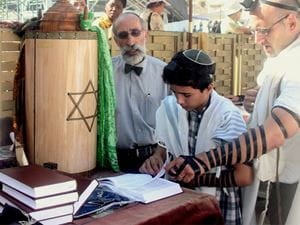
Peter van der Sluijs/Wikimedia Commons
What is a Bar Mitzvah?
Understanding Bar and Bat Mitzvah
A "Bar Mitzvah" is a "son of the commandment," with "bar" meaning "son" in Aramaic and "mitzvah" referring to "commandments." Similarly, a "Bat Mitzvah" is a "daughter of the commandment." Jewish law acknowledges that children cannot fully keep the commandments, so they are not obligated to do so until they become a "Bar Mitzvah" or "Bat Mitzvah." Boys reach this milestone at 13 years old, while girls do so at 12.
Denominations in Judaism
Contemporary Judaism consists of four major denominations: Conservative, Orthodox, Reconstructionist, and Reform. Orthodox Jews do not recognize the Bat Mitzvah as women are not permitted to take an active role in their religious services. The other three denominations offer more opportunities for women and girls to participate in the liturgies. While every girl 12 years old becomes a Bat Mitzvah automatically, Orthodox Jews do not have any religious rite to mark the occasion.
The Significance of the Ceremony
The Bar Mitzvah ceremony signifies the point at which children become recognized as full members of the community, with all the responsibilities that come with it. This status is granted whether or not there is a ritual or ceremony. Any Jewish boy over the age of 13 is a Bar Mitzvah.
Modern Interpretations
Many Jews today celebrate a Bar or Bat Mitzvah as a rite of passage from childhood into adulthood. Some people with no Jewish roots find the celebration to be a useful part of a child's upbringing. However, this "Judaism without Jewishness" can blur the lines of faith and practice.
Duties and Responsibilities
Being a Bar Mitzvah enables a variety of duties within the community. A Bar Mitzvah counts as an adult when determining the number needed for public prayers (the minyan), can sign a binding contract, and can testify before a court. Perhaps most importantly, a Jewish boy who becomes a Bar Mitzvah can be called forward during a Shabbat service to pray a blessing over the reading of the Torah. This invitation is called an aliyah.
The Ceremony and Traditions
In many Jewish communities today, the Bar Mitzvah ceremony invites the boy not only to recite the appropriate blessing but to read the Torah selection as well. Sometimes he will be asked to make a short speech or deliver a sermon. Many Jewish traditions include the bestowal of a tallit, the fringed prayer shawl that men wear during public prayers. These shawls are made in accordance with the commandment in the Torah to "make tassels on the four corners of the cloak you wear" (Deuteronomy 22.12). These tassels remind the wearer of the commandments of God.
Preparations for the Ceremony
A child may prepare for this day extensively. Some communities encourage the wearing of the tefillin for several months prior to the ceremony so that the child can become fully comfortable with the process of putting them on. Tefillin are also known as phylacteries. They consist of two small black boxes with straps, one of which is tied to the upper arm and the other to the forehead. Inside the tefillin are four small paper scrolls with scripture passages written on them. These passages include Exodus 13.1-10, Exodus 13.11-16, Deuteronomy 6.4-9, and Deuteronomy 11.13-21. The first two passages remind the wearer of a key event in Jewish history—the release from slavery in Egypt and the covenant to keep God's commandments. The third passage contains the Shema, the creedal statement about the unity of God and the obligation to love and worship God alone. The third reminds the wearer of God's promises to bless obedience and urges God's people to keep God's words in their hearts.
Expectations and Requirements
Some communities also expect the completion of volunteer projects, regular attendance at religious services, or the accomplishment of some intensive study before the ceremony. Most encourage familiarity with the liturgies, the ability to read a passage from the Torah in Hebrew, and the preparation of a sermon, the d'var Torah. Each synagogue will have its own list of requirements. While traditionally, the father would prepare the son or daughter, many today will enlist the help of a private tutor (often provided by the synagogue) or enroll the child in one of the many online preparatory programs for Bar and Bat Mitzvah ceremonies.
Continuing Education and Celebrations
The Bar or Bat Mitzvah marking point does not end the child's religious education. It is not a "graduation." On the contrary, many synagogues make clear that the learning of the Torah must continue throughout life. Some congregations, particularly Conservative synagogues, may also have a Confirmation ceremony around the age of 15-16 years old. This has been one way they have encouraged the younger teenagers to stay in religious education. The receptions after the service can be extravagant and are always joyful, a time of celebration, gift-giving, and blessings.
Read more about Jewish rites and rituals here.
Read from Patheos Jewish writers.
7/17/2023 6:02:10 PM

About Kathleen Mulhern
Kathleen Mulhern is an author, editor, historian, and adjunct professor of Church History and Christian Formation at Denver Seminary. She holds degrees in literature, church history, and European intellectual history.
Read More from Patheos Jewish Corner
Does Judaism Have Different Denominations?
How Are Judaism, Christianity and Islam Related?
What Are the Origins of Judaism?
What is the Jewish Holiday of Simchat Torah?
Most Popular
#107: Cast of Character(s): This Weeks Episode of The...
Progressive Christian
BONUS SHOW: Autism and RFK Jr.'s Cameo

57th Dove Awards Honor Dolly Parton, Crown New Voices

General Christian
A Biblical Vision of Success in Christian Life and...

General Christian
What a Stop Sign Can Teach Us About God’s Will

Catholic

The Real AI Story Is Adoption Without Trust

The First Eucharistic Controversy: Christ’s Real Presence

General Christian
Archdiocese Hosts Military Marriage Retreat in Germany

Catholic
Swimfan: Forgotten Aughts Pleasures

Catholic
Top Three Anti-Catholic Lies About Catholicism

Latter-day Saint
Patheos Explore the world's faith through different perspectives on religion and spirituality! Patheos has the views of the prevalent religions and spiritualities of the world.
Ad-Free & Subscriber Log-In Subscription Support
- About Us
- 2026 Calendar
- Videos
- Podcasts
- Library of World Religions
- Faith In Media Tracker
- Advertise With Us
- Write for Us
- Privacy Policy
- Terms of Service
- Do Not Sell My Data
- Contact Us
- Radiant Digital
- Manage Newsletter Subscriptions
- Unsubscribe From Notifications
- Sitemap
Copyright 2008-2026, Patheos. All rights reserved.
Subscription Support Ad-Free & Subscriber Log-In
Follow Patheos