
BuddhistCatholicContemplativeEvangelicalGeneral ChristianHinduJewishLatter-day SaintMuslimNew VisionsProgressive Christian
Beliefs
- Buddhist
- Catholic
- Contemplative
- Evangelical
- General Christian
- Hindu
- Jewish
- Latter-day Saint
- More Voices
- Muslim
- New Visions
- Pagan
- Progressive Christian
Topics
- Religion News
- Food and Religion
- Sports and Religion
- Religious Art
- Religious Music and Entertainment
- Religious Events
- History and Religion
- Style and Religion
- Politics and Religion
- Women in Religion
- Recreation Outdoors and Religion
- Business Finance and Religion
- Careers Workplace and Religion
- Education and Religion
- Family Parenting and Religion
- Health Fitness and Religion
- Home and Religion
- Relationships and Religion
- Technology and Religion
- Travel and Religion
Columnists
- Buddhist Columnists
- Business Finance and Religion Columnists
- Careers Workplace and Religion Columnists
- Catholic Columnists
- Contemplative Columnists
- Education and Religion Columnists
- Evangelists Columnists
- Family Parenting and Religion Columnists
- General Christian Columnists
- Health Fitness and Religion Columnists
- Hindu Columnists
- History and Religion Columnists
- Home and Religion Columnists
- Jewish Columnists
- More Voices Columnists
- Latter Day Columnists
- Muslim Columnists
- New Visions Columnists
- Nonreligious Columnists
- Pagan Columnists
- Politics and Religion Columnists
- Progressive Columnists
- Recreation Outdoors and Religion Columnists
- Relationships and Religion Columnists
- Religion News Columnists
- Religious Art Columnists
- Religious Events Columnists
- Religious Music and Entertainment Columnists
- Sports and Religion Columnists
- Style and Religion Columnists
- Technology and Religion Columnists
- Travel and Religion Columnists
- Women in Religion Columnists
Resource Library
- 2026 Calendar
- Library of World Religions
- The 100 Most Holy Places on Earth
- Patheos Answers
- Podcasts
- Videos
- Faith Leaders Database
- Anglican Episcopalian
- Bahai
- Baptist
- Buddhism
- Christianity
- Confucianism
- Eastern Orthodoxy
- Hinduism
- Holiness and Pentecostal
- ISKCON
- Islam
- Judaism
- Lutheran
- Methodist
- The Church of Jesus Christ of Latter-day Saints
- New Age
- Paganism
- Presbytarian and Reformed
- Protestantism
- Religion Behind the Scenes
- Roman Catholic
- Scientology
- Shia Islam
- Sikhism
- Sufism
- Sunni Islam
- Taoism
- Zen
- See all religions
Research Tools
 Ad-Free & Subscriber Log-In Subscription Support
Ad-Free & Subscriber Log-In Subscription Support
Follow Patheos 

- Trending:
- Forgiveness
- |
- Marriage
- |
- Consciousness
- |
- Death Penalty
- |
- Election
- |
- Halloween
Patheos answers the question:
What Does the Bible Say About Hell?
by Kathleen Mulhern, Ph.D.
Shutterstock.com
Everyone has a mental image of hell, but few can accurately quote what the Bible says about it. When it comes to describing what awaits people after they die, the Hebrew scriptures (also known as the Old Testament) usually uses the Hebrew word “Sheol.” This is sometimes translated as “hell” in modern Bibles, but it is just as commonly translated as “the grave,” “the pit,” or even left in the original Hebrew.
Descriptions of Sheol in the Old Testament do not have much in common with popular concepts of hell. Sheol seems to be less of a place of torment and more of a general underworld. In some Old Testament stories, Sheol appears to be where both the wicked and the righteous go after they die (e.g., Job 3.11-19). Another word related to hell in the Old Testament is “Gehenna.” This word was first used in reference to a valley near Jerusalem (the Valley of Hinnom) where pagan nations, and later, corrupt Israelites, offered human sacrifices (Jeremiah 7.30-31). As such, it kept its associations with burning and great suffering and became a symbol of the punishment the evil would face (Isaiah 66.24).
In the New Testament, hell is definitely a place of punishment. Jesus uses the image of Gehenna to warn people that they could be “in danger of the fire of hell” (Matthew 5.22). He speaks frequently in his teaching about the need for spiritual awakening and repentance lest the soul face darkness, weeping, and gnashing of teeth (Matthew 22.13) or “the eternal fire prepared for the devil and his angels” (Matthew 25.41). In the Gospel of Luke, he tells a story about two men, one poor and one rich, one taken to “Abraham’s side” and the other sent to hell, Hades, where he was in agony (Luke 16.19-31).
Other New Testament writers also describe the judgment and punishment awaiting those who reject God. The author of Hebrews describes the “raging fire that will consume the enemies of God” (Hebrews 10.27). In 2 Peter, the author describes the hell of disobedient angels as “gloomy dungeons” and warns those who deny God that they face destruction (2 Peter 2.1-4). Jude describes the punishment as “eternal fire” (Jude 1.7) and “blackest darkness” (Jude 1.13).
The book of Revelation has many vivid descriptions of future punishment. Those who align themselves with evil will “be tormented with burning sulfur” (Revelation 14.10). Those who reject the life of God face “a lake of fire” (Revelation 20.15) and eternal separation from God and the bliss of heaven (Revelation 21.6-8).
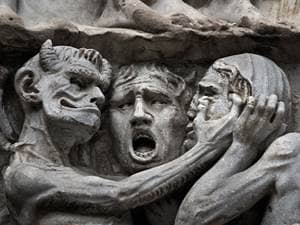
The repeated references to fire in the New Testament descriptions of hell match what most people envision when they think of Satan’s domain. It is a place that is filled with fire, demons, and the screams of the damned. This is the vision that artists such as Hieronymus Bosch (c. 1450-1516) and William Blake (1757-1827) depicted in their work. It also closely related to what Dante Alighieri (c. 1265-1321) became famous for describing in his great work, Divine Comedy.
Christians over the centuries have interpreted these scriptures in different ways, some quite literally and others metaphorically. Many contemporary Christians find the tone of judgment and the threats of punishment incompatible with the idea of a loving God. Nevertheless, it is impossible to read the Bible without recognizing the many warnings and the clear teachings about the consequences of human choices. Some of those choices will have eternal consequences.
Read more about Roman Catholic teaching on hell and purgatory here.
3/21/2024 5:34:23 PM
About About Kathleen Mulhern, Ph.D.
Kathleen Mulhern is a writer, editor, historian, speaker, and professor. She teaches courses in world history, European history, and history of Christianity. She has taught at Colorado School of Mines and Regis University, and is currently an adjunct professor at Denver Seminary in the areas of Church History and Spiritual Formation. Kathleen graduated with a B.A. from Wheaton College, earned an M.A. in French Literature from the University of Denver, an M.A. degree in Church History from Denver Seminary, and a Ph.D. in History from the University of Colorado.
More From Patheos About Christian Views on Hell
7 Things Every Christian Needs To Know About Hell
Why Do Christians Love Hell?
Hell And It's Existence According To Alternative Christian Teachings
Did Jesus Speak More About Hell Than About Heaven?
Four Reasons the Early Church Did Not Believe “Hell” Lasts Forever
What Did Jesus Say or Teach About Hell?
Most Popular

General Christian
When Halloween Unmasks Married Hearts

Evangelical

Evangelical
The REST of Your Life: A Creative Wrestles With Sabbath

#107: Cast of Character(s): This Weeks Episode of The...
Progressive Christian
BONUS SHOW: Autism and RFK Jr.'s Cameo

57th Dove Awards Honor Dolly Parton, Crown New Voices

General Christian
A Biblical Vision of Success in Christian Life and...

General Christian
What a Stop Sign Can Teach Us About God’s Will

Catholic

The Real AI Story Is Adoption Without Trust

The First Eucharistic Controversy: Christ’s Real Presence

General Christian
Archdiocese Hosts Military Marriage Retreat in Germany
Patheos Explore the world's faith through different perspectives on religion and spirituality! Patheos has the views of the prevalent religions and spiritualities of the world.
Ad-Free & Subscriber Log-In Subscription Support
- About Us
- 2026 Calendar
- Videos
- Podcasts
- Library of World Religions
- Faith In Media Tracker
- Advertise With Us
- Write for Us
- Privacy Policy
- Terms of Service
- Do Not Sell My Data
- Contact Us
- Radiant Digital
- Manage Newsletter Subscriptions
- Unsubscribe From Notifications
- Sitemap
Copyright 2008-2026, Patheos. All rights reserved.
Subscription Support Ad-Free & Subscriber Log-In
Follow Patheos