
BuddhistCatholicContemplativeEvangelicalGeneral ChristianHinduJewishLatter-day SaintMuslimNew VisionsProgressive Christian
Beliefs
- Buddhist
- Catholic
- Contemplative
- Evangelical
- General Christian
- Hindu
- Jewish
- Latter-day Saint
- More Voices
- Muslim
- New Visions
- Pagan
- Progressive Christian
Topics
- Religion News
- Food and Religion
- Sports and Religion
- Religious Art
- Religious Music and Entertainment
- Religious Events
- History and Religion
- Style and Religion
- Politics and Religion
- Women in Religion
- Recreation Outdoors and Religion
- Business Finance and Religion
- Careers Workplace and Religion
- Education and Religion
- Family Parenting and Religion
- Health Fitness and Religion
- Home and Religion
- Relationships and Religion
- Technology and Religion
- Travel and Religion
Columnists
- Buddhist Columnists
- Business Finance and Religion Columnists
- Careers Workplace and Religion Columnists
- Catholic Columnists
- Contemplative Columnists
- Education and Religion Columnists
- Evangelists Columnists
- Family Parenting and Religion Columnists
- General Christian Columnists
- Health Fitness and Religion Columnists
- Hindu Columnists
- History and Religion Columnists
- Home and Religion Columnists
- Jewish Columnists
- More Voices Columnists
- Latter Day Columnists
- Muslim Columnists
- New Visions Columnists
- Nonreligious Columnists
- Pagan Columnists
- Politics and Religion Columnists
- Progressive Columnists
- Recreation Outdoors and Religion Columnists
- Relationships and Religion Columnists
- Religion News Columnists
- Religious Art Columnists
- Religious Events Columnists
- Religious Music and Entertainment Columnists
- Sports and Religion Columnists
- Style and Religion Columnists
- Technology and Religion Columnists
- Travel and Religion Columnists
- Women in Religion Columnists
Resource Library
- 2026 Calendar
- Library of World Religions
- The 100 Most Holy Places on Earth
- Patheos Answers
- Podcasts
- Videos
- Faith Leaders Database
- Anglican Episcopalian
- Bahai
- Baptist
- Buddhism
- Christianity
- Confucianism
- Eastern Orthodoxy
- Hinduism
- Holiness and Pentecostal
- ISKCON
- Islam
- Judaism
- Lutheran
- Methodist
- The Church of Jesus Christ of Latter-day Saints
- New Age
- Paganism
- Presbytarian and Reformed
- Protestantism
- Religion Behind the Scenes
- Roman Catholic
- Scientology
- Shia Islam
- Sikhism
- Sufism
- Sunni Islam
- Taoism
- Zen
- See all religions
Research Tools
 Ad-Free & Subscriber Log-In Subscription Support
Ad-Free & Subscriber Log-In Subscription Support
Follow Patheos 

- Trending:
- Forgiveness
- |
- Marriage
- |
- Consciousness
- |
- Death Penalty
- |
- Election
- |
- Halloween
Patheos answers the question:
What Does It Mean to Be Enlightened in Buddhism?
by Kathleen Mulhern, PH.D.
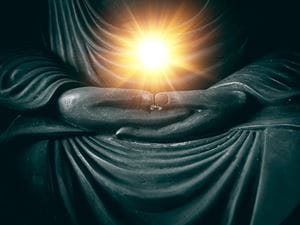
Shutterstock.com
Buddhist enlightenment is the achievement of Buddhahood. As Siddhartha Gautama sat under the Bodhi tree, he meditated until he attained the full realization of his nature. He became awakened, liberated from the endless cycles of suffering in birth, death, and rebirth. Buddha means “awakened one.” The goal of Buddhism is this liberation, also referred to as moksha. When one is enlightened, he or she has gained perfect insight into the Four Noble Truths. Dukkha, the suffering caused by desires and distortions, ceases.
Enlightenment is something of a paradox to an outsider of Buddhism. Buddhism teaches that nothing can be permanent. Everything always arises from something else, and everything later transforms into something else. A child becomes an adult. Love turns to sadness. Pain turns to healing and learning. Despite this, however, enlightenment is said to be a permanent state. Once enlightened, a person does not return to ignorance. At death, he or she leaves the cycle of life, death, and reincarnation, called samsara, and enters nirvana, a state of complete peace without the potential to be reborn into an imperfect life littered with suffering.
Nirvana is the goal of enlightenment; it is the end of rebirth and the extinction of all karma, good or bad. It is the dissolution of the self. Some Buddhist traditions, however, teach another goal for those who wish to continue existence for the sake of others. These may become bodhisattvas, enlightened beings who, despite being able to enter into complete nirvana upon their death, nonetheless choose to be reborn into suffering. They do this in order to spread the teaching of Buddhism and help others escape the suffering of samsara before they themselves enjoy peace.
Methods of achieving enlightenment vary between different schools and traditions within Buddhism. Zen Buddhism, for example, tends to emphasize koans, riddles, and proverbs meant to force students to think in ways that force them to confront their own illusions and misconceptions about reality. All partake of the nature of the Buddha, and once we realize this, we can attain enlightenment. Pure Land Buddhists, on the other hand, work to build up enough merit in this life that they can be reborn in the Pure Land and be with Amitabha Buddha in the next life. There the way of enlightenment is much more pleasant and accessible.
While the details of reaching enlightenment vary between Buddhist schools and traditions, most agree that doing so requires snuffing out dangerous desires and liberating oneself from attachment. Ridding oneself of attachment does not solely mean giving up on foods that people crave or other similar desires. It means extinguishing all forms of desire, greed, and hatred. This includes detaching oneself from the idea that there is a permanent, unchangeable Self. People want to believe in the false notion that there is an “I” and an “other.” Only when this notion is erased can a person achieve liberation from samsara, enlightenment, and nirvana.
There is obviously a great deal of debate about how best to snuff out dangerous desires. The largest and best-known method is the tradition known as the Middle Way. The Middle Way follows the Eightfold Path, a method comprised of right understanding, right intention, right speech, right action, right livelihood, right effort, right mindfulness, and right concentration. These eight steps can be grouped into three categories: wisdom, ethical conduct, and meditation. Though they are often read in a specific order, the eight steps on the Eightfold Path are not meant to be undertaken in any specific order but should reinforce and encourage one another.
Learn more about Buddhist understandings of human nature here.
3/9/2023 11:39:54 PM
About About Kathleen Mulhern, PH.D.
Kathleen Mulhern is a writer, editor, historian, speaker, and professor. She teaches courses in world history, European history, and history of Christianity. She has taught at Colorado School of Mines and Regis University, and is currently an adjunct professor at Denver Seminary in the areas of Church History and Spiritual Formation. Kathleen graduated with a B.A. from Wheaton College, earned an M.A. in French Literature from the University of Denver, an M.A. degree in Church History from Denver Seminary, and a Ph.D. in History from the University of Colorado.
More from Patheos about Enlightenment
Three Levels of Buddhism
The Unawakened Life Sucks - The First Noble Truth
The Denial of Rebirth
Understanding the Noble Quest
Most Popular

Catholic
The Sermon on the Mount, Part I: Matthew 4:12-5:12

Catholic
Janie Learns the Way of the Cross: A Catholic Review

Entertainment

Evangelical
How the author of the world's best hymn became a Christian

Catholic
Looking For Good Catholic Writing - October 2026


INNER CIRCLE: Profound Mystery (Of Christ In All Of Us)

General Christian
What Does Gêvâh Mean For Kimberley Guifoyle & Pete...

General Christian

Evangelical
Do Not Rejoice When Your Enemy Falls: The Cheers for Death

Progressive Christian
The purpose-driven labor priest
The Golden Rule Demands More than We Think
Patheos Explore the world's faith through different perspectives on religion and spirituality! Patheos has the views of the prevalent religions and spiritualities of the world.
Ad-Free & Subscriber Log-In Subscription Support
- About Us
- 2026 Calendar
- Videos
- Podcasts
- Library of World Religions
- Faith In Media Tracker
- Advertise With Us
- Write for Us
- Privacy Policy
- Terms of Service
- Do Not Sell My Data
- Contact Us
- Radiant Digital
- Manage Newsletter Subscriptions
- Unsubscribe From Notifications
- Sitemap
Copyright 2008-2026, Patheos. All rights reserved.
Subscription Support Ad-Free & Subscriber Log-In
Follow Patheos