
BuddhistCatholicContemplativeEvangelicalGeneral ChristianHinduJewishLatter-day SaintMuslimNew VisionsProgressive Christian
Beliefs
- Buddhist
- Catholic
- Contemplative
- Evangelical
- General Christian
- Hindu
- Jewish
- Latter-day Saint
- More Voices
- Muslim
- New Visions
- Pagan
- Progressive Christian
Topics
- Religion News
- Food and Religion
- Sports and Religion
- Religious Art
- Religious Music and Entertainment
- Religious Events
- History and Religion
- Style and Religion
- Politics and Religion
- Women in Religion
- Recreation Outdoors and Religion
- Business Finance and Religion
- Careers Workplace and Religion
- Education and Religion
- Family Parenting and Religion
- Health Fitness and Religion
- Home and Religion
- Relationships and Religion
- Technology and Religion
- Travel and Religion
Columnists
- Buddhist Columnists
- Business Finance and Religion Columnists
- Careers Workplace and Religion Columnists
- Catholic Columnists
- Contemplative Columnists
- Education and Religion Columnists
- Evangelists Columnists
- Family Parenting and Religion Columnists
- General Christian Columnists
- Health Fitness and Religion Columnists
- Hindu Columnists
- History and Religion Columnists
- Home and Religion Columnists
- Jewish Columnists
- More Voices Columnists
- Latter Day Columnists
- Muslim Columnists
- New Visions Columnists
- Nonreligious Columnists
- Pagan Columnists
- Politics and Religion Columnists
- Progressive Columnists
- Recreation Outdoors and Religion Columnists
- Relationships and Religion Columnists
- Religion News Columnists
- Religious Art Columnists
- Religious Events Columnists
- Religious Music and Entertainment Columnists
- Sports and Religion Columnists
- Style and Religion Columnists
- Technology and Religion Columnists
- Travel and Religion Columnists
- Women in Religion Columnists
Resource Library
- 2026 Calendar
- Library of World Religions
- The 100 Most Holy Places on Earth
- Patheos Answers
- Podcasts
- Videos
- Faith Leaders Database
- Anglican Episcopalian
- Bahai
- Baptist
- Buddhism
- Christianity
- Confucianism
- Eastern Orthodoxy
- Hinduism
- Holiness and Pentecostal
- ISKCON
- Islam
- Judaism
- Lutheran
- Methodist
- The Church of Jesus Christ of Latter-day Saints
- New Age
- Paganism
- Presbytarian and Reformed
- Protestantism
- Religion Behind the Scenes
- Roman Catholic
- Scientology
- Shia Islam
- Sikhism
- Sufism
- Sunni Islam
- Taoism
- Zen
- See all religions
Research Tools
 Ad-Free & Subscriber Log-In Subscription Support
Ad-Free & Subscriber Log-In Subscription Support
Follow Patheos 

- Trending:
- Forgiveness
- |
- Marriage
- |
- Consciousness
- |
- Death Penalty
- |
- Election
- |
- Halloween
Patheos answers the question:
What Does It Mean to Achieve Nirvana in Buddhism?
by Kathleen Mulhern, PH.D.
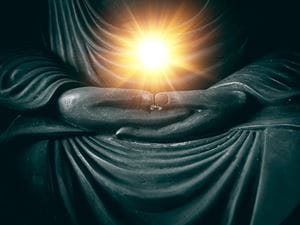
Shutterstock.com
The Buddhist idea of nirvana is sometimes compared to the ideas of heaven or Paradise as found in the three Abrahamic religions—Judaism, Christianity, and Islam—but this is not correct. Heaven is normally described as a place of joy and happiness in the presence of God. Buddhists do not believe in a God who rules the world and judges human lives, rewarding them with heaven or punishing them with hell. Rather, Buddhists understand their lives—past, present, and future—as cycles of ignorance and suffering in a ceaseless process of reincarnation that can only be overcome with enlightenment.
Nirvana, then, is usually understood as the achievement of that enlightenment, which culminates in a total cessation of suffering. It does not refer to a place that a person enters after death, but to an escape from samsara, the endless cycle of death and rebirth. To attain nirvana is to extinguish all sense of the self or individual reality. The word “nirvana” literally means “blown out,” like a candle flame. There is no conscious existence of the self in nirvana.
Nirvana can be partially achieved in this life. When enlightenment is attained and all attachments have been eliminated, the Buddhist experiences a state of nirvana. Such people are known as arhats. Upon their death, however, there is no reincarnation, no rebirth into the cycle of life and death, only non-existence as the suffering self. In the Mahayana Buddhist traditions, some who have attained enlightenment may choose not to enter the final state of nirvana upon death. Instead, they may choose, out of compassion, to reenter the cycle of reincarnation so that they can continue to help others toward enlightenment. These are called bodhisattvas.
While enlightenment and nirvana are considered the goals of Buddhism, not every Buddhist aims to achieve enlightenment within a lifetime. In fact, most Buddhists do not see themselves as likely to attain enlightenment in this lifetime, nor do they pursue it as a serious goal. That is often left to the Buddhist monks and nuns. Instead, many Buddhists simply aim to accumulate enough merit or good karma in this life to be born into a better life after they die.
Pure Land Buddhism is one of the best known and most popular schools of Buddhism in East Asia. Followers of this form of Mahayana Buddhism aim to accumulate good karma and be reborn into the Pure Land with Amitabha Buddha, a buddha who lived many lives as a bodhisattva and earned enough merit to create a land where those who call on his name can be reborn. Those who manage to be reborn into the Pure Land are not liberated from the cycle of rebirth, but they are much more likely to reach enlightenment than one who is reborn into a life on earth as it is much easier to work toward enlightenment and liberation while in the Pure Land. As such, those who practice Pure Land Buddhism believe that being reborn into the Pure Land is the next step on the path to enlightenment.
To learn more about Buddhist concepts of afterlife and salvation, read here.
5/10/2024 4:12:50 AM
About About Kathleen Mulhern, PH.D.
Kathleen Mulhern is a writer, editor, historian, speaker, and professor. She teaches courses in world history, European history, and history of Christianity. She has taught at Colorado School of Mines and Regis University, and is currently an adjunct professor at Denver Seminary in the areas of Church History and Spiritual Formation. Kathleen graduated with a B.A. from Wheaton College, earned an M.A. in French Literature from the University of Denver, an M.A. degree in Church History from Denver Seminary, and a Ph.D. in History from the University of Colorado.
More from Patheos about Nirvana
Attaining Equilibrium
Zen That Works
What is Authentic Zen? Or ... You Gotta Lot of Nerve
Attaining Nirvana - Complete Liberation
Most Popular

Dolly Parton’s Last Song Wins Dove Award with Grascals

Latter-day Saint
The Iron Gates and the Lion of the Lord

Evangelical

Progressive Christian
The Image: On the Horror of Capitalism and Matthew...

Progressive Christian
Why Christians Have a Sacred Duty to Vote: Biblical...

General Christian
Seventy and Five Years Old: God Still Starts New Chapters

Evangelical
Letters on Living the Faith by C.S. Lewis

General Christian
When Halloween Unmasks Married Hearts

Evangelical

Evangelical
The REST of Your Life: A Creative Wrestles With Sabbath

#107: Cast of Character(s): This Weeks Episode of The...
Progressive Christian
BONUS SHOW: Autism and RFK Jr.'s Cameo
Patheos Explore the world's faith through different perspectives on religion and spirituality! Patheos has the views of the prevalent religions and spiritualities of the world.
Ad-Free & Subscriber Log-In Subscription Support
- About Us
- 2026 Calendar
- Videos
- Podcasts
- Library of World Religions
- Faith In Media Tracker
- Advertise With Us
- Write for Us
- Privacy Policy
- Terms of Service
- Do Not Sell My Data
- Contact Us
- Radiant Digital
- Manage Newsletter Subscriptions
- Unsubscribe From Notifications
- Sitemap
Copyright 2008-2026, Patheos. All rights reserved.
Subscription Support Ad-Free & Subscriber Log-In
Follow Patheos