
BuddhistCatholicContemplativeEvangelicalGeneral ChristianHinduJewishLatter-day SaintMuslimNew VisionsProgressive Christian
Beliefs
- Buddhist
- Catholic
- Contemplative
- Evangelical
- General Christian
- Hindu
- Jewish
- Latter-day Saint
- More Voices
- Muslim
- New Visions
- Pagan
- Progressive Christian
Topics
- Religion News
- Food and Religion
- Sports and Religion
- Religious Art
- Religious Music and Entertainment
- Religious Events
- History and Religion
- Style and Religion
- Politics and Religion
- Women in Religion
- Recreation Outdoors and Religion
- Business Finance and Religion
- Careers Workplace and Religion
- Education and Religion
- Family Parenting and Religion
- Health Fitness and Religion
- Home and Religion
- Relationships and Religion
- Technology and Religion
- Travel and Religion
Columnists
- Buddhist Columnists
- Business Finance and Religion Columnists
- Careers Workplace and Religion Columnists
- Catholic Columnists
- Contemplative Columnists
- Education and Religion Columnists
- Evangelists Columnists
- Family Parenting and Religion Columnists
- General Christian Columnists
- Health Fitness and Religion Columnists
- Hindu Columnists
- History and Religion Columnists
- Home and Religion Columnists
- Jewish Columnists
- More Voices Columnists
- Latter Day Columnists
- Muslim Columnists
- New Visions Columnists
- Nonreligious Columnists
- Pagan Columnists
- Politics and Religion Columnists
- Progressive Columnists
- Recreation Outdoors and Religion Columnists
- Relationships and Religion Columnists
- Religion News Columnists
- Religious Art Columnists
- Religious Events Columnists
- Religious Music and Entertainment Columnists
- Sports and Religion Columnists
- Style and Religion Columnists
- Technology and Religion Columnists
- Travel and Religion Columnists
- Women in Religion Columnists
Resource Library
- 2026 Calendar
- Library of World Religions
- The 100 Most Holy Places on Earth
- Patheos Answers
- Podcasts
- Videos
- Faith Leaders Database
- Anglican Episcopalian
- Bahai
- Baptist
- Buddhism
- Christianity
- Confucianism
- Eastern Orthodoxy
- Hinduism
- Holiness and Pentecostal
- ISKCON
- Islam
- Judaism
- Lutheran
- Methodist
- The Church of Jesus Christ of Latter-day Saints
- New Age
- Paganism
- Presbytarian and Reformed
- Protestantism
- Religion Behind the Scenes
- Roman Catholic
- Scientology
- Shia Islam
- Sikhism
- Sufism
- Sunni Islam
- Taoism
- Zen
- See all religions
Research Tools
 Ad-Free & Subscriber Log-In Subscription Support
Ad-Free & Subscriber Log-In Subscription Support
Follow Patheos 

- Trending:
- Forgiveness
- |
- Marriage
- |
- Consciousness
- |
- Death Penalty
- |
- Election
- |
- Halloween
Patheos answers the question:
What are the Cardinal Virtues in Catholicism?
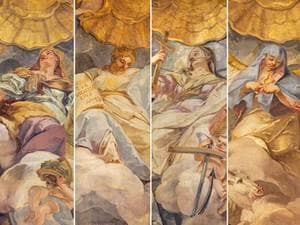
Renata Sedmakova / Shutterstock.com
It is commonly assumed that the “Four Cardinal Virtues” are a uniquely Roman Catholic concept. However, to the surprise of many, Christianity did not come up with the notion that there are four “cardinal” (Latin for “hinge”) virtues—on which all “lesser” virtues turn. Indeed, the tradition that there are four cardinal virtues pre-dates Christianity by at least 600 years.
Four Cardinal Virtues in Other Traditions
Many might be surprised to learn that Confucius (551-479 BCE) encouraged four cardinal virtues, as did the Stoics, starting with Zeno of Citium (3rd century BCE). Aristotle (384-322 BCE) believed there were four, as does Freemasonry. Plato (428-348 BCE) taught four cardinal virtues, as does Roman Catholicism.
In Confucianism, the four cardinal virtues are righteousness, ritual propriety, wisdom, and humility. In Platonism, on the other hand, the cardinal virtues were wisdom, courage, moderation, and justice. Not surprisingly, in Stoicism—another branch of Hellenistic philosophy—the cardinal virtues were the same as in Platonism, though they were often ordered differently. Aristotle defined the cardinal virtues (in his paradigm) as prudence, temperance, courage, and justice—and Roman Catholicism has the same four, directly drawn from Aristotle’s Nicomachean Ethics. Finally, in Freemasonry, the four virtues deemed as cardinal, or requisite, are fortitude, prudence, temperance, and justice.
Four Cardinal Virtues of Catholicism
While each of these schools of thought, and their respective cardinal virtues, are worth if examination, our focus here will be on the Roman Catholic version of the virtues, and what they mean for practitioners of that faith.
As noted above, the reason these four virtues are considered “cardinal” is because the word “cardinal” comes from the Latin for “hinge,” implying that every other virtue is less than the four cardinal ones—and every other virtue stem from or is contingent upon one of the four main virtues. If one does not have the root “cardinal” virtue, one will not have the consequent “lesser” virtues associated with it. One must develop the hinge virtues if one ever hopes to develop the minor virtues.
Prudence
In Catholicism, prudence is the most important of all the cardinal virtues. Theologically speaking, it is understood to mean wisdom. However, this is not the equivalent of knowledge gained from “book learning.” Rather, it is practical wisdom or moral “intelligence”—the kind of wisdom or thinking that allows one to live his or her life endowed with an ability to discern the proper way to live, the wisest path to take, and the best way to act in each circumstance. It is the ability to realize or know what actions will lead to virtue and holiness, and which will draw one away from God and His Holy Spirit. Prudence is the divine gift to see what most do not see, and the strength to apply what one knows is best. It is, in essence, having a divine “common sense” that not all enjoy, but all should seek to develop.
Justice
The theological concept of justice is too often wrapped up in thoughts and fears about the “judgement day.” However, as a virtue, justice is not about being judged by God. Rather, it is more about judging whether others are being treated fairly. With the rise of the social justice movement (in the 20th century), this cardinal virtue has taken on more importance than ever before. For Catholics, justice is the determination to render the rights or fairness due to each individual. It is a developed sense of the need to respect other people, to work for the common good of humanity, and even a sense of duty to ensure that others are treated fairly—and that their rights are upheld and preserved. For some Catholics today, the virtue of justice extends to concerns about the environment (and the just or appropriate treatment and use of it), animal rights (and concerns about abuses, particularly in commercial establishments), in addition to the rights of women, children, the poor, the disenfranchised, and refugees. This virtue includes the ability to see injustice where it exists, and a drive to correct it—in Christian and holy ways, but as boldly as is necessary to ensure the rights of others are met and protected.
Fortitude
The words “fortress” and “fortitude” come from the same root—meaning “that which defends against.” Thus, a fortress is a building which has fortifications or barricades against enemies, so that they don’t gain entrance. Similarly, to have fortitude is to set up mental, emotional, or spiritual barricades so that evil and sin do not gain entrance into the soul. Consequently, both words teach us of the importance of defending ourselves against that which would destroy us—physically, but also spiritually. The virtue of fortitude (sometimes rendered as “courage” or “determination”) enables the possessor to pursue what is good and holy, even in the face of fears and contrary impulses. This attribute ensures a firmness or resolve to pursue what is right, good, and holy, even when confronted with overwhelming temptation. Thus, society often refers to “moral fortitude”—or the strength to do what it morally right, regardless of the trends of society, the enticements of “friends,” or the temptations of the devil.
Temperance
This virtue is most often viewed has having to do with things like alcohol, sexual intimacy, or wealth. Each are, of themselves, not evil. However, each can be addictive, and each have been the cause of the fall of many formerly great men and women. Thus, being temperate implies that one is circumspect in his or her engagement in pleasures, assuring balance; not allowing any craving to be “fed” more than it should be, and ensuring that those “appetites” which should be suppressed or curtailed, are. For example, one may choose to drink, but not to excess. One may be sexually intimate, but within the bounds the Lord has sent. One may enjoy great monetary success, but is generous and philanthropic. This is the virtue of temperance. In most cases, it is not absolute abstinence. Rather, it is moderation and balance.
Overarching Purpose of the Four Cardinal Virtues
While Roman Catholicism holds that there are virtues which are innate to our soul, or part and parcel of what a divinely created being is (i.e., faith, hope, and charity/love), the four cardinal virtues (i.e., prudence, justice, fortitude, and temperance) are traits we develop through conscientious practice. We are not born with these four. As developed, they will function as a sort of internal compass, which will direct our paths down safe roads, ultimately leading us back to God. These four virtues are the foundation of Roman Catholic spirituality.
Learn more about Roman Catholic views around ethics and morality here.
3/7/2023 2:52:13 AM

About Alonzo L. Gaskill, Ph.D.
Alonzo L. Gaskill is an author, editor, theologian, lecturer, and professor of World Religions. He holds degrees in philosophy, theology/comparative religion, and biblical studies. He has authored more than two-dozen books and numerous articles on various aspects of religion; with topics ranging from world religions and interfaith dialogue, to scriptural commentaries, texts on symbolism, sacred space, and ritual, and even devotional literature.
More From Patheos About Cardinal Virtues
A Return to Cardinal Virtues
Virtues As Vices
Cardinal Virtues
Most Popular

General Christian
A Biblical Vision of Success in Christian Life and...

General Christian
How to Make a Decision When You Can't Hear God

Catholic

The Real AI Story Is Adoption Without Trust

The First Eucharistic Controversy: Christ’s Real Presence

General Christian
Archdiocese Hosts Military Marriage Retreat in Germany

Catholic
Swimfan: Forgotten Aughts Pleasures

Catholic
Top Three Anti-Catholic Lies About Catholicism

Latter-day Saint

Catholic
Pope Leo Celebrates Mass for Nurses & Docs While in...

Catholic
The Sermon on the Mount, Part I: Matthew 4:12-5:12

Catholic
Janie Learns the Way of the Cross: A Catholic Review
Patheos Explore the world's faith through different perspectives on religion and spirituality! Patheos has the views of the prevalent religions and spiritualities of the world.
Ad-Free & Subscriber Log-In Subscription Support
- About Us
- 2026 Calendar
- Videos
- Podcasts
- Library of World Religions
- Faith In Media Tracker
- Advertise With Us
- Write for Us
- Privacy Policy
- Terms of Service
- Do Not Sell My Data
- Contact Us
- Radiant Digital
- Manage Newsletter Subscriptions
- Unsubscribe From Notifications
- Sitemap
Copyright 2008-2026, Patheos. All rights reserved.
Subscription Support Ad-Free & Subscriber Log-In
Follow Patheos