
BuddhistCatholicContemplativeEvangelicalGeneral ChristianHinduJewishLatter-day SaintMuslimNew VisionsProgressive Christian
Beliefs
- Buddhist
- Catholic
- Contemplative
- Evangelical
- General Christian
- Hindu
- Jewish
- Latter-day Saint
- More Voices
- Muslim
- New Visions
- Pagan
- Progressive Christian
Topics
- Religion News
- Food and Religion
- Sports and Religion
- Religious Art
- Religious Music and Entertainment
- Religious Events
- History and Religion
- Style and Religion
- Politics and Religion
- Women in Religion
- Recreation Outdoors and Religion
- Business Finance and Religion
- Careers Workplace and Religion
- Education and Religion
- Family Parenting and Religion
- Health Fitness and Religion
- Home and Religion
- Relationships and Religion
- Technology and Religion
- Travel and Religion
Columnists
- Buddhist Columnists
- Business Finance and Religion Columnists
- Careers Workplace and Religion Columnists
- Catholic Columnists
- Contemplative Columnists
- Education and Religion Columnists
- Evangelists Columnists
- Family Parenting and Religion Columnists
- General Christian Columnists
- Health Fitness and Religion Columnists
- Hindu Columnists
- History and Religion Columnists
- Home and Religion Columnists
- Jewish Columnists
- More Voices Columnists
- Latter Day Columnists
- Muslim Columnists
- New Visions Columnists
- Nonreligious Columnists
- Pagan Columnists
- Politics and Religion Columnists
- Progressive Columnists
- Recreation Outdoors and Religion Columnists
- Relationships and Religion Columnists
- Religion News Columnists
- Religious Art Columnists
- Religious Events Columnists
- Religious Music and Entertainment Columnists
- Sports and Religion Columnists
- Style and Religion Columnists
- Technology and Religion Columnists
- Travel and Religion Columnists
- Women in Religion Columnists
Resource Library
- 2026 Calendar
- Library of World Religions
- The 100 Most Holy Places on Earth
- Patheos Answers
- Podcasts
- Videos
- Faith Leaders Database
- Anglican Episcopalian
- Bahai
- Baptist
- Buddhism
- Christianity
- Confucianism
- Eastern Orthodoxy
- Hinduism
- Holiness and Pentecostal
- ISKCON
- Islam
- Judaism
- Lutheran
- Methodist
- The Church of Jesus Christ of Latter-day Saints
- New Age
- Paganism
- Presbytarian and Reformed
- Protestantism
- Religion Behind the Scenes
- Roman Catholic
- Scientology
- Shia Islam
- Sikhism
- Sufism
- Sunni Islam
- Taoism
- Zen
- See all religions
Research Tools
 Ad-Free & Subscriber Log-In Subscription Support
Ad-Free & Subscriber Log-In Subscription Support
Follow Patheos 

- Trending:
- Forgiveness
- |
- Marriage
- |
- Consciousness
- |
- Death Penalty
- |
- Election
- |
- Halloween
Muslim
Patheos answers the question:
What Are Tarawih Prayers?
shutterstock.com
In Islam and its various denominations, prayer is a central act of worship, and there are many types of prayer in Islam. For example, Duʿāʾ (meaning “calling”) is the spontaneous prayer of an individual which flows from the heart and may be uttered during a time of need, distress, or illness. Salah (or Salat), on the other hand, is the ritual prayer that one is expected to offer at specified times throughout the day—and the term literally means “prayer” or “supplication.” (Sunnis offer this prayer five times a day, whereas Shi’a Muslims typically do it three times a day.) In addition to the two previously mentioned prayers, Dhikr (meaning “remembrance”) is an inward supplication in “remembrance” of God and is common among Sufi Muslims. This third kind of prayer may include music or dancing—though not all Muslims allow for music or dancing during prayer, seeing it as haram (or “forbidden”).
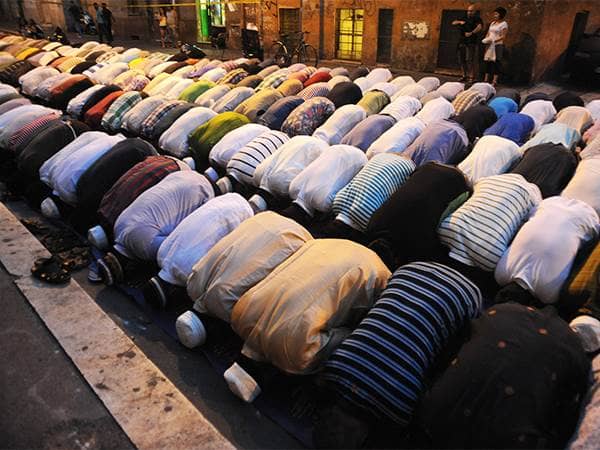
A prayer specific to the Islamic month of Ramadan is Tārawīh (meaning to “relax” or “rest”). This is essentially a month-long prayer which is offered each night of Ramadan, after ’Isha (the evening prayer), and consists of reciting portions of the Holy Qur’an in Arabic while participating in certain ritual gestures (i.e., bowing, prostrating oneself, and standing). This prayer is called Tārawīh because it is more “relaxed” than other prayers, with breaks in between rakahs (or “units” of prayer). It is usual to recite or pray one entire juz' each night as a means of completing the recitation of the entire Qur’an in a single month. (The Qur’an has 30 “parts” or divisions of varying lengths, and a juz' consists of one of those parts.)
In Islam, during the holy month of Ramadan when the hajj or pilgrimage takes place, it has been traditional to try to read the entire Holy Qur’an. Essentially, the Tārawīh prayers fulfill that tradition by praying (or reciting) the entire Qur’an (takmil) during that special month of pilgrimage. While this complete recitation of the sacred book can be performed at home, many Muslim men will gather to the Mosque (or “place of prostration”) each night of the month of Ramadan and engage in Tārawīh as the imam reads (or recites) aloud the Holy Qur’an, while participants engage in the prescribed ritual gestures. (Tārawīh is sometimes referred to as the “Standing of Ramadan” or the “Standing of Night in Ramadan” because one stands during portions of the religious exercise.)
While Tarawih prayers are Sunnah (meaning not obligatory), many Sunni Muslims feel like this complete recitation of the Qur’an (through prayer) is part of how a practicing Muslim should observe the annual holiday of Ramadan—which is Islam’s most important commemorative time of the year. In Sunni tradition, the voluntary nighttime prayer (of Tārawīh) can be traced back to the Prophet Muhmmad (PBUH), who is said to have encouraged this practice. Thus, in the Hadith, we read:
“The Messenger of Allah (PBUH) used to urge (the people) to perform (optional Tārawīh) prayer at night during the month of Ramadan. He did not order them or make it obligatory on them. He (PBUH) said, ‘Whosoever performs (optional Tārawīh) prayers at night during the month of Ramadan, with Faith and in the hope of receiving Allah's reward, will have his past sins forgiven.’” (Riyad as-Salihin 1188)
As a consequence, with the Prophet’s (PBUH) blessing, and Allah’s willingness to forgive all past sins, those in the Sunni tradition see this prayer as both important and impactful.
For those of the Shiite tradition, on the other hand, it is believed that Tārawīh prayer is a later “innovation” introduced by Umar (circa 582-644 CE)—the principal advisor of Abu Bakr, who was Muhammad’s (PBUH) father-in-law and the second of the Sunni kalifs (or califs). For Muslims of this smaller denomination, this particular prayer is not believed to trace back to the Prophet (PBUH) and, thus, it is perceived as having no obligatory status or even significant import.
Prayer is one of the most important acts of worship in Islam, and portions of the Holy Qur’an are used as the text for Islam’s most sacred and obligatory prayers. The Qur’an is held to be a book-length direct quotation of the words of Allah. Thus, Tārawīh prayers (during the month of Ramadan) might appropriately be seen as among the most reverential acts one can engage in, as a means of showing devotion to God, and love for His word.
8/5/2024 10:57:14 PM

Second only in authority to the Qur’an would be the...
Learn about the significance, rituals, and spiritual...

Today, the Nation of Islam as approximately 50,000 members...

How Do Muslims Practice Their Faith?
While most Muslims are members of one of two main...

Do Muslims Celebrate Christmas?
There are Muslims who celebrate Christmas but, as one...

Do Muslims Believe in Jesus Christ?
While He is not worshiped by Muslims, He is greatly...

About Alonzo L. Gaskill, PhD
Alonzo L. Gaskill is a Professor of Church history and doctrine. He holds a bachelor's degree in philosophy, a masters in theology, and a PhD in biblical studies.
Most Popular

General Christian
A Biblical Vision of Success in Christian Life and...

Catholic
Swimfan: Forgotten Aughts Pleasures

Catholic
Top Three Anti-Catholic Lies About Catholicism

Catholic
Pope Leo Celebrates Mass for Nurses & Docs While in...

Catholic
The Sermon on the Mount, Part I: Matthew 4:12-5:12

Catholic
Janie Learns the Way of the Cross: A Catholic Review

Entertainment

Evangelical
How the author of the world's best hymn became a Christian

Catholic
Looking For Good Catholic Writing - October 2026


INNER CIRCLE: Profound Mystery (Of Christ In All Of Us)

General Christian
What Does Gêvâh Mean For Kimberley Guifoyle & Pete...
Patheos Explore the world's faith through different perspectives on religion and spirituality! Patheos has the views of the prevalent religions and spiritualities of the world.
Ad-Free & Subscriber Log-In Subscription Support
- About Us
- 2026 Calendar
- Videos
- Podcasts
- Library of World Religions
- Faith In Media Tracker
- Advertise With Us
- Write for Us
- Privacy Policy
- Terms of Service
- Do Not Sell My Data
- Contact Us
- Radiant Digital
- Manage Newsletter Subscriptions
- Unsubscribe From Notifications
- Sitemap
Copyright 2008-2026, Patheos. All rights reserved.
Subscription Support Ad-Free & Subscriber Log-In
Follow Patheos