
BuddhistCatholicContemplativeEvangelicalGeneral ChristianHinduJewishLatter-day SaintMuslimNew VisionsProgressive Christian
Beliefs
- Buddhist
- Catholic
- Contemplative
- Evangelical
- General Christian
- Hindu
- Jewish
- Latter-day Saint
- More Voices
- Muslim
- New Visions
- Pagan
- Progressive Christian
Topics
- Religion News
- Food and Religion
- Sports and Religion
- Religious Art
- Religious Music and Entertainment
- Religious Events
- History and Religion
- Style and Religion
- Politics and Religion
- Women in Religion
- Recreation Outdoors and Religion
- Business Finance and Religion
- Careers Workplace and Religion
- Education and Religion
- Family Parenting and Religion
- Health Fitness and Religion
- Home and Religion
- Relationships and Religion
- Technology and Religion
- Travel and Religion
Columnists
- Buddhist Columnists
- Business Finance and Religion Columnists
- Careers Workplace and Religion Columnists
- Catholic Columnists
- Contemplative Columnists
- Education and Religion Columnists
- Evangelists Columnists
- Family Parenting and Religion Columnists
- General Christian Columnists
- Health Fitness and Religion Columnists
- Hindu Columnists
- History and Religion Columnists
- Home and Religion Columnists
- Jewish Columnists
- More Voices Columnists
- Latter Day Columnists
- Muslim Columnists
- New Visions Columnists
- Nonreligious Columnists
- Pagan Columnists
- Politics and Religion Columnists
- Progressive Columnists
- Recreation Outdoors and Religion Columnists
- Relationships and Religion Columnists
- Religion News Columnists
- Religious Art Columnists
- Religious Events Columnists
- Religious Music and Entertainment Columnists
- Sports and Religion Columnists
- Style and Religion Columnists
- Technology and Religion Columnists
- Travel and Religion Columnists
- Women in Religion Columnists
Resource Library
- 2026 Calendar
- Library of World Religions
- The 100 Most Holy Places on Earth
- Patheos Answers
- Podcasts
- Videos
- Faith Leaders Database
- Anglican Episcopalian
- Bahai
- Baptist
- Buddhism
- Christianity
- Confucianism
- Eastern Orthodoxy
- Hinduism
- Holiness and Pentecostal
- ISKCON
- Islam
- Judaism
- Lutheran
- Methodist
- The Church of Jesus Christ of Latter-day Saints
- New Age
- Paganism
- Presbytarian and Reformed
- Protestantism
- Religion Behind the Scenes
- Roman Catholic
- Scientology
- Shia Islam
- Sikhism
- Sufism
- Sunni Islam
- Taoism
- Zen
- See all religions
Research Tools
 Ad-Free & Subscriber Log-In Subscription Support
Ad-Free & Subscriber Log-In Subscription Support
Follow Patheos 

- Trending:
- Forgiveness
- |
- Marriage
- |
- Consciousness
- |
- Death Penalty
- |
- Election
- |
- Halloween
Patheos answers the question:
Is Jesus God?
by Kathleen Mulhern, PH.D.
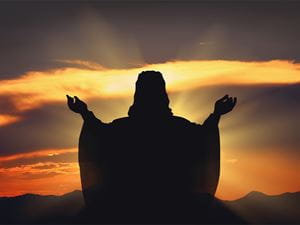
Shutterstock.com
Christians believe that the Jewish man named Jesus, born around 4 B.C. and executed by the Romans around A.D. 33, was also fully divine, and thus they teach that he is God. The gospels describe him as God’s Son (John 3.16) and attribute divine characteristics and powers to him. He could heal the sick (Luke 4.40), restore sight to the blind (Mark 10.46-52) and hearing to the deaf (Mark 7.31-35), make paralyzed people whole (Luke 5.17-25), cast out demons (Matthew 8.28-32), turn water into wine (John 2.1-11), raise the dead (Luke 7.11-15; John 11.38-44), walk on water (Mark 6.45-51), quiet storms (Mark 4.35-39), and multiply bread (Matthew 14.13-21). Early disciples worshipped him as God and prayed to him. Later New Testament writings referred to him as God (John 1.1), as Alpha and Omega (the Beginning and the End; Revelation 22.13), and as enthroned with God in heaven (Revelation 5.6).
The gospels are also clear, however, that Jesus was fully human. He was born into a Jewish peasant family; grew up as a carpenter’s son; had good friends; enjoyed good meals and went to parties; worked, wept, suffered, and died (Matthew 26.37; Mark 15.37; Luke 7.36, 22.44; John 11.1-3, 35). Jesus’ teachings are full of common references to human life that show his familiarity with the world of his day—farming, shepherding, weddings, funerals, cooking, politics, and more.
The Hebrew scriptures had prophesied about a Messiah who would come as a delivering hero of his people (Isaiah 42.1-4, 52.13-53.12; Daniel 7.13-14), and the Jews of Jesus’ day were anticipating his arrival as an opportunity to escape the oppression of the Romans and reestablish the ancient kingdom of David. Jesus said he was the Messiah (Mark 14.61-62), but he reinterpreted the meaning of this word. He taught his followers that the Messiah would deliver his people by setting them free from their sins (Matthew 26.27-28), and that he would do this by taking all human guilt on himself on the cross. He would initiate God’s victory over evil and introduce people to God’s kingdom, a kingdom of justice and love and divine presence (John 18.36-37). In accepting his forgiveness, his followers could be initiated into life with God; Jesus thus breached the gap between humanity and God.
As a human, Jesus could die on the cross; as God, he could absorb all the evil of the world. Because most early Christians were Jewish and thus strict monotheists, they struggled to understand how Jesus could also be God. Jesus’ identity as both a fully human being and a fully divine being was one of the key theological debates in the early years of the Church, and by the end of the 4th century, the language of Trinity (God as Father, Son, and Spirit) became the normative way to describe the relationship between Jesus and God. Jesus was the Son of God who became human. One of Jesus’ names is Immanuel, which means “God with us.” He is also called Savior, Lord, the Word of God, Creator, and the Image of God.
Read more about Christian beliefs about Jesus here.
3/23/2021 6:32:40 PM
About ABOUT KATHLEEN MULHERN, PH.D
Kathleen Mulhern is a writer, editor, historian, speaker, and professor. She teaches courses in world history, European history, and history of Christianity. She has taught at Colorado School of Mines and Regis University, and is currently an adjunct professor at Denver Seminary in the areas of Church History and Spiritual Formation. Kathleen graduated with a B.A. from Wheaton College, earned an M.A. in French Literature from the University of Denver, an M.A. degree in Church History from Denver Seminary, and a Ph.D. in History from the University of Colorado.
More From Patheos About Jesus and God
Jesus Did Make The Claim That He Was God
Who is Jesus?
Why belief in the deity of Jesus Christ is crucial for Christian identity
On the Origins of Divine Christology
If Raised from the Dead Proves Jesus Was God, Then Who Are We When We Get Our New Bod?
Is Jesus Divine Because He Was Worshipped?
Most Popular

General Christian
How to Save Yourself From Spiritual Narcissists

'Super Scam Me' Exposes AI Jon Bon Jovi Romance Scam

The Brazilian Remake of Kendricks' 'Flywheel' Opens in...

Catholic
The Dangers of Gradual Accommodation (Winking at Sin)

Jewish
Building a Little Ark in a Frightening World

Dolly Parton’s Last Song Wins Dove Award with Grascals

Latter-day Saint
The Iron Gates and the Lion of the Lord

Evangelical

Progressive Christian
The Image: On the Horror of Capitalism and Matthew...

Progressive Christian
Why Christians Have a Sacred Duty to Vote: Biblical...

General Christian
Seventy and Five Years Old: God Still Starts New Chapters

Evangelical
Letters on Living the Faith by C.S. Lewis
Patheos Explore the world's faith through different perspectives on religion and spirituality! Patheos has the views of the prevalent religions and spiritualities of the world.
Ad-Free & Subscriber Log-In Subscription Support
- About Us
- 2026 Calendar
- Videos
- Podcasts
- Library of World Religions
- Faith In Media Tracker
- Advertise With Us
- Write for Us
- Privacy Policy
- Terms of Service
- Do Not Sell My Data
- Contact Us
- Radiant Digital
- Manage Newsletter Subscriptions
- Unsubscribe From Notifications
- Sitemap
Copyright 2008-2026, Patheos. All rights reserved.
Subscription Support Ad-Free & Subscriber Log-In
Follow Patheos