
BuddhistCatholicContemplativeEvangelicalGeneral ChristianHinduJewishLatter-day SaintMuslimNew VisionsProgressive Christian
Beliefs
- Buddhist
- Catholic
- Contemplative
- Evangelical
- General Christian
- Hindu
- Jewish
- Latter-day Saint
- More Voices
- Muslim
- New Visions
- Pagan
- Progressive Christian
Topics
- Religion News
- Food and Religion
- Sports and Religion
- Religious Art
- Religious Music and Entertainment
- Religious Events
- History and Religion
- Style and Religion
- Politics and Religion
- Women in Religion
- Recreation Outdoors and Religion
- Business Finance and Religion
- Careers Workplace and Religion
- Education and Religion
- Family Parenting and Religion
- Health Fitness and Religion
- Home and Religion
- Relationships and Religion
- Technology and Religion
- Travel and Religion
Columnists
- Buddhist Columnists
- Business Finance and Religion Columnists
- Careers Workplace and Religion Columnists
- Catholic Columnists
- Contemplative Columnists
- Education and Religion Columnists
- Evangelists Columnists
- Family Parenting and Religion Columnists
- General Christian Columnists
- Health Fitness and Religion Columnists
- Hindu Columnists
- History and Religion Columnists
- Home and Religion Columnists
- Jewish Columnists
- More Voices Columnists
- Latter Day Columnists
- Muslim Columnists
- New Visions Columnists
- Nonreligious Columnists
- Pagan Columnists
- Politics and Religion Columnists
- Progressive Columnists
- Recreation Outdoors and Religion Columnists
- Relationships and Religion Columnists
- Religion News Columnists
- Religious Art Columnists
- Religious Events Columnists
- Religious Music and Entertainment Columnists
- Sports and Religion Columnists
- Style and Religion Columnists
- Technology and Religion Columnists
- Travel and Religion Columnists
- Women in Religion Columnists
Resource Library
- 2026 Calendar
- Library of World Religions
- The 100 Most Holy Places on Earth
- Patheos Answers
- Podcasts
- Videos
- Faith Leaders Database
- Anglican Episcopalian
- Bahai
- Baptist
- Buddhism
- Christianity
- Confucianism
- Eastern Orthodoxy
- Hinduism
- Holiness and Pentecostal
- ISKCON
- Islam
- Judaism
- Lutheran
- Methodist
- The Church of Jesus Christ of Latter-day Saints
- New Age
- Paganism
- Presbytarian and Reformed
- Protestantism
- Religion Behind the Scenes
- Roman Catholic
- Scientology
- Shia Islam
- Sikhism
- Sufism
- Sunni Islam
- Taoism
- Zen
- See all religions
Research Tools
 Ad-Free & Subscriber Log-In Subscription Support
Ad-Free & Subscriber Log-In Subscription Support
Follow Patheos 

- Trending:
- Forgiveness
- |
- Marriage
- |
- Consciousness
- |
- Death Penalty
- |
- Election
- |
- Halloween
Hindu
Patheos answers the question:
How Many Hindu Gods Are There?
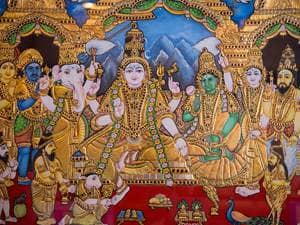
People commonly assume Hinduism is a polytheistic religion, and yet outsiders often wonder exactly how many gods Hindus believe in. What’s interesting and often surprising to non-Hindus is that many practitioners of Hinduism actually are polytheists, but not all are. Indeed, one can technically be a “good Hindu” and be a polytheist, monotheist, modalist, or even a henotheist. Thus, in Hinduism, there really isn’t uniformity of belief, making the answer to the question “How many gods does Hinduism have?” a rather complex one.
Estimates of the total number of Hindu gods run from as low as 1 (that’s right, one) to as high as 330 million. Wow! While that disparity will likely be confusing to strict monotheists (like Jews, Christians, and Muslims), for Hindus, this is completely logical, largely because Hindus are left to decide for themselves what they feel about the nature of God, how many gods they believe exist, and how to approach the divine (as they engage in puja or worship). Hinduism simply isn’t a dogmatic tradition, which explains how they could accept both monotheistic and manifold constructs of the divine.
So, how is it possible for Hinduism to have only one God while, at the same time, having as many as 330 million gods? Well, the answer to this lies in the fact that Hinduism comfortably accepts both infinite and single expressions of the divine.
The “Ultimate” God (of Hinduism) is called “Brahman” by many believers. For monotheistic Hindus, everything is but a manifestation of Brahman, and all things are part of Brahman. Thus, if Brahman is the only God you believe in—and if you think the 330 million other Hindu gods are simply ways to conceive of (or understand) Brahman, then you’re a monotheistic Hindu. If, on the other hand, you believe that Brahman is the one supreme God, but that there are many other legitimate lesser deities, then you might be a henotheistic Hindu. If your sense is that Brahman appears in 330 million different modes (as Brahma, Vishnu, Shiva, etc.), then you would likely be a modalistic Hindu. And if you worship several different gods as distinct and separate entities, you’re a polytheist. Each of these approaches is found among “mainstream” practitioners of Hinduism. Thus, one passage of Hindu scripture tells of a guru repeatedly asking his disciple “How many gods are there?” In essence, though the student gives a different answer each time the question is asked of him, his guru always responds with “Yes, but…” Accordingly, the answer to the question depends entirely on one’s personal understanding of Brahman, the “Ultimate.”
This variety in “orthodox beliefs” regarding God’s nature will usually cause those from non-Hindu monotheistic traditions to wonder, “How can this be?” Hindus constantly find that, as they try to explain their faith’s variety of beliefs about God to those outside of Hinduism, there is typically a disconnect. It simply doesn’t make sense to many non-Hindus. There is a somewhat humorous story, which tells of a conversation between a Christian and a Hindu, and which illustrates how incredibly hard it is for Christians to grasp the Hindu approach to God. One description of the dialogue goes as follows:
Christian: “So which is it? One God, or a whole bunch of gods?”
Hindu: “Absolutely! Or, if you prefer, not so absolutely.”
Christian: “No, seriously, what’s the answer?”
Hindu: “Well, how many gods would you like for there to be?”
Christian: “That’s ridiculous! You’re avoiding my question!”
Hindu: “Well, what if I told you that human beings have no right to tell the Divine (God, the Eternal, the Ultimate) what forms to take—or how many forms are acceptable?”
Christian: “But it has to be one way or the other.”
Hindu: “Does it? If everyone understands that any label for God is inadequate, then what does it matter which label is used, or how many labels are used? They’re all inadequate.”
Christian: “So there is one God?”
Hindu: “From a certain point of view.”
Christian: “And there are lots of gods?”
Hindu: “From a certain point of view.”
Hinduism essentially allows for millions of gods and innumerable beliefs about God; but it also allows for a monotheistic approach to the divine. This faith tradition imagines God in many forms and speaks of the divine by many names, but it also quite comfortably allows for God to be a singular being that either appears in different modes (or forms), or which is conceived of in millions of ways (much like how Jesus is called the “lamb of God,” the “bread of life,” or the “way” in Christianity).
For Hindus, selecting your God (or gods) is a bit like finding the right life-partner; you need to find the one that’s right for you! Typical Hindus embrace the view of God that works best for them personally. That construct of the divine might be male, female, or even androgenous; but it might also be one God or millions of gods. Hindus tend to look for a construct of God that fits their personal views and needs. That construct will almost certainly be influenced by where one is born, what caste one is born into, the views about the divine of the family in which one was reared, and one’s personal needs. But, for some Hindus, it matters less whether their understanding of the number of gods which exist is “correct,” and more whether it “meets their needs.”
So, how many gods does Hinduism have? Well, exactly as many as its practitioners need! And that number can change from day to day—as new gods emerge, old gods combine, or one’s life circumstance changes! Yes, Hinduism has “one God,” but it also has millions of gods. And that is perfectly fine and even logical to most Hindus.
5/24/2024 4:03:29 PM
Most Popular
General Christian
A Biblical Vision of Success in Christian Life and...
Catholic
Swimfan: Forgotten Aughts Pleasures
Catholic
Top Three Anti-Catholic Lies About Catholicism
Catholic
Pope Leo Celebrates Mass for Nurses & Docs While in...
Catholic
The Sermon on the Mount, Part I: Matthew 4:12-5:12
Catholic
Janie Learns the Way of the Cross: A Catholic Review
Entertainment
Evangelical
How the author of the world's best hymn became a Christian
Catholic
Looking For Good Catholic Writing - October 2026
INNER CIRCLE: Profound Mystery (Of Christ In All Of Us)
General Christian
What Does Gêvâh Mean For Kimberley Guifoyle & Pete...
Patheos Explore the world's faith through different perspectives on religion and spirituality! Patheos has the views of the prevalent religions and spiritualities of the world.
Ad-Free & Subscriber Log-In Subscription Support
- About Us
- 2026 Calendar
- Videos
- Podcasts
- Library of World Religions
- Faith In Media Tracker
- Advertise With Us
- Write for Us
- Privacy Policy
- Terms of Service
- Do Not Sell My Data
- Contact Us
- Radiant Digital
- Manage Newsletter Subscriptions
- Unsubscribe From Notifications
- Sitemap
Copyright 2008-2026, Patheos. All rights reserved.
Subscription Support Ad-Free & Subscriber Log-In
Follow Patheos