
BuddhistCatholicContemplativeEvangelicalGeneral ChristianHinduJewishLatter-day SaintMuslimNew VisionsProgressive Christian
Beliefs
- Buddhist
- Catholic
- Contemplative
- Evangelical
- General Christian
- Hindu
- Jewish
- Latter-day Saint
- More Voices
- Muslim
- New Visions
- Pagan
- Progressive Christian
Topics
- Religion News
- Food and Religion
- Sports and Religion
- Religious Art
- Religious Music and Entertainment
- Religious Events
- History and Religion
- Style and Religion
- Politics and Religion
- Women in Religion
- Recreation Outdoors and Religion
- Business Finance and Religion
- Careers Workplace and Religion
- Education and Religion
- Family Parenting and Religion
- Health Fitness and Religion
- Home and Religion
- Relationships and Religion
- Technology and Religion
- Travel and Religion
Columnists
- Buddhist Columnists
- Business Finance and Religion Columnists
- Careers Workplace and Religion Columnists
- Catholic Columnists
- Contemplative Columnists
- Education and Religion Columnists
- Evangelists Columnists
- Family Parenting and Religion Columnists
- General Christian Columnists
- Health Fitness and Religion Columnists
- Hindu Columnists
- History and Religion Columnists
- Home and Religion Columnists
- Jewish Columnists
- More Voices Columnists
- Latter Day Columnists
- Muslim Columnists
- New Visions Columnists
- Nonreligious Columnists
- Pagan Columnists
- Politics and Religion Columnists
- Progressive Columnists
- Recreation Outdoors and Religion Columnists
- Relationships and Religion Columnists
- Religion News Columnists
- Religious Art Columnists
- Religious Events Columnists
- Religious Music and Entertainment Columnists
- Sports and Religion Columnists
- Style and Religion Columnists
- Technology and Religion Columnists
- Travel and Religion Columnists
- Women in Religion Columnists
Resource Library
- 2026 Calendar
- Library of World Religions
- The 100 Most Holy Places on Earth
- Patheos Answers
- Podcasts
- Videos
- Faith Leaders Database
- Anglican Episcopalian
- Bahai
- Baptist
- Buddhism
- Christianity
- Confucianism
- Eastern Orthodoxy
- Hinduism
- Holiness and Pentecostal
- ISKCON
- Islam
- Judaism
- Lutheran
- Methodist
- The Church of Jesus Christ of Latter-day Saints
- New Age
- Paganism
- Presbytarian and Reformed
- Protestantism
- Religion Behind the Scenes
- Roman Catholic
- Scientology
- Shia Islam
- Sikhism
- Sufism
- Sunni Islam
- Taoism
- Zen
- See all religions
Research Tools
 Ad-Free & Subscriber Log-In Subscription Support
Ad-Free & Subscriber Log-In Subscription Support
Follow Patheos 

- Trending:
- Forgiveness
- |
- Marriage
- |
- Consciousness
- |
- Death Penalty
- |
- Election
- |
- Halloween
Buddhist
Patheos answers the question:
How Does Karma Work in Buddhism?
by Kathleen Mulhern, PH.D.
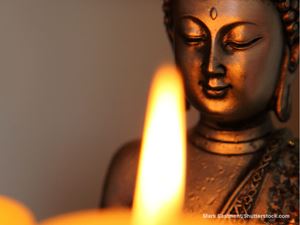
The Buddhist concept of karma has entered the English lexicon in recent decades, and its use has exploded. People use it in casual conversation, and it’s a popular and convenient term for that proverb that says, “what goes around comes around,” i.e., people get what they deserve. Karma is the Sanskrit word for “action” or “doing” and is an integral part of many East Asian and Southeast Asian religions such as Buddhism, Hinduism, and Jainism. In these religions, karma is the consequences of actions, but it is more than the basic sense of cause and effect. In Buddhism, karma is a moral natural law that, like gravity, operates with or without awareness of it. Karma is not fate or predetermination, both of which suggest that there is nothing the individual can do to change things. In Buddhism, change is always possible. Each life bears the karmic results of earlier lives, yet the actions of each life can make future lives better or worse.
Each bad action creates bad consequences, but those consequences might be experienced in the short-term or through multiple lives. Karma accumulates through many reincarnations, and yet from a Buddhist perspective karma can be changed. The karma people build up in this life may not catch up to them during this life; it may not even affect them in their next life. Nevertheless, each person determines his or her own realities. Those experiencing bad karmic consequences from unknown pasts can contribute to better futures by seeking enlightenment and doing good. One such way of changing karma is to gain merit through studying the dharma, supporting Buddhist monasteries, practicing meditation, taking vows, or, in some cultures, going on a pilgrimage to various Buddhist shrines.
Someone who has lived a good life or accumulated merit will be reborn into a good situation, perhaps into a higher social position, into greater wealth, into a safer home situation, or a life with fewer hardships and challenges. On the other hand, a person who lived a life of greed and cruelty could be reborn with severe health challenges, into lower social or economic conditions, or as one even more trapped in the bad habits developed in earlier lives.
Some Buddhist traditions teach that there are realms of existence. Some of these realms are the existences of gods or demi-gods, while others are the existences of beasts or hungry ghosts. These terms merely represent experiential states. For example, those who are reborn as gods experience an easy life, full of riches and power and status. This is not necessarily good, however, because such people rarely achieve enlightenment. Their preoccupations with pleasures keep them from seeking the dharma or achieving merit, and when they die, they have no good karma to prevent a more unfortunate reincarnation. On the other hand, some are reborn as hungry ghosts, suffering constant cravings and dissatisfactions. They, too, find the pursuit of enlightenment difficult. The best rebirth is that of a human—fully vulnerable to suffering, but also capable of acquiring good karma, gaining merit, and seeking enlightenment.
There is some debate in different Buddhist traditions as to what happens to a person’s built-up karma once enlightenment is achieved. Some argue any remaining karma simply disappears. Others claim that when a person achieves enlightenment, they cease to create any karma whatsoever, since it is karma—both good and bad—that keeps a person trapped in samsara, the cycle of rebirth. Instead, an enlightened being lives out long enough to play out any remaining karma, and upon death, he or she achieves nirvana—complete liberation from the cycles of death and rebirth.
Read more about Buddhist concepts of karma and merit here.
8/15/2024 10:44:23 PM
About About Kathleen Mulhern, PH.D.
Kathleen Mulhern is a writer, editor, historian, speaker, and professor. She teaches courses in world history, European history, and history of Christianity. She has taught at Colorado School of Mines and Regis University, and is currently an adjunct professor at Denver Seminary in the areas of Church History and Spiritual Formation. Kathleen graduated with a B.A. from Wheaton College, earned an M.A. in French Literature from the University of Denver, an M.A. degree in Church History from Denver Seminary, and a Ph.D. in History from the University of Colorado.
More from Patheos about Karma
Patterns That Lead to Suffering
The Marks of Existence
Awareness
Most Popular
Catholic
The Parable Of The Sower And The Word Within

'Super Scam Me' Exposes AI Jon Bon Jovi Romance Scam

The Brazilian Remake of Kendricks' 'Flywheel' Opens in...

Catholic
The Dangers of Gradual Accommodation (Winking at Sin)

Jewish
Building a Little Ark in a Frightening World

Dolly Parton’s Last Song Wins Dove Award with Grascals

Latter-day Saint
The Iron Gates and the Lion of the Lord

Evangelical
Progressive Christian
The Image: On the Horror of Capitalism and Matthew...

Progressive Christian
Why Christians Have a Sacred Duty to Vote: Biblical...

General Christian
Seventy and Five Years Old: God Still Starts New Chapters

Evangelical
Letters on Living the Faith by C.S. Lewis
Patheos Explore the world's faith through different perspectives on religion and spirituality! Patheos has the views of the prevalent religions and spiritualities of the world.
Ad-Free & Subscriber Log-In Subscription Support
- About Us
- 2026 Calendar
- Videos
- Podcasts
- Library of World Religions
- Faith In Media Tracker
- Advertise With Us
- Write for Us
- Privacy Policy
- Terms of Service
- Do Not Sell My Data
- Contact Us
- Radiant Digital
- Manage Newsletter Subscriptions
- Unsubscribe From Notifications
- Sitemap
Copyright 2008-2026, Patheos. All rights reserved.
Subscription Support Ad-Free & Subscriber Log-In
Follow Patheos