
BuddhistCatholicContemplativeEvangelicalGeneral ChristianHinduJewishLatter-day SaintMuslimNew VisionsProgressive Christian
Beliefs
- Buddhist
- Catholic
- Contemplative
- Evangelical
- General Christian
- Hindu
- Jewish
- Latter-day Saint
- More Voices
- Muslim
- New Visions
- Pagan
- Progressive Christian
Topics
- Religion News
- Food and Religion
- Sports and Religion
- Religious Art
- Religious Music and Entertainment
- Religious Events
- History and Religion
- Style and Religion
- Politics and Religion
- Women in Religion
- Recreation Outdoors and Religion
- Business Finance and Religion
- Careers Workplace and Religion
- Education and Religion
- Family Parenting and Religion
- Health Fitness and Religion
- Home and Religion
- Relationships and Religion
- Technology and Religion
- Travel and Religion
Columnists
- Buddhist Columnists
- Business Finance and Religion Columnists
- Careers Workplace and Religion Columnists
- Catholic Columnists
- Contemplative Columnists
- Education and Religion Columnists
- Evangelists Columnists
- Family Parenting and Religion Columnists
- General Christian Columnists
- Health Fitness and Religion Columnists
- Hindu Columnists
- History and Religion Columnists
- Home and Religion Columnists
- Jewish Columnists
- More Voices Columnists
- Latter Day Columnists
- Muslim Columnists
- New Visions Columnists
- Nonreligious Columnists
- Pagan Columnists
- Politics and Religion Columnists
- Progressive Columnists
- Recreation Outdoors and Religion Columnists
- Relationships and Religion Columnists
- Religion News Columnists
- Religious Art Columnists
- Religious Events Columnists
- Religious Music and Entertainment Columnists
- Sports and Religion Columnists
- Style and Religion Columnists
- Technology and Religion Columnists
- Travel and Religion Columnists
- Women in Religion Columnists
Resource Library
- 2026 Calendar
- Library of World Religions
- The 100 Most Holy Places on Earth
- Patheos Answers
- Podcasts
- Videos
- Faith Leaders Database
- Anglican Episcopalian
- Bahai
- Baptist
- Buddhism
- Christianity
- Confucianism
- Eastern Orthodoxy
- Hinduism
- Holiness and Pentecostal
- ISKCON
- Islam
- Judaism
- Lutheran
- Methodist
- The Church of Jesus Christ of Latter-day Saints
- New Age
- Paganism
- Presbytarian and Reformed
- Protestantism
- Religion Behind the Scenes
- Roman Catholic
- Scientology
- Shia Islam
- Sikhism
- Sufism
- Sunni Islam
- Taoism
- Zen
- See all religions
Research Tools
 Ad-Free & Subscriber Log-In Subscription Support
Follow Patheos 

- Trending:
- Advent
- |
- Forgiveness
- |
- Thanksgiving
- |
- Election
- |
- Seasonal Holidays
- |
- Marriage
Patheos answers the question:
How Are Christianity, Judaism, and Islam Connected?
shutterstock.com
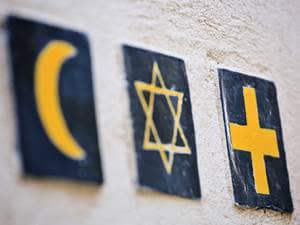
Judaism, Christianity, and Islam are all world religions which originated in the Middle East, with Judaism being the oldest of the three traditions: Christianity being the second, and Islam being the more recent of the three. Christianity emerged out of Judaism in the first century of the common era, and Islam emerged as a religion in the seventh century, with elements of both Jewish and Christian theology and practice.
The connections between Judaism, Christianity, and Islam are varied, including scriptural canon, systematic theology, and a communal nature. Judaism, Christianity, and Islam are sometimes called the “Abrahamic traditions” because of the way in which all three religions claim the figure of Abraham is central to their respective faith tradition. Another way to think about the relationship between the three religions is to compare religious development to language developments. For example, French, Spanish, and Italian are three different languages with different grammatical rules, vocabulary, and parts of speech. However, they are each considered “romance languages” because of their shared linguistic heritage, which means they share some overlapping concepts and word roots. In this way, Judaism, Christianity, and Islam share some mutually intelligible beliefs, practices, and ideas because of the way in which the three faiths emerged in world history, almost like the ways in which Hinduism, Buddhism and Jainism share overlapping concepts.
This is the historical way in which Judaism, Christianity, and Islam are connected. The reality of this historical connection has meant that there are many practical points of connection. Judaism and Christianity are connected, particularly when it comes to the Hebrew Bible. which both of those traditions consider to be a sacred, canonical text. The earliest Christians, or followers of Jesus, were almost all Jews, because Jesus himself was a Jewish man who practiced an observant Jewish life. As a result, the origins of many Christian practices were developed during a time when some Christians understood their faith to be a reformation of Judaism, and not an entirely separate religion. This means that some of the central rituals of Christian worship derive from Jewish practices. For example, every Friday night Jewish people ritually bless wine and bread in consecration of Shabbat, the Jewish sabbath, which is a practice that existed in the first century CE. In most Christian congregations today, the ritual of communion is celebrated on Sunday morning, the Christian sabbath, where a priest or minister will consecrate bread and wine as the body and blood of Jesus Christ. While the Christian ritual of communion derives from Jesus’ teaching in the gospel, most religious studies scholars understand that Jesus was likely utilizing ritual aspects of religion in which his community would have already been familiar. Theologically, the world of Christianity emerged during a time when Jewish worship remained centered around the Temple in Jerusalem, where people who had sinned could come and bring animal sacrifices in order to receive atonement for their sins. The theological concept of Jesus Christ as the perfect sacrifice, which atones for the sins of the world, builds on the theology of sacrifice, sin, and atonement, already present in Judaism.
In a similar vein, the Quran—the most holy book of Islam—make reference to many stories and figures found in both the Hebrew Bible and the Greek New Testament. In Islam, many of the holy figures of both Judaism and Christianity are also considered holy. For example, Islam embraces Abraham, Moses, and Jesus as prophets of God, among others; and the Angel Gabriel figures prominently as God’s messenger in many Muslim stories. Islam understands itself to be the final and perfect revelation of God’s revealed religion, which builds on the corrupted (but still valuable) prophecies of earlier Christian and Jewish prophets. As a result, Jews and Christians have a special status in Islam, where they are considered “the People of the Book.” Judaism and Islam also share many similar approaches to religious law, as well as similar practices of worship. Judaism teaches one should pray three times a day at set times, and Shia Muslims also pray three times a day at set times. Of course, in a similar vein, Sunni Muslims pray five times a day at set times. Both Judaism and Islam have restrictions on eating pork and insects, and both require special methods of slaughter for meat to be proper to eat. In the daily practice of religious worship, observant Jews and Muslims find many similarities in their methods and forms.
Learn more about world religions here.
3/31/2021 11:08:04 PM
More From Patheos
What is the Difference Between the Bible and the Quran?
Do Christians and Muslims Worship the Same God?
Most Popular
Catholic
When The Letter Of The Law Misses Its Purpose

Latter-day Saint

Latter-day Saint
Progressive Christian
Personal Devotion After Deconstruction

General Christian
"Why Do Churches Talk So Much About Money?"

Progressive Christian
Watch and Pray: On Mark 13:33-37
Catholic
Debate on Purgatory & Biblical Evidences for It

Catholic
Set the table for the coming King

A Modest Proposal for President Trump
Catholic
Praise and Thanks As Natural as Breathing
Buddhist
If I Stop Becoming, Will I Disappear?

Progressive Christian
BONUS SHOW: Happy Thanksgiving
Patheos Explore the world's faith through different perspectives on religion and spirituality! Patheos has the views of the prevalent religions and spiritualities of the world.
Ad-Free & Subscriber Log-In Subscription Support
- About Us
- 2026 Calendar
- Videos
- Podcasts
- Library of World Religions
- Faith In Media Tracker
- Advertise With Us
- Write for Us
- Privacy Policy
- Terms of Service
- Do Not Sell My Data
- Contact Us
- Radiant Digital
- Manage Newsletter Subscriptions
- Unsubscribe From Notifications
- Sitemap
Copyright 2008-2026, Patheos, part of the Radiant Digital network of media brands. All rights reserved.
Subscription Support Ad-Free & Subscriber Log-In
Follow Patheos