
BuddhistCatholicContemplativeEvangelicalGeneral ChristianHinduJewishLatter-day SaintMuslimNew VisionsProgressive Christian
Beliefs
- Buddhist
- Catholic
- Contemplative
- Evangelical
- General Christian
- Hindu
- Jewish
- Latter-day Saint
- More Voices
- Muslim
- New Visions
- Pagan
- Progressive Christian
Topics
- Religion News
- Food and Religion
- Sports and Religion
- Religious Art
- Religious Music and Entertainment
- Religious Events
- History and Religion
- Style and Religion
- Politics and Religion
- Women in Religion
- Recreation Outdoors and Religion
- Business Finance and Religion
- Careers Workplace and Religion
- Education and Religion
- Family Parenting and Religion
- Health Fitness and Religion
- Home and Religion
- Relationships and Religion
- Technology and Religion
- Travel and Religion
Columnists
- Buddhist Columnists
- Business Finance and Religion Columnists
- Careers Workplace and Religion Columnists
- Catholic Columnists
- Contemplative Columnists
- Education and Religion Columnists
- Evangelists Columnists
- Family Parenting and Religion Columnists
- General Christian Columnists
- Health Fitness and Religion Columnists
- Hindu Columnists
- History and Religion Columnists
- Home and Religion Columnists
- Jewish Columnists
- More Voices Columnists
- Latter Day Columnists
- Muslim Columnists
- New Visions Columnists
- Nonreligious Columnists
- Pagan Columnists
- Politics and Religion Columnists
- Progressive Columnists
- Recreation Outdoors and Religion Columnists
- Relationships and Religion Columnists
- Religion News Columnists
- Religious Art Columnists
- Religious Events Columnists
- Religious Music and Entertainment Columnists
- Sports and Religion Columnists
- Style and Religion Columnists
- Technology and Religion Columnists
- Travel and Religion Columnists
- Women in Religion Columnists
Resource Library
- 2026 Calendar
- Library of World Religions
- The 100 Most Holy Places on Earth
- Patheos Answers
- Podcasts
- Videos
- Faith Leaders Database
- Anglican Episcopalian
- Bahai
- Baptist
- Buddhism
- Christianity
- Confucianism
- Eastern Orthodoxy
- Hinduism
- Holiness and Pentecostal
- ISKCON
- Islam
- Judaism
- Lutheran
- Methodist
- The Church of Jesus Christ of Latter-day Saints
- New Age
- Paganism
- Presbytarian and Reformed
- Protestantism
- Religion Behind the Scenes
- Roman Catholic
- Scientology
- Shia Islam
- Sikhism
- Sufism
- Sunni Islam
- Taoism
- Zen
- See all religions
Research Tools
 Ad-Free & Subscriber Log-In Subscription Support
Ad-Free & Subscriber Log-In Subscription Support
Follow Patheos 

- Trending:
- Forgiveness
- |
- Marriage
- |
- Consciousness
- |
- Death Penalty
- |
- Election
- |
- Halloween
Buddhist
Patheos answers the question:
Does Buddhism Have a God?
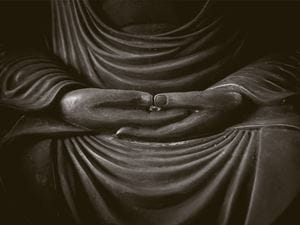
Sidhartha Gautama (AKA “the Buddha”) was born to an Indian king and his wife in the 6th century BCE. At his birth, a prophecy was given about his ultimate destiny. His father was told (by a Hindu Brahmin priest) that the boy would grow to become either a great monarch (like his father) or a holy man—which, according to some readings of the tradition, meant he would be the founder of a great religion. Because of this commonly told story, there is a somewhat tongue-in-cheek meme that depicts the Buddha saying to his father, the king, “Why become a king when you can become a god?” As clever as this sounds, it not only misrepresents the original prophecy about Sidhartha’s ultimate destiny, but it also gives a false impression about what Buddhists believe about God.
Contrary to popular assumptions, the Buddha is not the “God” of Buddhism. Certainly, most Buddhists don’t see him that way. Yes, he is venerated as the perfect example of an enlightened being—the term “Buddha” meaning “awakened one” (i.e., one who is enlightened). And yes, some certainly see him as a sort of “savior” being. However, the notion that he is the God of Buddhism—akin to how YHWH is the God of Judaism or Zeus is the God of the Greek Pantheon—is just not the case. Very few Buddhists would perceive Sidhartha in that way.
So, if Sidhartha is not the God of Buddhism, who is? Well, to answer that question, it is important to understand that, like almost any religion, Buddhism has many denominations and many different approaches to being a Buddhist. Various practitioners have their own personal doctrinal views, and different denominations have differing teachings as well. Thus, any query into what Buddhism embraces or observes can only be answered through understanding the personal beliefs of the Buddhist being questioned. Even if you know what denomination someone belongs to, that is no guarantee you will know what their personal practices or beliefs are because Buddhism is not a dogmatic faith that dictates what its practitioners have to believe or how they must practice their faith. It is filled with a variety of viewpoints, practices, denominations, and sacred texts and, accordingly, one must be careful about generalizations when talking about this ancient religious tradition.
While there are three main branches of Buddhism—Theravada, Mahayana, and Vajrayana—each of these primary denominations has sub-denominations within them. Thus, there are technically hundreds of sects of this ancient tradition, and an even greater variety of views on God. The Theravada tradition, for example, is largely non-theistic, not teaching about, emphasizing, or encouraging belief in a god (or gods). Indeed, some scholars doubt that the Buddha personally had a “God” that he worshiped. As has been pointed out, “Buddhism in its purity ignored the existence of a God.” So, early Theravada Buddhists may have assumed that the Hindu gods existed, but they were not worshiped by those same Buddhists. Rather, the gods of Hinduism were simply understood to be spirits which had yet to attain their final liberation from the “wheel” of reincarnation. For many early Buddhists, the “gods” held no power over a practitioner’s day-to-day life. The “gods,” if it is even appropriate to call them that, were subject to the same universal laws that all of us are, and they are simply beings trying to work their way to Nirvana—just as you and I are. Hence, the Buddha taught that one should not seek “divine intervention”—because the “gods” (according to Theravada tradition) are not beings which have any power to help humans gain enlightenment or achieve Nirvana. Contrast this view with the beliefs of those in the Mahayana and Vajrayana denominations. Practitioners of these traditions tend to believe in many deities, savior beings, and bodhisattvas. Therefore, while many (if not most) Theravada Buddhists tend to be non-theistic, several Mahayana and Vajrayana Buddhist traditions believe in, venerate, appeal to, and worship, a variety of divine beings. While no mainstream Buddhist denominations traditionally speak of a “Creator God,” there are beings (like Vajrapāṇi, Mañjuśrī, or Avalokiteśvara) which certain Mahayana and Vajrayana Buddhists perceived as divine and treat as gods.
So, does Buddhism have a God? It might be better to ask, “Do all Buddhists believe in God?” To that, the answer would have to be “No.” However, many Buddhists actually do believe in one or more deities, some of which are married divinities and others which are single. No major denominations of Buddhism teach that the Buddha is their God but, in pretty much every Buddhist tradition, he is revered because he “revealed” the means by which dukkha (or “suffering”) can end and Nirvana can be achieved. For some Buddhists, that Nirvana will be filled with various divine beings; while, for others, it absolutely will not. It all just depends and, for most Theravada Buddhists, the existence of a God just doesn’t matter.
5/29/2024 3:49:18 AM
What are the Ten Paramis in Buddhism?
There are a series of paramīs or “perfected”...
Much like almost any major world religion, Buddhism has...
Is Buddhism A Religion Or A Philosophy?
From its origins, in the 6th century BCE, Buddhism has...

Buddhism, like Hinduism, is not a theologically dogmatic...
Celebrated on December 8, Bodhi Day is a Mahayana...
Explore the profound and accessible path of Pure Land...

About Alonzo L. Gaskill, PhD
Alonzo L. Gaskill is a Professor of Church history and doctrine. He holds a bachelor's degree in philosophy, a masters in theology, and a PhD in biblical studies.
Most Popular

General Christian
A Biblical Vision of Success in Christian Life and...

Catholic
Pope Leo Celebrates Mass for Nurses & Docs While in...

Catholic
The Sermon on the Mount, Part I: Matthew 4:12-5:12

Catholic
Janie Learns the Way of the Cross: A Catholic Review

Entertainment

Evangelical
How the author of the world's best hymn became a Christian

Catholic
Looking For Good Catholic Writing - October 2026


INNER CIRCLE: Profound Mystery (Of Christ In All Of Us)

General Christian
What Does Gêvâh Mean For Kimberley Guifoyle & Pete...

General Christian

Evangelical
Do Not Rejoice When Your Enemy Falls: The Cheers for Death
Patheos Explore the world's faith through different perspectives on religion and spirituality! Patheos has the views of the prevalent religions and spiritualities of the world.
Ad-Free & Subscriber Log-In Subscription Support
- About Us
- 2026 Calendar
- Videos
- Podcasts
- Library of World Religions
- Faith In Media Tracker
- Advertise With Us
- Write for Us
- Privacy Policy
- Terms of Service
- Do Not Sell My Data
- Contact Us
- Radiant Digital
- Manage Newsletter Subscriptions
- Unsubscribe From Notifications
- Sitemap
Copyright 2008-2026, Patheos. All rights reserved.
Subscription Support Ad-Free & Subscriber Log-In
Follow Patheos