
BuddhistCatholicContemplativeEvangelicalGeneral ChristianHinduJewishLatter-day SaintMuslimNew VisionsProgressive Christian
Beliefs
- Buddhist
- Catholic
- Contemplative
- Evangelical
- General Christian
- Hindu
- Jewish
- Latter-day Saint
- More Voices
- Muslim
- New Visions
- Pagan
- Progressive Christian
Topics
- Religion News
- Food and Religion
- Sports and Religion
- Religious Art
- Religious Music and Entertainment
- Religious Events
- History and Religion
- Style and Religion
- Politics and Religion
- Women in Religion
- Recreation Outdoors and Religion
- Business Finance and Religion
- Careers Workplace and Religion
- Education and Religion
- Family Parenting and Religion
- Health Fitness and Religion
- Home and Religion
- Relationships and Religion
- Technology and Religion
- Travel and Religion
Columnists
- Buddhist Columnists
- Business Finance and Religion Columnists
- Careers Workplace and Religion Columnists
- Catholic Columnists
- Contemplative Columnists
- Education and Religion Columnists
- Evangelists Columnists
- Family Parenting and Religion Columnists
- General Christian Columnists
- Health Fitness and Religion Columnists
- Hindu Columnists
- History and Religion Columnists
- Home and Religion Columnists
- Jewish Columnists
- More Voices Columnists
- Latter Day Columnists
- Muslim Columnists
- New Visions Columnists
- Nonreligious Columnists
- Pagan Columnists
- Politics and Religion Columnists
- Progressive Columnists
- Recreation Outdoors and Religion Columnists
- Relationships and Religion Columnists
- Religion News Columnists
- Religious Art Columnists
- Religious Events Columnists
- Religious Music and Entertainment Columnists
- Sports and Religion Columnists
- Style and Religion Columnists
- Technology and Religion Columnists
- Travel and Religion Columnists
- Women in Religion Columnists
Resource Library
- 2026 Calendar
- Library of World Religions
- The 100 Most Holy Places on Earth
- Patheos Answers
- Podcasts
- Videos
- Faith Leaders Database
- Anglican Episcopalian
- Bahai
- Baptist
- Buddhism
- Christianity
- Confucianism
- Eastern Orthodoxy
- Hinduism
- Holiness and Pentecostal
- ISKCON
- Islam
- Judaism
- Lutheran
- Methodist
- The Church of Jesus Christ of Latter-day Saints
- New Age
- Paganism
- Presbytarian and Reformed
- Protestantism
- Religion Behind the Scenes
- Roman Catholic
- Scientology
- Shia Islam
- Sikhism
- Sufism
- Sunni Islam
- Taoism
- Zen
- See all religions
Research Tools
 Ad-Free & Subscriber Log-In Subscription Support
Ad-Free & Subscriber Log-In Subscription Support
Follow Patheos 

- Trending:
- Forgiveness
- |
- Marriage
- |
- Consciousness
- |
- Death Penalty
- |
- Election
- |
- Halloween
Buddhist
Patheos answers the question:
Do Buddhists Pray?
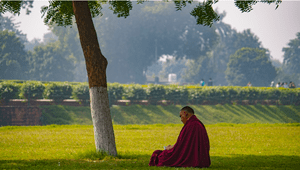
Wikimedia Commons
When non-Buddhists inquire about prayer, they are often referring to an individual's supplication before God—a speaking from one person to a God or gods about concerns in that person's life. Since most of Buddhist is nontheistic, meaning that they do not believe in a God or gods who would receive a person's individual request, it's hard to use the word prayer in the context of Buddhist devotion.
Nevertheless, the generally encouraging implications of this word have proved it useful as Buddhists seek to convey their practice of devotion. It is often used to describe the hopes and aspirations of the Buddha way, the desire that all creatures would find enlightenment and thus release from suffering. This spirit of "lovingkindness" finds expression in "prayers" of meditation and focused peace. In this sense, the Buddhist at prayer is seeking within for the resources to achieve Buddhahood and is visibly reverencing those who have already achieved it.
Most Buddhists, however, are not imploring a God to intervene on their behalf or change a present situation. They are internally expressing their longing for freedom from suffering and their hope of enlightenment. Buddhism contains within itself a visceral recognition that change in the world is up to the individual. Each person has within the germ of enlightenment, and each person alone is responsible for bringing it to fulfillment. There is no deity who is standing by to grant supernatural assistance. Thus prayer involves self-dedication and concentrated meditation on the issues of life and the choices for right living.
Buddhism, however, is not a monolithic religious philosophy, and in the 2,500 years since Buddha's life and teachings, the religion has developed three distinct sects: Theravada Buddhism, Mahayana Buddhism, and Vajrayana Buddhism. These three sects vary in their teachings around deities. Theravada Buddhism is nontheist, meaning it does not recognize supernatural beings who have absolute power over the matters of this earth. Mahayana Buddhism and Vajrayana Buddhism have developed pantheons of gods and deities, most of whom are buddhas and bodhisattvas. In these traditions especially, prayers are expressed toward these beings who may give aid.
Sometimes these expressions take the form of a mantra, a sacred word or text repeated with great frequency. In Mahayana Buddhism, the devotion to bodhisattvas has led to the common practice of reciting their names or the names of various Buddhas as an act of hope in the power of the bodhisattva to assist their journey into enlightenment. This is the Buddhist practice most like prayer.
In Tibetan Buddhism, mantras have been vested into a variety of material objects, like prayer wheels and prayer flags. Spinning the prayer wheels or seeing the wind whip the flags becomes the essence of the prayer, and the concept of an "answer" to these prayers becomes nonsensical. The prayers are simply the yearnings of all people for enlightenment, for freedom from suffering.
In many Chinese Buddhist communities, ancestors continue to have a role to play in the present life. These Buddhists will offer prayer to their ancestors in the form of burning incense or burning small paper tokens that depict material goods or money. These prayers are for the well-being of the ancestors, who then can create good for their living family members.
In Zen Buddhism, prayer most often takes the form of intense meditation. Zen Buddhist monks are strictly trained in this, and older monks conduct sesshin, periodic sessions that require the novice to sit for many hours each day in silent meditation. Sometimes they are taught to meditation on one or more sutra—verses or passages of sacred texts; sometimes they are called on to memorize long passages of classical texts; and other times they are given a koan—an enigma or paradox that cannot be solved by logic or rational thought and thereby pushes the practitioner to resolve it with intuition and enlightenment. None of this may look like prayer from other religious traditions because it involves neither a supplicant nor a divine recipient who can dispense special graces nor a specific request for help.
In every sect of Buddhism, festivals and pilgrimages are a primary means of expressing devotion. There are countless sacred sites that afford a Buddhist pilgrim the opportunity of deepening devotion, cultivating awareness, and imploring the goodwill of bodhisattvas.
Temples, stupas (monuments containing relics associated with different buddhas and bodhisattvas), sacred groves, and other shrines offer occasions for "prayer" That is, the pilgrim undertaking a journey to such a site is praying—expressing devotion, intensifying spiritual desire, and cultivating awareness.
Clearly, there is no single authoritative teaching on prayer in the Buddhist experience. The community shares many diverse and contradictory ideas, which have developed over centuries of cultural change and intermixing with other religious traditions. Prayer or no prayer, the Buddhist way is the pursuit of compassion and enlightenment. In their desire for this way, Buddhists' longings may be called "prayer."
5/14/2024 8:31:10 PM

About Kathleen Mulhern
Kathleen Mulhern is an author, editor, historian, and adjunct professor of Church History and Christian Formation at Denver Seminary. She holds degrees in literature, church history, and European intellectual history.
Read More from Patheos on Buddhists
STOP THE WAR: A Meditation on a Zen Koan
Most Popular

General Christian
A Biblical Vision of Success in Christian Life and...

Catholic
Pope Leo Celebrates Mass for Nurses & Docs While in...

Catholic
The Sermon on the Mount, Part I: Matthew 4:12-5:12

Catholic
Janie Learns the Way of the Cross: A Catholic Review

Entertainment

Evangelical
How the author of the world's best hymn became a Christian

Catholic
Looking For Good Catholic Writing - October 2026


INNER CIRCLE: Profound Mystery (Of Christ In All Of Us)

General Christian
What Does Gêvâh Mean For Kimberley Guifoyle & Pete...

General Christian

Evangelical
Do Not Rejoice When Your Enemy Falls: The Cheers for Death
Patheos Explore the world's faith through different perspectives on religion and spirituality! Patheos has the views of the prevalent religions and spiritualities of the world.
Ad-Free & Subscriber Log-In Subscription Support
- About Us
- 2026 Calendar
- Videos
- Podcasts
- Library of World Religions
- Faith In Media Tracker
- Advertise With Us
- Write for Us
- Privacy Policy
- Terms of Service
- Do Not Sell My Data
- Contact Us
- Radiant Digital
- Manage Newsletter Subscriptions
- Unsubscribe From Notifications
- Sitemap
Copyright 2008-2026, Patheos. All rights reserved.
Subscription Support Ad-Free & Subscriber Log-In
Follow Patheos