
BuddhistCatholicContemplativeEvangelicalGeneral ChristianHinduJewishLatter-day SaintMuslimNew VisionsProgressive Christian
Beliefs
- Buddhist
- Catholic
- Contemplative
- Evangelical
- General Christian
- Hindu
- Jewish
- Latter-day Saint
- More Voices
- Muslim
- New Visions
- Pagan
- Progressive Christian
Topics
- Religion News
- Food and Religion
- Sports and Religion
- Religious Art
- Religious Music and Entertainment
- Religious Events
- History and Religion
- Style and Religion
- Politics and Religion
- Women in Religion
- Recreation Outdoors and Religion
- Business Finance and Religion
- Careers Workplace and Religion
- Education and Religion
- Family Parenting and Religion
- Health Fitness and Religion
- Home and Religion
- Relationships and Religion
- Technology and Religion
- Travel and Religion
Columnists
- Buddhist Columnists
- Business Finance and Religion Columnists
- Careers Workplace and Religion Columnists
- Catholic Columnists
- Contemplative Columnists
- Education and Religion Columnists
- Evangelists Columnists
- Family Parenting and Religion Columnists
- General Christian Columnists
- Health Fitness and Religion Columnists
- Hindu Columnists
- History and Religion Columnists
- Home and Religion Columnists
- Jewish Columnists
- More Voices Columnists
- Latter Day Columnists
- Muslim Columnists
- New Visions Columnists
- Nonreligious Columnists
- Pagan Columnists
- Politics and Religion Columnists
- Progressive Columnists
- Recreation Outdoors and Religion Columnists
- Relationships and Religion Columnists
- Religion News Columnists
- Religious Art Columnists
- Religious Events Columnists
- Religious Music and Entertainment Columnists
- Sports and Religion Columnists
- Style and Religion Columnists
- Technology and Religion Columnists
- Travel and Religion Columnists
- Women in Religion Columnists
Resource Library
- 2026 Calendar
- Library of World Religions
- The 100 Most Holy Places on Earth
- Patheos Answers
- Podcasts
- Videos
- Faith Leaders Database
- Anglican Episcopalian
- Bahai
- Baptist
- Buddhism
- Christianity
- Confucianism
- Eastern Orthodoxy
- Hinduism
- Holiness and Pentecostal
- ISKCON
- Islam
- Judaism
- Lutheran
- Methodist
- The Church of Jesus Christ of Latter-day Saints
- New Age
- Paganism
- Presbytarian and Reformed
- Protestantism
- Religion Behind the Scenes
- Roman Catholic
- Scientology
- Shia Islam
- Sikhism
- Sufism
- Sunni Islam
- Taoism
- Zen
- See all religions
Research Tools
 Ad-Free & Subscriber Log-In Subscription Support
Ad-Free & Subscriber Log-In Subscription Support
Follow Patheos 

- Trending:
- Forgiveness
- |
- Marriage
- |
- Consciousness
- |
- Death Penalty
- |
- Election
- |
- Halloween
- Home
- Buddhism
- Food and Religion
- Answers
- Are All Buddhists Vegetarian
Buddhist
Patheos answers the question:
Are All Buddhists Vegetarian?
pxHere.com
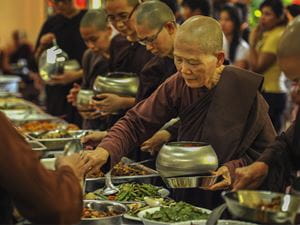
Not all Buddhists are vegetarian. Buddhism is not a monolithic religious philosophy, and in the 2,500 years since Buddha's life and teachings, the religion has developed three distinct sects: Theravada Buddhism, Mahayana Buddhism, and Vajrayana Buddhism. While all three sects adhere to the Buddha's teachings, which include the imperative not to kill, not all Buddhists apply this ethic to animal life when the killing is for consumption. Of the three sects, those within Mahayana Buddhism are most likely to believe a vegetarian lifestyle is required. In Theravada and Vajrayana Buddhism, vegetarianism is a personal choice.
The question of eating meat has been a perennial debate in Buddhist circles. Many will point out that it is unclear that Buddha himself was a vegetarian. He almost certainly ate meat before his enlightenment and it seems possible, from many accounts, that he continued to do so. What is clear is that he did not require this of his disciples. Because his followers were to accept as sustenance whatever was given them as alms, they were not to question or be picky about the nature of that sustenance. Whatever they were given, they were to eat. There were some limits in regard to the nature of the food; certain items were taboo, including the meat of horses or elephants or leopards, among others. They were also required to reject the gift if in fact, the animal had been slaughtered for the purpose of feeding the Buddha disciple. Alms of meat should be "left over" from an earlier meal.
Nevertheless, the first principle of the Buddhist way is not to kill. In the development of Mahayana Buddhism, this principle took center place. Mahayana Buddhism developed around 100 B.C. to A.D. 100 as a result of great debates that were taking place within the movement. There were a variety of key arguments at the time about what Buddhist doctrine truly was and how it was to be practiced by monks and laity. Because of this context, Mahayana Buddhism became known as a community that emphasized the authority of the sacred texts.
As Mahayana Buddhism moved out of India and rooted itself in the far East—particularly in China, east and southeast Asia—it assimilated many of the practices and beliefs of the prevailing systems, especially Taoism and Confucianism, both of which have strong vegetarian elements in their ethical systems. To this day, vegetarianism has a stronger appeal in some areas than in others and is more prevalent among monks than among the laity.
The Lankavatara, a Mahayana Sutra (sacred scripture), teaches vegetarianism quite overtly, mandating it as part of proper Buddhist spirituality. Some of the other Buddhist sects do not recognize these scriptures. Thus vegetarianism may or may not be normative in their spiritualities. Even among the Mahayana, there are a variety of ways to be vegetarian. For example, some may find it acceptable to eat meat when offered at a dinner party but not to buy and cook meat in their own homes. Some might call this equivocation, while others would see this as the typical Buddhist Middle Way, the place of finding peace, of avoiding extremes, of practicing moderation.
Other Buddhists, operating out of the way of compassion, might reject meat-eating simply as a measure of avoiding cruelty, of practicing compassion toward all living things. While Jainists—another ancient offshoot of Hinduism—require a level of compassion toward all living things that rejects even the intentional death of insects and plants, Buddhism's sense of moderation, of balance, seeks rather to recognize animals as inhabitants at their level of creation—able to suffer, to fear, and to experience death. This, then, calls at a minimum for a merciful standard in regard to animal slaughter.
The bodhisattva, an "enlightened" person, is one who has perfected the way of compassion and has achieved Buddhahood, but who has intentionally rejected the path of nirvana in order to help others discover enlightenment. Within this model, the Buddhist recognizes the call to perfection, and for many, this includes vegetarianism.
The Buddhist way calls for mindfulness in all things, and thus the way a Buddhist eats is as meaningful as what a Buddhist eats. That is, some Buddhists encourage limiting meals to certain times of the day and eating slowly, with awareness. Food, then, is just another avenue for the Buddhist to practice the Eightfold Path and its call to "right view," "right conduct," and "right practice." Right understanding and thought must be accompanied by right speech, action, livelihood and the right effort, mindfulness, and concentration. These paths touch on every aspect of life, and as food plays a central part of both personal and communal life, it too falls within the parameters of the call to awareness. The life of the animal merits consideration as a part of the Wheel of Life and Death.
6/6/2025 9:11:55 PM

About Kathleen Mulhern
Kathleen Mulhern is an author, editor, historian, and adjunct professor of Church History and Christian Formation at Denver Seminary. She holds degrees in literature, church history, and European intellectual history.
Read more about Buddhist ethics here.
A Possible Zen-Inspired Senior Living Community in Southern California
Most Popular

- Home
- Buddhism
- Food and Religion
- Answers
- Are All Buddhists Vegetarian
General Christian
A Biblical Vision of Success in Christian Life and...

- Home
- Buddhism
- Food and Religion
- Answers
- Are All Buddhists Vegetarian
Catholic

- Home
- Buddhism
- Food and Religion
- Answers
- Are All Buddhists Vegetarian
The Real AI Story Is Adoption Without Trust

- Home
- Buddhism
- Food and Religion
- Answers
- Are All Buddhists Vegetarian
General Christian
Archdiocese Hosts Military Marriage Retreat in Germany

- Home
- Buddhism
- Food and Religion
- Answers
- Are All Buddhists Vegetarian
Catholic
Swimfan: Forgotten Aughts Pleasures

- Home
- Buddhism
- Food and Religion
- Answers
- Are All Buddhists Vegetarian
Catholic
Top Three Anti-Catholic Lies About Catholicism

- Home
- Buddhism
- Food and Religion
- Answers
- Are All Buddhists Vegetarian
Latter-day Saint

- Home
- Buddhism
- Food and Religion
- Answers
- Are All Buddhists Vegetarian
Catholic
Pope Leo Celebrates Mass for Nurses & Docs While in...

- Home
- Buddhism
- Food and Religion
- Answers
- Are All Buddhists Vegetarian
Catholic
The Sermon on the Mount, Part I: Matthew 4:12-5:12

- Home
- Buddhism
- Food and Religion
- Answers
- Are All Buddhists Vegetarian
Catholic
Janie Learns the Way of the Cross: A Catholic Review

- Home
- Buddhism
- Food and Religion
- Answers
- Are All Buddhists Vegetarian
Entertainment

- Home
- Buddhism
- Food and Religion
- Answers
- Are All Buddhists Vegetarian
Evangelical
How the author of the world's best hymn became a Christian
Patheos Explore the world's faith through different perspectives on religion and spirituality! Patheos has the views of the prevalent religions and spiritualities of the world.
Ad-Free & Subscriber Log-In Subscription Support
- About Us
- 2026 Calendar
- Videos
- Podcasts
- Library of World Religions
- Faith In Media Tracker
- Advertise With Us
- Write for Us
- Privacy Policy
- Terms of Service
- Do Not Sell My Data
- Contact Us
- Radiant Digital
- Manage Newsletter Subscriptions
- Unsubscribe From Notifications
- Sitemap
Copyright 2008-2026, Patheos. All rights reserved.
Subscription Support Ad-Free & Subscriber Log-In
Follow Patheos