
BuddhistCatholicContemplativeEvangelicalGeneral ChristianHinduJewishLatter-day SaintMuslimNew VisionsProgressive Christian
Beliefs
- Buddhist
- Catholic
- Contemplative
- Evangelical
- General Christian
- Hindu
- Jewish
- Latter-day Saint
- More Voices
- Muslim
- New Visions
- Pagan
- Progressive Christian
Topics
- Religion News
- Food and Religion
- Sports and Religion
- Religious Art
- Religious Music and Entertainment
- Religious Events
- History and Religion
- Style and Religion
- Politics and Religion
- Women in Religion
- Recreation Outdoors and Religion
- Business Finance and Religion
- Careers Workplace and Religion
- Education and Religion
- Family Parenting and Religion
- Health Fitness and Religion
- Home and Religion
- Relationships and Religion
- Technology and Religion
- Travel and Religion
Columnists
- Buddhist Columnists
- Business Finance and Religion Columnists
- Careers Workplace and Religion Columnists
- Catholic Columnists
- Contemplative Columnists
- Education and Religion Columnists
- Evangelists Columnists
- Family Parenting and Religion Columnists
- General Christian Columnists
- Health Fitness and Religion Columnists
- Hindu Columnists
- History and Religion Columnists
- Home and Religion Columnists
- Jewish Columnists
- More Voices Columnists
- Latter Day Columnists
- Muslim Columnists
- New Visions Columnists
- Nonreligious Columnists
- Pagan Columnists
- Politics and Religion Columnists
- Progressive Columnists
- Recreation Outdoors and Religion Columnists
- Relationships and Religion Columnists
- Religion News Columnists
- Religious Art Columnists
- Religious Events Columnists
- Religious Music and Entertainment Columnists
- Sports and Religion Columnists
- Style and Religion Columnists
- Technology and Religion Columnists
- Travel and Religion Columnists
- Women in Religion Columnists
Resource Library
- 2026 Calendar
- Library of World Religions
- The 100 Most Holy Places on Earth
- Patheos Answers
- Podcasts
- Videos
- Faith Leaders Database
- Anglican Episcopalian
- Bahai
- Baptist
- Buddhism
- Christianity
- Confucianism
- Eastern Orthodoxy
- Hinduism
- Holiness and Pentecostal
- ISKCON
- Islam
- Judaism
- Lutheran
- Methodist
- The Church of Jesus Christ of Latter-day Saints
- New Age
- Paganism
- Presbytarian and Reformed
- Protestantism
- Religion Behind the Scenes
- Roman Catholic
- Scientology
- Shia Islam
- Sikhism
- Sufism
- Sunni Islam
- Taoism
- Zen
- See all religions
Research Tools
 Ad-Free & Subscriber Log-In Subscription Support
Ad-Free & Subscriber Log-In Subscription Support
Follow Patheos 

- Trending:
- Forgiveness
- |
- Marriage
- |
- Consciousness
- |
- Death Penalty
- |
- Election
- |
- Halloween
Progressive Christian
The Problem Isn't the Bible
June 18, 2014 by Brian McLaren
Editors' Note: This article is part of the Public Square 2014 Summer Series: Conversations on Religious Trends. Read other perspectives from the Progressive Christian community here.
Earlier this year, I blogged my hunch that this would be the year of the Bible. I felt we were reaching a tipping point after which the cat would be out of the bag, by which I meant that important conversations about the Bible would escape from the seminary classroom to the local congregation. With important releases by Adam Hamilton, Peter Enns, Steve Chalke, and many others (including, I hope, my newest book), that hunch seems to be coming true.
Many people, of course, think there are only two ways to read the Bible: their way and the wrong way. But there are actually multiple options, as this matrix shows.
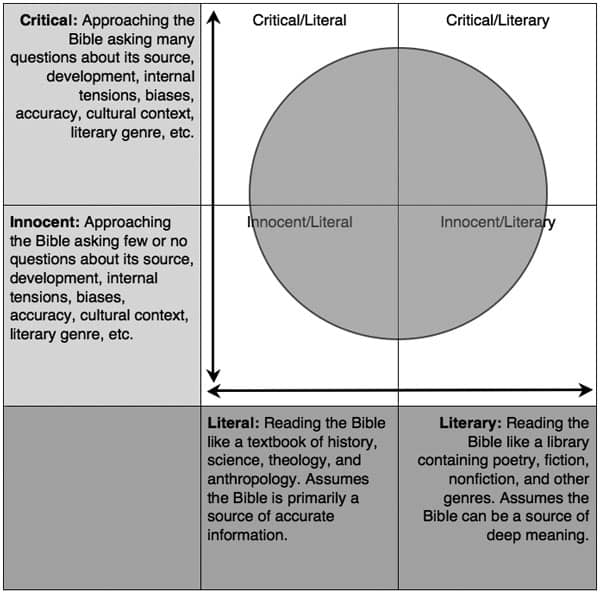
Within these four general categories, there are countless locations or points of view, and many of us move back and forth from one quadrant to another, depending on our mood or context.
There's one other feature to the diagram that's relevant to ways the Bible is being re-thought. While some people read the Bible as an academic or intellectual exercise only, many of us—as indicated by the shaded circular space that overlaps all four quadrants—read it with some sense of personal need, maybe even desperation. In this circle, we are seeking guidance and wisdom for how to live our lives because we are aware that as individuals, families, communities, nations, and civilizations, we are always on the verge of tipping over into self-destruction.
In other words, those of us in the gray circle aren't primarily seeking information from the Bible. Rather, we're seeking meaning, hope, guidance, perhaps even salvation from something that threatens to destroy us. And—dare we say it?—we may even be seeking revelation, some encounter that gets our minds into realities too big to be contained within our minds. We feel ourselves to be in trouble, in a predicament, on a quest, and we're ever vigilant for news that might help us cope with the mysteries and challenges in which we find ourselves. So the shaded circle represents a personal or predicamental approach, as opposed to merely an academic, doctrinal, analytic, political, or informational approach. It can bring people from all four quadrants together.
As a boy, I was introduced to the Bible from the lower left quadrant. When I got older, I moved to the lower right quadrant and gained new insights. I was never attracted to the upper left quadrant, but I read many authors who wrote from that quadrant. From them I gained the freedom to apply critical thinking to this text that I had come to love. Finally, I found myself at home in the upper right quadrant, where I can enter the Bible as a library, a literary collection containing poetry, fiction, nonfiction, and other genres, and where I have complete freedom to ask questions about the Bible's sources, development, internal tensions, biases, accuracy, cultural context, and genre. In my movement from quadrant to quadrant, I have remained in that shaded circle of reading personally, because I still feel myself deep in the mysteries, dangers, and wonders of the human predicament.
From this space, I don't need to presume agreement among writers. I can allow them to make statements and counter-statements, to agree and to disagree. Similarly, I don't need to assume every detail in the library is factual. Instead, I can read with the assumption that ancient storytellers had aims other than journalistic objectivity, scientific accuracy, or even absolute clarity.
This personal/critical/literary approach has freed me from the need to defend the violence found in the Bible, often attributed to God. It has also freed me from the opposite extreme: the need to throw out the Bible because it contains this violence. It has allowed me to trace how violence and the idea of God are gradually disentangled through the course of the biblical narrative, leading to a radically gracious and nonviolent vision of God. With a personal/critical/literary approach, I can see how our ideas of God have always matured as we matured, which challenges me to keep maturing now.
Of course, plenty of people tell me I'm not allowed to read the Bible in this way. To them, anything other than innocent/literal belief is nothing but unbelief. I try to respond politely but firmly: You are free to read the Bible literally and innocently if you prefer, but you don't have the authority to force everybody else to do so. If they push harder and claim that authority, I reassure them that my problem is not with the Bible's authority, but with theirs.
The Bible—and the same could be said for the Quran or any other sacred text—is too good and too important to be left to those who won't think critically about it. And frankly, it is too dangerous.
As this fresh conversation about the Bible makes its way from seminary classrooms into local congregations, people will discover that reading the Bible with personal engagement, critical thinking, and literary skill yields more joy, more insight, more wisdom, and, yes, more revelation than before.
6/18/2014 4:00:00 AM
2014 Religious Trends
Rediscovering Scripture
Progressive Christian
Public Square
Bible
Progressive Christianity
Sacred Texts
Christianity
more at patheos
1

Bible & Catholicism on Mortal Sin (vs. John Anderson)
2
'House of David' S2 Finally Makes Its Prime Video Debut
3

Cultivating Communities of Intention
4
Sometimes You Just Have To Trust Yourself
About Brian McLaren
Brian D. McLaren is an author, speaker, activist, and networker among innovative Christian leaders. His dozen-plus books include A New Kind of Christianity, A Generous Orthodoxy, Naked Spirituality, and Why Did Jesus, Moses, the Buddha, and Mohammed Cross the Road? He and his wife, Grace, live in Florida and have four adult children and four grandchildren. He's an avid wildlife and outdoors enthusiast. His newest book, We Make the Road by Walking, is available now and offers 52+ fresh readings of the Bible, from Genesis to Revelation.
Patheos Explore the world's faith through different perspectives on religion and spirituality! Patheos has the views of the prevalent religions and spiritualities of the world.
Ad-Free & Subscriber Log-In Subscription Support
- About Us
- 2026 Calendar
- Videos
- Podcasts
- Library of World Religions
- Faith In Media Tracker
- Advertise With Us
- Write for Us
- Privacy Policy
- Terms of Service
- Do Not Sell My Data
- Contact Us
- Radiant Digital
- Manage Newsletter Subscriptions
- Unsubscribe From Notifications
- Sitemap
Copyright 2008-2026, Patheos. All rights reserved.
Subscription Support Ad-Free & Subscriber Log-In
Follow Patheos