
BuddhistCatholicContemplativeEvangelicalGeneral ChristianHinduJewishLatter-day SaintMuslimNew VisionsProgressive Christian
Beliefs
- Buddhist
- Catholic
- Contemplative
- Evangelical
- General Christian
- Hindu
- Jewish
- Latter-day Saint
- More Voices
- Muslim
- New Visions
- Pagan
- Progressive Christian
Topics
- Religion News
- Food and Religion
- Sports and Religion
- Religious Art
- Religious Music and Entertainment
- Religious Events
- History and Religion
- Style and Religion
- Politics and Religion
- Women in Religion
- Recreation Outdoors and Religion
- Business Finance and Religion
- Careers Workplace and Religion
- Education and Religion
- Family Parenting and Religion
- Health Fitness and Religion
- Home and Religion
- Relationships and Religion
- Technology and Religion
- Travel and Religion
Columnists
- Buddhist Columnists
- Business Finance and Religion Columnists
- Careers Workplace and Religion Columnists
- Catholic Columnists
- Contemplative Columnists
- Education and Religion Columnists
- Evangelists Columnists
- Family Parenting and Religion Columnists
- General Christian Columnists
- Health Fitness and Religion Columnists
- Hindu Columnists
- History and Religion Columnists
- Home and Religion Columnists
- Jewish Columnists
- More Voices Columnists
- Latter Day Columnists
- Muslim Columnists
- New Visions Columnists
- Nonreligious Columnists
- Pagan Columnists
- Politics and Religion Columnists
- Progressive Columnists
- Recreation Outdoors and Religion Columnists
- Relationships and Religion Columnists
- Religion News Columnists
- Religious Art Columnists
- Religious Events Columnists
- Religious Music and Entertainment Columnists
- Sports and Religion Columnists
- Style and Religion Columnists
- Technology and Religion Columnists
- Travel and Religion Columnists
- Women in Religion Columnists
Resource Library
- 2026 Calendar
- Library of World Religions
- The 100 Most Holy Places on Earth
- Patheos Answers
- Podcasts
- Videos
- Faith Leaders Database
- Anglican Episcopalian
- Bahai
- Baptist
- Buddhism
- Christianity
- Confucianism
- Eastern Orthodoxy
- Hinduism
- Holiness and Pentecostal
- ISKCON
- Islam
- Judaism
- Lutheran
- Methodist
- The Church of Jesus Christ of Latter-day Saints
- New Age
- Paganism
- Presbytarian and Reformed
- Protestantism
- Religion Behind the Scenes
- Roman Catholic
- Scientology
- Shia Islam
- Sikhism
- Sufism
- Sunni Islam
- Taoism
- Zen
- See all religions
Research Tools
 Ad-Free & Subscriber Log-In Subscription Support
Ad-Free & Subscriber Log-In Subscription Support
Follow Patheos 

- Trending:
- Forgiveness
- |
- Marriage
- |
- Consciousness
- |
- Death Penalty
- |
- Election
- |
- Halloween
Catholic
Who Told You You Were Naked?
March 21, 2011 by Elizabeth Scalia
The woman saw that the tree was good for food, pleasing to the eyes, and desirable for gaining wisdom. So she took some of its fruit and ate it; and she also gave some to her husband, who was with her, and he ate it.
Then the eyes of both of them were opened, and they realized that they were naked; so they sewed fig leaves together and made loincloths for themselves.
. . .
Then [the Lord] said, "Where are you?"
[Adam] answered, "I heard you in the garden; but I was afraid, because I was naked, so I hid myself."
Then [the Lord] asked, "Who told you that you were naked?" (Gen. 3:6-7,9-11)
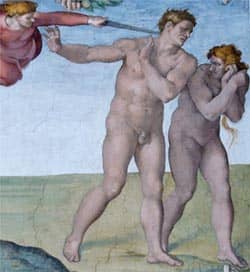 I like the question, "who told you that you were naked?" Prior to this consciousness Adam and Eve were happily running around naked, like every other creature in the wild. Then: awareness. And what was the awareness? That their nakedness was "dirty"? Unlikely.
Animals do not perceive their nakedness or try to protect their genitalia, but suddenly, Adam and Eve were doing just that. Why? Evolution? Fruit?
What matters is that suddenly they knew more than they had known, and what they knew—what they suddenly understood—was that they were vulnerable.
Their awareness of their vulnerability might have led to their excuse-making, too. Until that point they had enjoyed a blissful relationship with the Creator; nothing that had passed between them and God should have given them a quick rise to fear. Yet suddenly attuned to their vulnerability, they feared enough to hem and haw and look for someone else to blame.
Aside from serpent, there was only each other.
We tend to think of the first sin as one of simple disobedience, and perhaps it was. But perhaps there was another component that deepened the offence—the lack of trust, manifested in a refusal to be wholly seen; humans covering themselves up both physically and metaphorically, with fig leaves and with the sloughing off of blame onto others, rather than revealing themselves and taking responsibility for their actions.
The taint of Original Sin: God has been trying to get us to trust Him, to reveal ourselves to Him and to be vulnerable and open to Him ever since.
Perhaps this explains the command by God for the Jews to circumcise the men. The foreskin of the penis affords some protection for the organ—a bit of shelter, a place to hide. When God chose the Jews as His own, he required this symbolic (and real) acquiescence, this willingness to be completely vulnerable and exposed to whatever may come. The unsheathed penis is extraordinarily sensitive and responsive—precisely the qualities God wanted of the Jews. He made a covenant with them; He would be their God, they would be His people, and the deal was sealed in blood. At its shedding, man and God are bonded.
The need to be vulnerable and open to God is part and parcel of having a real relationship with Him, just as it is the necessary component in human relationships. We see the blood covenant and the need for vulnerability and openness mirrored in the relationship between a husband and wife—or we did, when virginity was kept for marriage. The thin membrane of the hymen is a kind of counterpart to the foreskin. In shedding the foreskin the Jew becomes openly vulnerable to God. In remaining a virgin until marriage, the woman becomes vulnerable only (but fully) to her husband, and he—in receiving that vulnerability—answers only to her, gives his deepest self and the sweat of all of his labors to her. It is another blood covenant. At the shedding of that blood, they become one flesh. One entity.
When we talk of Jesus, the bridegroom shedding blood for his bride the church, we might remember that his bride shed blood at the beginning, and still does so, today.
Why do we not know that? Why is it never taught that way? For centuries and centuries virginity was little more than a premium—a selling point for chattel—and even today, in some cultures, that idea remains.
God says, "be my people," and there is a blood covenant. A man and woman say "be mine" and there is a blood covenant. We have never understood.
So God becomes Incarnate and tries to explain: be opened. I will show you how. I will make myself vulnerable to you. You may have my blood. It is shed for you and for all so that sins may be forgiven.
It is the greatest of the blood covenants, because the blood covers and draws into oneness not a tribe, nor a mate, but an entire creation—for better or worse. The marriage of heaven to earth, God to man; a true consummation. From the cross Jesus said, "it is consummated" (Jn. 19:30). This covenant is renewed daily, in the mass; the shedding of blood continues in the martyrdoms within the bride, even to today.
Article Continued On Next Page
Page: 1 of 2
3/21/2011 4:00:00 AM
Catholic
Awareness
Blood
Covenant
Eden
Lent
Sacred Texts
Sexuality
Christianity
Roman Catholicism
more at patheos
1

Thoughts on a "primitive culture"
2

100 Motown Stars: Info. & Links / My Detroit Heritage
3

Reconnecting With What Matters Most
4

In Defense of Escapism: When Art Becomes Refuge

About Elizabeth Scalia
Elizabeth Scalia is a weekly columnist at First Things.
Patheos Explore the world's faith through different perspectives on religion and spirituality! Patheos has the views of the prevalent religions and spiritualities of the world.
Ad-Free & Subscriber Log-In Subscription Support
- About Us
- 2026 Calendar
- Videos
- Podcasts
- Library of World Religions
- Faith In Media Tracker
- Advertise With Us
- Write for Us
- Privacy Policy
- Terms of Service
- Do Not Sell My Data
- Contact Us
- Radiant Digital
- Manage Newsletter Subscriptions
- Unsubscribe From Notifications
- Sitemap
Copyright 2008-2026, Patheos. All rights reserved.
Subscription Support Ad-Free & Subscriber Log-In
Follow Patheos