
BuddhistCatholicContemplativeEvangelicalGeneral ChristianHinduJewishLatter-day SaintMuslimNew VisionsProgressive Christian
Beliefs
- Buddhist
- Catholic
- Contemplative
- Evangelical
- General Christian
- Hindu
- Jewish
- Latter-day Saint
- More Voices
- Muslim
- New Visions
- Pagan
- Progressive Christian
Topics
- Religion News
- Food and Religion
- Sports and Religion
- Religious Art
- Religious Music and Entertainment
- Religious Events
- History and Religion
- Style and Religion
- Politics and Religion
- Women in Religion
- Recreation Outdoors and Religion
- Business Finance and Religion
- Careers Workplace and Religion
- Education and Religion
- Family Parenting and Religion
- Health Fitness and Religion
- Home and Religion
- Relationships and Religion
- Technology and Religion
- Travel and Religion
Columnists
- Buddhist Columnists
- Business Finance and Religion Columnists
- Careers Workplace and Religion Columnists
- Catholic Columnists
- Contemplative Columnists
- Education and Religion Columnists
- Evangelists Columnists
- Family Parenting and Religion Columnists
- General Christian Columnists
- Health Fitness and Religion Columnists
- Hindu Columnists
- History and Religion Columnists
- Home and Religion Columnists
- Jewish Columnists
- More Voices Columnists
- Latter Day Columnists
- Muslim Columnists
- New Visions Columnists
- Nonreligious Columnists
- Pagan Columnists
- Politics and Religion Columnists
- Progressive Columnists
- Recreation Outdoors and Religion Columnists
- Relationships and Religion Columnists
- Religion News Columnists
- Religious Art Columnists
- Religious Events Columnists
- Religious Music and Entertainment Columnists
- Sports and Religion Columnists
- Style and Religion Columnists
- Technology and Religion Columnists
- Travel and Religion Columnists
- Women in Religion Columnists
Resource Library
- 2026 Calendar
- Library of World Religions
- The 100 Most Holy Places on Earth
- Patheos Answers
- Podcasts
- Videos
- Faith Leaders Database
- Anglican Episcopalian
- Bahai
- Baptist
- Buddhism
- Christianity
- Confucianism
- Eastern Orthodoxy
- Hinduism
- Holiness and Pentecostal
- ISKCON
- Islam
- Judaism
- Lutheran
- Methodist
- The Church of Jesus Christ of Latter-day Saints
- New Age
- Paganism
- Presbytarian and Reformed
- Protestantism
- Religion Behind the Scenes
- Roman Catholic
- Scientology
- Shia Islam
- Sikhism
- Sufism
- Sunni Islam
- Taoism
- Zen
- See all religions
Research Tools
 Ad-Free & Subscriber Log-In Subscription Support
Ad-Free & Subscriber Log-In Subscription Support
Follow Patheos 

- Trending:
- Forgiveness
- |
- Marriage
- |
- Consciousness
- |
- Death Penalty
- |
- Election
- |
- Halloween
Revelation of the Magi: An Excerpt
December 02, 2010 by Brent Landau
Editor’s Note: This month in the Patheos Book Club, we’re reading and discussing the new book Revelation of the Magi: The Lost Tale of the Wise Men’s Journey to Bethlehem, by Brent Landau. Below is an excerpt from the Introduction. Purchase the book here.
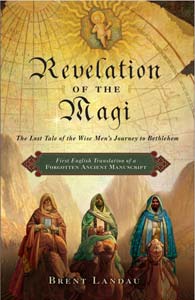 The Magi -- usually known as the “Three Wise Men” or “Three Kings” -- are easily the most famous of the visitors who appear at Jesus’s birth in the Gospel accounts of the Christmas story. Despite their great fame, however, there is only one short passage in the New Testament that tells of the Magi, and this account is remarkably vague about these figures, in Matthew chapter 2, verses 1 through 12.
Amid a wide range of early Christian speculation on the Magi -- apocryphal Gospels, hymns, sermons, mosaics, wood carvings, and sculptures on sarcophagi -- one composition is particularly impressive and yet surprisingly unknown. Called the Revelation of the Magi, it is a lengthy narrative that claims to be the personal testimony of the Magi themselves on the events of Christ’s coming. Though versions of this legend were well known in Christian Europe throughout the Middle Ages, this book presents the first-ever complete English translation of the Revelation of the Magi.
Not only does the Revelation of the Magi have the distinction of being the most substantial early Christian composition about the Magi; its narrative complexity matches almost any early Christian writing. Thus, the first thing that one notices about the Revelation of the Magi is that whoever wrote it devoted a great deal of time and thought to crafting a rich and intricate story line. As a scholar of early Christian writings, I noticed several other surprising features immediately. Its location of the Magi in the far-eastern land of Shir was highly unusual, since most early Christians thought that the Magi came from Persia, Baylon, or Arabia.
Also surprising was its identification of the Star of Bethlehem with Christ himself, an interpretation found nowhere else in the diverse array of early Christian speculation about this mysterious celestial portent. But finally, and most importantly, I was surprised that neither I nor any of my colleagues knew of this impressive text’s existence before I stumbled across a mention of it in an article.
The Revelation of the Magi is indeed a fascinating and imaginative story about some of the Bible’s most intriguing figures. But the emphasis of the Revelation of the Magi on the universality of Christ’s revelation may also captivate many readers. The questions this writing poses are of potential importance for anyone who considers herself or himself religious, spiritual or simply interested in theological questions.
From the manuscript:
1. Introduction
About the revelation of the Magi, and about their coming to Jerusalem, and about the gifts that they brought to Christ. An account of the revelations and the visions, which the kings, [sons of kings,] of the great East spoke, who were called Magi in the language of that land because in silence, without a sound, they glorified and they prayed. And in silence and in the mind they glorified and prayed to the exalted and holy majesty of the Lord of life, to the holy and glorious Father, who is hidden by the great brightness of himself and is more lofty and holy than all reasoning. And the language of human beings is not able to speak about him as he is, except as he has wished, and when he has wished, and by means of whom he wishes. And neither his heavenly worlds nor the lower ones are able to speak about his majesty, except as it is fitting for the will of his majesty to reveal to the worlds so that they are able to partake from the gift of his majesty, because (his majesty) is great and they are not able to speak of it.
***
11. The Appearance of the Star to the Magi
Then, when the time and fulfillment of what was written in the books happened, concerning the revelation of the light of the hidden star, we were indeed thought worthy for it to come in our days and to receive it with joy, as we were commanded by our fathers and as we ourselves read in the books. And each of us saw wondrous and diverse visions that were never before seen by us, but their mysteries were in these books that we were reading. And each one came from his dwelling place according to our ancient custom to ascend the Mountain of Victories [text missing] to wash in the Spring of Purification, as we were accustomed. And we saw [text missing] in the form of an ineffable pillar of light descending, and it came to rest above the water. And we were afraid and shook when we saw it. And we cannot speak about the brilliance of the star of light, since its radiance was many times greater than the sun, and the sun could not stand out before the light of its rays. And just like the moon looks in the daytime in the days of Nisan, when the sun rises and it is absorbed in its light, so also did the sun seem to us when the star rose over us. And the light of the star, which surpassed the sun, appeared to us ourselves and the sons of our mysteries, but it did not appear to anyone else, because they were removed from its mysteries and its coming. And we rejoiced, and glorified, and gave unmeasured thanks to the Father of heavenly majesty that it appeared in our days and we were thought worthy to see it.
Article Continued On Next Page
Page: 1 of 2
12/2/2010 5:00:00 AM
Book Club
Christmas
History
Sacred Texts
Christianity
more at patheos
1

Misinterpretations Of Colbert’s Remarks On The Afterlife
2
Team Saint Paul Sends Five to Serve U.S. Military
3

The Pursuit of Happiness: All’s Well That Ends Well
4

Meet Catholic Fantasy Writer Paul Leone
About
Patheos Explore the world's faith through different perspectives on religion and spirituality! Patheos has the views of the prevalent religions and spiritualities of the world.
Ad-Free & Subscriber Log-In Subscription Support
- About Us
- 2026 Calendar
- Videos
- Podcasts
- Library of World Religions
- Faith In Media Tracker
- Advertise With Us
- Write for Us
- Privacy Policy
- Terms of Service
- Do Not Sell My Data
- Contact Us
- Radiant Digital
- Manage Newsletter Subscriptions
- Unsubscribe From Notifications
- Sitemap
Copyright 2008-2026, Patheos. All rights reserved.
Subscription Support Ad-Free & Subscriber Log-In
Follow Patheos