
BuddhistCatholicContemplativeEvangelicalGeneral ChristianHinduJewishLatter-day SaintMuslimNew VisionsProgressive Christian
Beliefs
- Buddhist
- Catholic
- Contemplative
- Evangelical
- General Christian
- Hindu
- Jewish
- Latter-day Saint
- More Voices
- Muslim
- New Visions
- Pagan
- Progressive Christian
Topics
- Religion News
- Food and Religion
- Sports and Religion
- Religious Art
- Religious Music and Entertainment
- Religious Events
- History and Religion
- Style and Religion
- Politics and Religion
- Women in Religion
- Recreation Outdoors and Religion
- Business Finance and Religion
- Careers Workplace and Religion
- Education and Religion
- Family Parenting and Religion
- Health Fitness and Religion
- Home and Religion
- Relationships and Religion
- Technology and Religion
- Travel and Religion
Columnists
- Buddhist Columnists
- Business Finance and Religion Columnists
- Careers Workplace and Religion Columnists
- Catholic Columnists
- Contemplative Columnists
- Education and Religion Columnists
- Evangelists Columnists
- Family Parenting and Religion Columnists
- General Christian Columnists
- Health Fitness and Religion Columnists
- Hindu Columnists
- History and Religion Columnists
- Home and Religion Columnists
- Jewish Columnists
- More Voices Columnists
- Latter Day Columnists
- Muslim Columnists
- New Visions Columnists
- Nonreligious Columnists
- Pagan Columnists
- Politics and Religion Columnists
- Progressive Columnists
- Recreation Outdoors and Religion Columnists
- Relationships and Religion Columnists
- Religion News Columnists
- Religious Art Columnists
- Religious Events Columnists
- Religious Music and Entertainment Columnists
- Sports and Religion Columnists
- Style and Religion Columnists
- Technology and Religion Columnists
- Travel and Religion Columnists
- Women in Religion Columnists
Resource Library
- 2026 Calendar
- Library of World Religions
- The 100 Most Holy Places on Earth
- Patheos Answers
- Podcasts
- Videos
- Faith Leaders Database
- Anglican Episcopalian
- Bahai
- Baptist
- Buddhism
- Christianity
- Confucianism
- Eastern Orthodoxy
- Hinduism
- Holiness and Pentecostal
- ISKCON
- Islam
- Judaism
- Lutheran
- Methodist
- The Church of Jesus Christ of Latter-day Saints
- New Age
- Paganism
- Presbytarian and Reformed
- Protestantism
- Religion Behind the Scenes
- Roman Catholic
- Scientology
- Shia Islam
- Sikhism
- Sufism
- Sunni Islam
- Taoism
- Zen
- See all religions
Research Tools
 Ad-Free & Subscriber Log-In Subscription Support
Ad-Free & Subscriber Log-In Subscription Support
Follow Patheos 

- Trending:
- Forgiveness
- |
- Marriage
- |
- Consciousness
- |
- Death Penalty
- |
- Election
- |
- Halloween
Catholic
"Racism Is a God-Damned Thing": Father John Markoe, S.J.
February 22, 2011 by Pat McNamara
 As a whole, the Catholic Church was slow to get fully involved in the Civil Rights movement of the mid-20th century. Whether or not Catholics publicly endorsed segregation, they certainly accepted it in their churches and schools, North and South.
Many Catholic institutions weren't fully integrated until the 1960s, but before that era there were some exceptions to that general reality, usually forged via an informal network of laypeople, priests, and nuns who were long-committed to promoting racial justice.
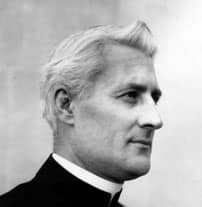 One of these was a Midwestern Jesuit who led sit-ins, marches, and boycotts long before they made national headlines. Tall and handsome, John Markoe looked like a movie star, and in fact his story would actually make a good movie; it is the story of a lumberjack, football star, soldier, alcoholic, priest, teacher, activist. Markoe's biography, a peer noted, "reads like fiction." NAACP leader Roy Wilkins said Markoe "fought the Civil Rights battle long before it became respectable, or even popular."
Born in 1890 to a blueblood family whose ancestors included Benjamin Franklin, John Prince Markoe was the son of a prominent Minnesota doctor. At 18 he was accepted to West Point, but deferred the appointment in order to go west, to work on the railroads. In 1910, he entered the military academy, where his friends included Dwight Eisenhower. He played football against Knute Rockne and Jim Thorpe, and was named an honorably-mentioned All-American.
When he graduated in 1914, the yearbook said: "Possessing unlimited abilities, there is very little which he is incapable of performing." But he earned his classmates' contempt when he stood up for Marcus Alexander, the Point's only African-American cadet. His final class ranking might have been higher, had Markoe not been a full-fledged alcoholic by his senior year.
Lieutenant Markoe was assigned to the Tenth Cavalry, a Black regiment. He welcomed the opportunity, fraternizing with his troops more than was deemed appropriate for a white officer. But nine months after graduation, heavy drinking cost him his commission. He never fully forgave himself. Back in Minnesota, he entered the lumber business and enlisted in the National Guard.
In 1916, during the unofficial war against Pancho Villa in Mexico, he regained his commission. Down in Mexico, Markoe got letters from his brother Bill, a Jesuit working with African-Americans. These piqued his interest, and he started thinking about another kind of life than the army. After his discharge in 1917, Captain John Markoe joined the Jesuits in Missouri. He and Bill took a private vow to work for the "salvation of the Negroes in the United States." (Bill later worked with their cousin John LaFarge, also a Jesuit, for racial justice.)
As part of his training, John was assigned to St. Louis, a highly segregated city. African-American Catholics were relegated to separate parishes, denied a Catholic education, and banned from Catholic hospitals. (The local archbishop was notoriously racist.) John worked in Black parishes and attended NAACP meetings. In magazine articles, he argued that racism was a moral issue, even a heresy. His work was not well-received by local whites, Catholics included.
Ordained in 1928, Markoe was assigned to St. Elizabeth's Church, a Black parish in St. Louis. The work was hard, yielded few results, and some of his fellow priests ostracized him. It took a toll, and after twenty years of sobriety, he returned to the bottle. On one occasion, it took half a dozen police to drag the priest out of a bar, as he had taken on its entire clientele. For seven years after that, he stayed at St. Joseph's Infirmary, Missouri, fighting alcoholism.
In 1943, he re-entered the fight. Assigned to St. Malachy's, another Black parish in St. Louis, Markoe and his brother Bill campaigned to desegregate the Jesuits' St. Louis University. Father Claude Heithaus, a sociology professor, publicly asked why the school admitted people of all faiths, but rejected Catholics on account of their color. They won the fight, but John was soon sent ("exiled," some said) to Creighton University, Omaha, where he spent the rest of his days.
Initially it seemed like his Civil Rights days were finished, but they were really just beginning. Omaha, where segregation was still the rule, had a NAACP chapter as early as 1912, and in 1919 it witnessed a race riot. Malcolm X was born there, but Klan activity forced his family's departure. Whitney Young, director of the National Urban League, worked there in the postwar years.
Markoe's official assignment was teaching math, but he worked mainly with the DePorres Club (named for St. Martin DePorres, a saint of African descent), which he organized to educate the public on race. A decade before these issues attracted national attention, the club led sit-ins at Omaha restaurants, boycotted companies with discrimination practices, and organized public marches. Markoe was there at every step. One member said, he "kept us going."
Article Continued On Next Page
Page: 1 of 2
2/22/2011 5:00:00 AM
Catholic
In Ages Past
Civil Rights
Integration
Jesuit
Racism
Christianity
Roman Catholicism
more at patheos
1
How Rare Legal Victories Sustain the Death Penalty
2
What does Homer have to do with Christ?
3

How Managing Conflict Can Strengthen Your Marriage
4
Beyond the Altar: Why the Church is Failing at Discipleship

About Pat McNamara
Dr. Pat McNamara is a published historian. He blogs about American Catholic History at McNamara's Blog.
Patheos Explore the world's faith through different perspectives on religion and spirituality! Patheos has the views of the prevalent religions and spiritualities of the world.
Ad-Free & Subscriber Log-In Subscription Support
- About Us
- 2026 Calendar
- Videos
- Podcasts
- Library of World Religions
- Faith In Media Tracker
- Advertise With Us
- Write for Us
- Privacy Policy
- Terms of Service
- Do Not Sell My Data
- Contact Us
- Radiant Digital
- Manage Newsletter Subscriptions
- Unsubscribe From Notifications
- Sitemap
Copyright 2008-2026, Patheos. All rights reserved.
Subscription Support Ad-Free & Subscriber Log-In
Follow Patheos