
BuddhistCatholicContemplativeEvangelicalGeneral ChristianHinduJewishLatter-day SaintMuslimNew VisionsProgressive Christian
Beliefs
- Buddhist
- Catholic
- Contemplative
- Evangelical
- General Christian
- Hindu
- Jewish
- Latter-day Saint
- More Voices
- Muslim
- New Visions
- Pagan
- Progressive Christian
Topics
- Religion News
- Food and Religion
- Sports and Religion
- Religious Art
- Religious Music and Entertainment
- Religious Events
- History and Religion
- Style and Religion
- Politics and Religion
- Women in Religion
- Recreation Outdoors and Religion
- Business Finance and Religion
- Careers Workplace and Religion
- Education and Religion
- Family Parenting and Religion
- Health Fitness and Religion
- Home and Religion
- Relationships and Religion
- Technology and Religion
- Travel and Religion
Columnists
- Buddhist Columnists
- Business Finance and Religion Columnists
- Careers Workplace and Religion Columnists
- Catholic Columnists
- Contemplative Columnists
- Education and Religion Columnists
- Evangelists Columnists
- Family Parenting and Religion Columnists
- General Christian Columnists
- Health Fitness and Religion Columnists
- Hindu Columnists
- History and Religion Columnists
- Home and Religion Columnists
- Jewish Columnists
- More Voices Columnists
- Latter Day Columnists
- Muslim Columnists
- New Visions Columnists
- Nonreligious Columnists
- Pagan Columnists
- Politics and Religion Columnists
- Progressive Columnists
- Recreation Outdoors and Religion Columnists
- Relationships and Religion Columnists
- Religion News Columnists
- Religious Art Columnists
- Religious Events Columnists
- Religious Music and Entertainment Columnists
- Sports and Religion Columnists
- Style and Religion Columnists
- Technology and Religion Columnists
- Travel and Religion Columnists
- Women in Religion Columnists
Resource Library
- 2026 Calendar
- Library of World Religions
- The 100 Most Holy Places on Earth
- Patheos Answers
- Podcasts
- Videos
- Faith Leaders Database
- Anglican Episcopalian
- Bahai
- Baptist
- Buddhism
- Christianity
- Confucianism
- Eastern Orthodoxy
- Hinduism
- Holiness and Pentecostal
- ISKCON
- Islam
- Judaism
- Lutheran
- Methodist
- The Church of Jesus Christ of Latter-day Saints
- New Age
- Paganism
- Presbytarian and Reformed
- Protestantism
- Religion Behind the Scenes
- Roman Catholic
- Scientology
- Shia Islam
- Sikhism
- Sufism
- Sunni Islam
- Taoism
- Zen
- See all religions
Research Tools
 Ad-Free & Subscriber Log-In Subscription Support
Ad-Free & Subscriber Log-In Subscription Support
Follow Patheos 

- Trending:
- Forgiveness
- |
- Marriage
- |
- Consciousness
- |
- Death Penalty
- |
- Election
- |
- Halloween
Pope's Discourse to Academic World
October 08, 2009
October 8, 2009
The following are excerpts of the address Pope Benedict XVI gave at a meeting in Prague on September 27, 2009 with representatives of the world of academia and culture.
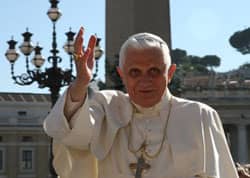 I address you as one who has been a professor, solicitous of the right to academic freedom and the responsibility for the authentic use of reason, and is now the Pope who, in his role as Shepherd, is recognized as a voice for the ethical reasoning of humanity. While some argue that the questions raised by religion, faith and ethics have no place within the purview of collective reason, that view is by no means axiomatic. The freedom that underlies the exercise of reason -- be it in a university or in the Church -- has a purpose: it is directed to the pursuit of truth, and as such gives expression to a tenet of Christianity which in fact gave rise to the university.
***
The proper autonomy of a university, or indeed any educational institution, finds meaning in its accountability to the authority of truth. Nevertheless, that autonomy can be thwarted in a variety of ways. The great formative tradition, open to the transcendent, which stands at the base of universities across Europe, was in this land, and others, systematically subverted by the reductive ideology of materialism, the repression of religion and the suppression of the human spirit. In 1989, however, the world witnessed in dramatic ways the overthrow of a failed totalitarian ideology and the triumph of the human spirit. The yearning for freedom and truth is inalienably part of our common humanity. It can never be eliminated; and, as history has shown, it is denied at humanity's own peril. It is to this yearning that religious faith, the various arts, philosophy, theology and other scientific disciplines, each with its own method, seek to respond, both on the level of disciplined reflection and on the level of a sound praxis.
***
The idea of an integrated education, based on the unity of knowledge grounded in truth, must be regained. It serves to counteract the tendency, so evident in contemporary society, towards a fragmentation of knowledge. With the massive growth in information and technology there comes the temptation to detach reason from the pursuit of truth. Sundered from the fundamental human orientation towards truth, however, reason begins to lose direction: it withers, either under the guise of modesty, resting content with the merely partial or provisional, or under the guise of certainty, insisting on capitulation to the demands of those who indiscriminately give equal value to practically everything. The relativism that ensues provides a dense camouflage behind which new threats to the autonomy of academic institutions can lurk. While the period of interference from political totalitarianism has passed, is it not the case that frequently, across the globe, the exercise of reason and academic research are -- subtly and not so subtly -- constrained to bow to the pressures of ideological interest groups and the lure of short-term utilitarian or pragmatic goals? What will happen if our culture builds itself only on fashionable arguments, with little reference to a genuine historical intellectual tradition, or on the viewpoints that are most vociferously promoted and most heavily funded? What will happen if in its anxiety to preserve a radical secularism, it detaches itself from its life-giving roots? Our societies will not become more reasonable or tolerant or adaptable but rather more brittle and less inclusive, and they will increasingly struggle to recognize what is true, noble and good.
Read the entire address at Zenit.org.
10/8/2009 4:00:00 AM
Faith on Campus
education
Roman Catholicism
more at patheos
1
2

“Love” Songs…Could We Do Better?
3

As Fulton Sheen Is Beatified, Don't Forget Walter A. Maier
4

The Strange Line MAGA Christianity Just Decided to Draw
About
Patheos Explore the world's faith through different perspectives on religion and spirituality! Patheos has the views of the prevalent religions and spiritualities of the world.
Ad-Free & Subscriber Log-In Subscription Support
- About Us
- 2026 Calendar
- Videos
- Podcasts
- Library of World Religions
- Faith In Media Tracker
- Advertise With Us
- Write for Us
- Privacy Policy
- Terms of Service
- Do Not Sell My Data
- Contact Us
- Radiant Digital
- Manage Newsletter Subscriptions
- Unsubscribe From Notifications
- Sitemap
Copyright 2008-2026, Patheos. All rights reserved.
Subscription Support Ad-Free & Subscriber Log-In
Follow Patheos