
BuddhistCatholicContemplativeEvangelicalGeneral ChristianHinduJewishLatter-day SaintMuslimNew VisionsProgressive Christian
Beliefs
- Buddhist
- Catholic
- Contemplative
- Evangelical
- General Christian
- Hindu
- Jewish
- Latter-day Saint
- More Voices
- Muslim
- New Visions
- Pagan
- Progressive Christian
Topics
- Religion News
- Food and Religion
- Sports and Religion
- Religious Art
- Religious Music and Entertainment
- Religious Events
- History and Religion
- Style and Religion
- Politics and Religion
- Women in Religion
- Recreation Outdoors and Religion
- Business Finance and Religion
- Careers Workplace and Religion
- Education and Religion
- Family Parenting and Religion
- Health Fitness and Religion
- Home and Religion
- Relationships and Religion
- Technology and Religion
- Travel and Religion
Columnists
- Buddhist Columnists
- Business Finance and Religion Columnists
- Careers Workplace and Religion Columnists
- Catholic Columnists
- Contemplative Columnists
- Education and Religion Columnists
- Evangelists Columnists
- Family Parenting and Religion Columnists
- General Christian Columnists
- Health Fitness and Religion Columnists
- Hindu Columnists
- History and Religion Columnists
- Home and Religion Columnists
- Jewish Columnists
- More Voices Columnists
- Latter Day Columnists
- Muslim Columnists
- New Visions Columnists
- Nonreligious Columnists
- Pagan Columnists
- Politics and Religion Columnists
- Progressive Columnists
- Recreation Outdoors and Religion Columnists
- Relationships and Religion Columnists
- Religion News Columnists
- Religious Art Columnists
- Religious Events Columnists
- Religious Music and Entertainment Columnists
- Sports and Religion Columnists
- Style and Religion Columnists
- Technology and Religion Columnists
- Travel and Religion Columnists
- Women in Religion Columnists
Resource Library
- 2026 Calendar
- Library of World Religions
- The 100 Most Holy Places on Earth
- Patheos Answers
- Podcasts
- Videos
- Faith Leaders Database
- Anglican Episcopalian
- Bahai
- Baptist
- Buddhism
- Christianity
- Confucianism
- Eastern Orthodoxy
- Hinduism
- Holiness and Pentecostal
- ISKCON
- Islam
- Judaism
- Lutheran
- Methodist
- The Church of Jesus Christ of Latter-day Saints
- New Age
- Paganism
- Presbytarian and Reformed
- Protestantism
- Religion Behind the Scenes
- Roman Catholic
- Scientology
- Shia Islam
- Sikhism
- Sufism
- Sunni Islam
- Taoism
- Zen
- See all religions
Research Tools
 Ad-Free & Subscriber Log-In Subscription Support
Ad-Free & Subscriber Log-In Subscription Support
Follow Patheos 

- Trending:
- Forgiveness
- |
- Marriage
- |
- Consciousness
- |
- Death Penalty
- |
- Election
- |
- Halloween
The Language of Science and Faith: An Excerpt
April 01, 2011 by Karl W. Giberson and Francis S. Collins
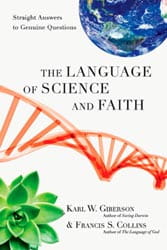 Chapter 3
How Do We Relate science and Religion?
And God said, "Let there be light," and there was light.
Genesis 1:3
Science and theology have things to say to each other since both are concerned with the search for truth attained through motivated belief.
John Polkinghorne
The Christian tradition has always engaged the secular culture. As early as the first century we find St. Paul, in his famous Mars Hill sermon, relating his message to local Greek philosophy. Early church fathers like Origen constantly borrowed secular concepts and ideas to illuminate and extend the Christian message. Augustine's classic City of God was a profound meditation on the relation between the kingdom of God and the secular world (city of man). Aquinas's Summa Theologica was a medieval integration of Christianity with newly arrived secular Greek philosophy.
This task, particularly in the work of Aquinas, demanded a familiarity with prevailing understandings of the natural world as articulated in the natural philosophy of the day. By the nineteenth century the exploration of nature would come to be called "science," but these earlier generations of thinkers did not perceive the investigation of nature as fundamentally different than the investigation of any other area of knowledge. They assumed knowledge was a seamless whole and everything related to everything else, with revealed knowledge—revelation—functioning as the primary foundation on which reflection would take place. For thinkers like Aquinas, theology was the "queen of the sciences."
In this chapter we consider the animated conversation between science and religion as it occurs today. Our considerations will be informed by the history of this conversation, of course, but we must keep in mind that religion and science were not distinct categories of knowledge in the past. The modern compartmentalization of knowledge would seem inadequate and even peculiar to many thinkers from the past.
Do Science and Religion Have to Overlap?
We start by recognizing that most of science does not connect in any meaningful way to most of religion. The (mis)perception that science and religion constantly engage each other is created by a media in love with conflict. Every time a controversy erupts over evolution, stem cells, genetics or cosmology, the media reports that science is once again challenging religion. In such stories science is advancing in its usual way by discovering new knowledge and religion is responding in its usual way by being defensive, reactionary and protective of insights from the past. This is a misleading picture. The thousands of scientific journals that report the work of the scientific community are filled with obscure discoveries that have no meaningful connection of any sort to religion and are blissfully ignored by the media and most everyone else.
In such journals we read of new measurements of the speed of light or the mass of elementary particles, determined with new levels of precision. We read of new insights into the causes of various diseases, the ongoing advance of nanotechnology or the origin of interesting geological features on the earth and other bodies in our solar system. It is all but impossible to relate such knowledge to religion and no effort need be expended trying to do so for there is simply no point. Furthermore, the Bible is completely silent on topics like these and many others.
Christians explore these and most other scientific topics without worrying about faith implications. On some subjects, of course, the Bible does make casual, sometimes literary, reference to the natural world, such as when God is connected to thunder, whirlwinds, clouds, green pastures and lions. Such allusions also occasion no worry.
But sometimes the Bible speaks with reasonable clarity about the natural world, and it is here that problems arise. In Psalm 93 we read: "The world is firmly established; it cannot be moved." This is not a passage readily dismissed as a literary device, and in fact, it occasioned great consternation in the seventeenth century when Galileo tried to convince his fellow Christians that the earth was not fixed but moved around the sun. Galileo, in the tradition of Augustine and Aquinas, struggled to reconcile the new astronomy with this venerable biblical assurance that the earth did not move. He famously quipped, "The Bible teaches us how to go to heaven, not how the heavens go," anticipating the point we made earlier, that science and religion can often avoid conflict by simply keeping them separate.
Galileo's task in the seventeenth century was like ours in the twenty-first, except we wrestle with new topics like biological evolution and the big bang, not the motion of the earth. The simple "science and religion are independent" formula, however, did not work for Galileo in his day, although thoughtful Christians today have learned to be careful not to treat Bible verses as scientific statements.
Article Continued On Next Page
Page: 1 of 4
4/1/2011 4:00:00 AM
Book Club
Creationism
Darwin
evolution
literature
Mainline Protestantism
Reason
science
Christianity
Evangelicalism
more at patheos
1

The King of Comedy: Scorsese, Scorsese, Where Art Thou?
2

R.J. Halbert’s 'Architect': Faith, Hope & Supernatural
3

Want a Tradwife? You'll Have to be a Tradhusband, Or Not
4

Faith and Finding Your Current Season
About
Patheos Explore the world's faith through different perspectives on religion and spirituality! Patheos has the views of the prevalent religions and spiritualities of the world.
Ad-Free & Subscriber Log-In Subscription Support
- About Us
- 2026 Calendar
- Videos
- Podcasts
- Library of World Religions
- Faith In Media Tracker
- Advertise With Us
- Write for Us
- Privacy Policy
- Terms of Service
- Do Not Sell My Data
- Contact Us
- Radiant Digital
- Manage Newsletter Subscriptions
- Unsubscribe From Notifications
- Sitemap
Copyright 2008-2026, Patheos. All rights reserved.
Subscription Support Ad-Free & Subscriber Log-In
Follow Patheos