
BuddhistCatholicContemplativeEvangelicalGeneral ChristianHinduJewishLatter-day SaintMuslimNew VisionsProgressive Christian
Beliefs
- Buddhist
- Catholic
- Contemplative
- Evangelical
- General Christian
- Hindu
- Jewish
- Latter-day Saint
- More Voices
- Muslim
- New Visions
- Pagan
- Progressive Christian
Topics
- Religion News
- Food and Religion
- Sports and Religion
- Religious Art
- Religious Music and Entertainment
- Religious Events
- History and Religion
- Style and Religion
- Politics and Religion
- Women in Religion
- Recreation Outdoors and Religion
- Business Finance and Religion
- Careers Workplace and Religion
- Education and Religion
- Family Parenting and Religion
- Health Fitness and Religion
- Home and Religion
- Relationships and Religion
- Technology and Religion
- Travel and Religion
Columnists
- Buddhist Columnists
- Business Finance and Religion Columnists
- Careers Workplace and Religion Columnists
- Catholic Columnists
- Contemplative Columnists
- Education and Religion Columnists
- Evangelists Columnists
- Family Parenting and Religion Columnists
- General Christian Columnists
- Health Fitness and Religion Columnists
- Hindu Columnists
- History and Religion Columnists
- Home and Religion Columnists
- Jewish Columnists
- More Voices Columnists
- Latter Day Columnists
- Muslim Columnists
- New Visions Columnists
- Nonreligious Columnists
- Pagan Columnists
- Politics and Religion Columnists
- Progressive Columnists
- Recreation Outdoors and Religion Columnists
- Relationships and Religion Columnists
- Religion News Columnists
- Religious Art Columnists
- Religious Events Columnists
- Religious Music and Entertainment Columnists
- Sports and Religion Columnists
- Style and Religion Columnists
- Technology and Religion Columnists
- Travel and Religion Columnists
- Women in Religion Columnists
Resource Library
- 2026 Calendar
- Library of World Religions
- The 100 Most Holy Places on Earth
- Patheos Answers
- Podcasts
- Videos
- Faith Leaders Database
- Anglican Episcopalian
- Bahai
- Baptist
- Buddhism
- Christianity
- Confucianism
- Eastern Orthodoxy
- Hinduism
- Holiness and Pentecostal
- ISKCON
- Islam
- Judaism
- Lutheran
- Methodist
- The Church of Jesus Christ of Latter-day Saints
- New Age
- Paganism
- Presbytarian and Reformed
- Protestantism
- Religion Behind the Scenes
- Roman Catholic
- Scientology
- Shia Islam
- Sikhism
- Sufism
- Sunni Islam
- Taoism
- Zen
- See all religions
Research Tools
 Ad-Free & Subscriber Log-In Subscription Support
Follow Patheos 

- Trending:
- Advent
- |
- Forgiveness
- |
- Thanksgiving
- |
- Election
- |
- Seasonal Holidays
- |
- Marriage
Kwanzaa: History and Recipes
December 11, 2009
Patheos staff
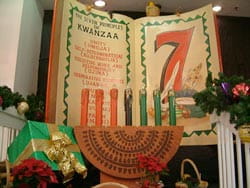 Kwanzaa is a holiday celebrating African culture and values, and it occurs annually from December 26 to January 1. Although it originated as recently as 1966, during the American civil rights movement, Kwanzaa has quickly grown in popularity. It is a celebration for African Americans, for African descendants in other countries, and for Africans in general. During this holiday, observers strengthen and celebrate African community, family, and culture.
The word "Kwanzaa" is part of the Swahili phrase "matunda ya Kwanza," meaning "first fruits." This holiday is modeled after first fruit, or harvest, festivals that took place in ancient Africa over a seven-day period.
During Kwanzaa, however, emphasis is placed on cultural, rather than on agricultural, values. In particular, it focuses on Seven Principles (Nguzo Saba) for uniting those of African heritage: unity, self-determination, collective work and responsibility, cooperative economics, purpose, creativity, and faith.
As such, Kwanzaa is not a religious, but rather a cultural holiday. Although beginning on the day after Christmas, it is not meant as an alternative celebration. Instead, Africans who are Christian (or of any other faith) may celebrate both holidays. During Christmas, they recognize their religious heritage; during Kwanzaa, they acknowledge their cultural heritage.
As part of the celebration, family members decorate a table with special symbols. They usually begin with an African tablecloth, which they cover with a woven mat and a candleholder with seven candles. These candles represent the Seven Principles and are black, red, and green. The one black candle symbolizes the African people, the three red candles their struggle, and the three green candles their hopes for the future. On each day of Kwanzaa, one candle is lit.
Besides these objects, observers also decorate the table with ears of corn, a cup (for pouring a libation in honor of ancestors), books on African life, as well as African objects of art. Many families have striven to keep Kwanzaa simple and focused on internal values, apart from the commercialism and hectic activities often accompanying Christmas.
Food
Observers of Kwanzaa hold a special feast (Karamu) on the evening of December 31, which is the sixth day of the holiday. This is traditionally divided into various formal parts, including: Welcoming, Remembering, Reassessment and Recommitment, Rejoicing, Libation Statement, and the Farewell Statement.
No one type of food is necessarily associated with this feast. Depending on the region, however, many families do serve sweet potato waffles, sweet potato pie or soup, besides fried okra, collard greens, and benne cakes. In addition, Kwanzaa meals usually include traditional African dishes; this, again, will depend where the family and its ancestors trace their roots. Those from Kenya often prepare chicken with coconut milk, those from Ghana prepare coconut rum balls.
Benne cakes are cookies originally from West Africa. The word "Benne" means sesame seeds, which are associated with good luck. The tradition of eating these treats is still preserved in some regions of the American South.
Recipes
 Benne cakes
1 cup finely packed brown sugar
1/4 cup butter
1 egg, beaten
1/2 teaspoon vanilla extract
1 teaspoon freshly squeezed lemon juice
1/2 cup all-purpose flour
1/2 teaspoon baking powder
1/4 teaspoon salt
1 cup toasted sesame seeds
Preheat the oven to 325°. Lightly grease a cookie sheet. Mix together the brown sugar and butter, and beat until they are creamy. Stir in the egg, vanilla extract, and lemon juice. Add flour, baking powder, salt, and sesame seeds. Drop rounded teaspoons of dough onto the cookie sheet 2 inches apart. Bake for 15 minutes or until the edges are browned.
 Sweet Potato Waffles
¼ cup butter
1 ½ cups flour
3 tsp. baking powder
1 tsp. salt
¼ tsp. nutmeg
3 eggs, separated
1 cup milk
1 cup mashed sweet potatoes
Melt butter. Set it aside to cool. Sift dry ingredients together. Beat egg yolks, then combine with milk, sweet potatoes, and melted butter. Stir in dry ingredients. Beat egg whites until they form soft peaks. Fold into sweet potato mixture. Cook on a preheated waffle iron.
12/11/2009 5:00:00 AM
Holiday Traditions
Food
History
Holidays
more at patheos
1

On Eagle's Wings Is 50. The Story Behind the Hymn.
2

What Lauryn Hill’s “Everything” Says About Faith and Hip Hop
3

The "New Birth of Freedom" Exhibit Celebrates America
4
The Persistent Widow: Why Jesus Says to Pester God
About
Patheos Explore the world's faith through different perspectives on religion and spirituality! Patheos has the views of the prevalent religions and spiritualities of the world.
Ad-Free & Subscriber Log-In Subscription Support
- About Us
- 2026 Calendar
- Videos
- Podcasts
- Library of World Religions
- Faith In Media Tracker
- Advertise With Us
- Write for Us
- Privacy Policy
- Terms of Service
- Do Not Sell My Data
- Contact Us
- Radiant Digital
- Manage Newsletter Subscriptions
- Unsubscribe From Notifications
- Sitemap
Copyright 2008-2026, Patheos, part of the Radiant Digital network of media brands. All rights reserved.
Subscription Support Ad-Free & Subscriber Log-In
Follow Patheos