
BuddhistCatholicContemplativeEvangelicalGeneral ChristianHinduJewishLatter-day SaintMuslimNew VisionsProgressive Christian
Beliefs
- Buddhist
- Catholic
- Contemplative
- Evangelical
- General Christian
- Hindu
- Jewish
- Latter-day Saint
- More Voices
- Muslim
- New Visions
- Pagan
- Progressive Christian
Topics
- Religion News
- Food and Religion
- Sports and Religion
- Religious Art
- Religious Music and Entertainment
- Religious Events
- History and Religion
- Style and Religion
- Politics and Religion
- Women in Religion
- Recreation Outdoors and Religion
- Business Finance and Religion
- Careers Workplace and Religion
- Education and Religion
- Family Parenting and Religion
- Health Fitness and Religion
- Home and Religion
- Relationships and Religion
- Technology and Religion
- Travel and Religion
Columnists
- Buddhist Columnists
- Business Finance and Religion Columnists
- Careers Workplace and Religion Columnists
- Catholic Columnists
- Contemplative Columnists
- Education and Religion Columnists
- Evangelists Columnists
- Family Parenting and Religion Columnists
- General Christian Columnists
- Health Fitness and Religion Columnists
- Hindu Columnists
- History and Religion Columnists
- Home and Religion Columnists
- Jewish Columnists
- More Voices Columnists
- Latter Day Columnists
- Muslim Columnists
- New Visions Columnists
- Nonreligious Columnists
- Pagan Columnists
- Politics and Religion Columnists
- Progressive Columnists
- Recreation Outdoors and Religion Columnists
- Relationships and Religion Columnists
- Religion News Columnists
- Religious Art Columnists
- Religious Events Columnists
- Religious Music and Entertainment Columnists
- Sports and Religion Columnists
- Style and Religion Columnists
- Technology and Religion Columnists
- Travel and Religion Columnists
- Women in Religion Columnists
Resource Library
- 2026 Calendar
- Library of World Religions
- The 100 Most Holy Places on Earth
- Patheos Answers
- Podcasts
- Videos
- Faith Leaders Database
- Anglican Episcopalian
- Bahai
- Baptist
- Buddhism
- Christianity
- Confucianism
- Eastern Orthodoxy
- Hinduism
- Holiness and Pentecostal
- ISKCON
- Islam
- Judaism
- Lutheran
- Methodist
- The Church of Jesus Christ of Latter-day Saints
- New Age
- Paganism
- Presbytarian and Reformed
- Protestantism
- Religion Behind the Scenes
- Roman Catholic
- Scientology
- Shia Islam
- Sikhism
- Sufism
- Sunni Islam
- Taoism
- Zen
- See all religions
Research Tools
 Ad-Free & Subscriber Log-In Subscription Support
Ad-Free & Subscriber Log-In Subscription Support
Follow Patheos 

- Trending:
- Forgiveness
- |
- Marriage
- |
- Consciousness
- |
- Death Penalty
- |
- Election
- |
- Halloween
Catholic
John Paul II and a Holy Life
April 29, 2011 by Pia de Solenni
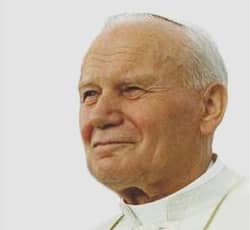 As we approach the beatification of Pope John Paul II, media headlines continue to question whether the beatification might in fact be too hasty or, worse, erroneous. While valid questions are raised, I think the issue of John Paul II's sanctity has been somewhat conflated with the Church and the Vatican's handling of the sex abuse crisis.
Last week, John Allen, a Vatican journalist whom I generally admire, wrote a troubling piece for Newsweek in which he suggests that the crisis might be cause to at least delay the beatification. In a subsequent piece for the National Catholic Reporter, he seems to clarify his position and argue that there's nothing amiss with the beatification itself.
Meanwhile, George Weigel wrote a thorough defense of the beatification process as it relates specifically to John Paul. Maureen Dowd, however, seemed to take a cue from Allen's first piece. She writes, "Not beatifying or canonizing John Paul would be hugely symbolic, a message far more powerful than the ad hoc apologies and payoffs to victims."
Beatification is one step toward canonization when someone is formally declared a saint. In this first phase, it is determined that the individual lived a life of heroic virtue. Numerous witnesses are consulted, as well as the person's own work, writings, etc. In addition, one documented miracle must be present. Once the person is beatified, permission can be sought to venerate the blessed person in a particular locale. Upon canonization, the individual can be acknowledged as a saint and publicly venerated throughout the world, no special permission required. The declaration of sanctity does not make the person a saint. That individual is already a saint in heaven regardless of who confirms it.
John Paul II lived life well; he was holy. We see it in the pictures of his youth and early priesthood. We see it in his writings and teachings. We hear of it from people who knew him. As pope, he provided the witness of someone who was always ready to take up the cross. He was a consummate pastor. He didn't cow to intimidation. That's part of the reason he played such a crucial role in the collapse of communism.
When the sex abuse crisis was uncovered in the United States in 2002, Americans were already used to rapid response news. We'd seen the O.J. Simpson chase live almost ten years before. Since that point, cable news and the nascent internet kept us up to speed on all breaking news. For Americans, it was unfathomable that the Vatican would be so uninformed on a major news story that directly affected the Catholic Church and her clergy. But in fact, the Vatican was woefully unaware and ill prepared to respond. It took several weeks for the Vatican to be fully apprised of the facts and longer to respond.
However, fully apprised of the situation, John Paul II addressed the evil of the abuse scandal at the end of a Sunday Angelus. In his Holy Thursday Letter to Priests that same March, he wrote of the priests who had given in to the "most grievous forms of the mysterium iniquitatis [mystery of evil] at work in the world." He made similarly strong statements to the American cardinals whom he summoned to Rome just weeks later: "The abuse which has caused this crisis is by every standard wrong and rightly considered a crime by society; it is also an appalling sin in the eyes of God."
Not unlike Pope Benedict, John Paul II did a much better job of communicating about the crisis than have others affiliated with the Vatican.
Naturally, questions like the pope's friendship with Father Marcial Maciel Degollado, the now disgraced founder of the Legionaries of Christ, surface and demand an accounting. According to some reports, Maciel paved his way with gifts, including cash. One man known to decline the gifts was then Cardinal Ratzinger who is now Pope Benedict XVI.
By this point, particularly after the investigation for the beatification of John Paul II, the Vatican has to know who was involved in covering up for Maciel. So far, there has been no public evidence that John Paul II knowingly facilitated his lies and deceits. Were there such evidence, the beatification would not be going forward. However, someone had to know. In all probability, the Vatican now knows.
Article Continued On Next Page
Page: 1 of 2
4/29/2011 4:00:00 AM
Catholic
Vatican
Beatification
Clergy
John Paul II
Media
Marcial Maciel Degollado
Pope Benedict
Sexual Abuse
Christianity
Roman Catholicism
more at patheos
1
Trump Reveals Why He Is So Unqualified to Be U.S. President
2

Further Talks on the Gospel of the Kingdom
3

Summer in Winter, Heaven in Hell
4
Easter: A Zen Buddhist Appreciation
About
Patheos Explore the world's faith through different perspectives on religion and spirituality! Patheos has the views of the prevalent religions and spiritualities of the world.
Ad-Free & Subscriber Log-In Subscription Support
- About Us
- 2026 Calendar
- Videos
- Podcasts
- Library of World Religions
- Faith In Media Tracker
- Advertise With Us
- Write for Us
- Privacy Policy
- Terms of Service
- Do Not Sell My Data
- Contact Us
- Radiant Digital
- Manage Newsletter Subscriptions
- Unsubscribe From Notifications
- Sitemap
Copyright 2008-2026, Patheos. All rights reserved.
Subscription Support Ad-Free & Subscriber Log-In
Follow Patheos