
BuddhistCatholicContemplativeEvangelicalGeneral ChristianHinduJewishLatter-day SaintMuslimNew VisionsProgressive Christian
Beliefs
- Buddhist
- Catholic
- Contemplative
- Evangelical
- General Christian
- Hindu
- Jewish
- Latter-day Saint
- More Voices
- Muslim
- New Visions
- Pagan
- Progressive Christian
Topics
- Religion News
- Food and Religion
- Sports and Religion
- Religious Art
- Religious Music and Entertainment
- Religious Events
- History and Religion
- Style and Religion
- Politics and Religion
- Women in Religion
- Recreation Outdoors and Religion
- Business Finance and Religion
- Careers Workplace and Religion
- Education and Religion
- Family Parenting and Religion
- Health Fitness and Religion
- Home and Religion
- Relationships and Religion
- Technology and Religion
- Travel and Religion
Columnists
- Buddhist Columnists
- Business Finance and Religion Columnists
- Careers Workplace and Religion Columnists
- Catholic Columnists
- Contemplative Columnists
- Education and Religion Columnists
- Evangelists Columnists
- Family Parenting and Religion Columnists
- General Christian Columnists
- Health Fitness and Religion Columnists
- Hindu Columnists
- History and Religion Columnists
- Home and Religion Columnists
- Jewish Columnists
- More Voices Columnists
- Latter Day Columnists
- Muslim Columnists
- New Visions Columnists
- Nonreligious Columnists
- Pagan Columnists
- Politics and Religion Columnists
- Progressive Columnists
- Recreation Outdoors and Religion Columnists
- Relationships and Religion Columnists
- Religion News Columnists
- Religious Art Columnists
- Religious Events Columnists
- Religious Music and Entertainment Columnists
- Sports and Religion Columnists
- Style and Religion Columnists
- Technology and Religion Columnists
- Travel and Religion Columnists
- Women in Religion Columnists
Resource Library
- 2026 Calendar
- Library of World Religions
- The 100 Most Holy Places on Earth
- Patheos Answers
- Podcasts
- Videos
- Faith Leaders Database
- Anglican Episcopalian
- Bahai
- Baptist
- Buddhism
- Christianity
- Confucianism
- Eastern Orthodoxy
- Hinduism
- Holiness and Pentecostal
- ISKCON
- Islam
- Judaism
- Lutheran
- Methodist
- The Church of Jesus Christ of Latter-day Saints
- New Age
- Paganism
- Presbytarian and Reformed
- Protestantism
- Religion Behind the Scenes
- Roman Catholic
- Scientology
- Shia Islam
- Sikhism
- Sufism
- Sunni Islam
- Taoism
- Zen
- See all religions
Research Tools
 Ad-Free & Subscriber Log-In Subscription Support
Ad-Free & Subscriber Log-In Subscription Support
Follow Patheos 

- Trending:
- Forgiveness
- |
- Marriage
- |
- Consciousness
- |
- Death Penalty
- |
- Election
- |
- Halloween
Catholic
Gwen John: Art and Faith in the Shadows
November 23, 2010 by James Sullivan
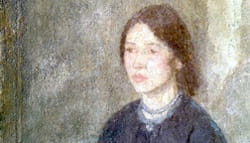 On September 18, 1939, the public hospital in the port city of Dieppe, France recorded the death of a 63-year-old woman, a Catholic painter of some reputation. Gwen John had traveled to this city from Paris only days before, carrying nothing except a notarized copy of her will and burial instructions.
Augustus John, her extroverted younger brother, a prodigious talent in the world of painting and portraiture, remarked that his sister brought nothing for herself and yet had managed to see to it that her cats would be fed and cared for while she was away. This quality of self-forgetfulness, which crossed the barrier into self-destructiveness, brought an end to the career of one of the few notable Catholic painters of the post-Impressionist period.
The isolated and forlorn condition of Gwen John's passing only served to fuel what Cecily Langdale has called "the Gwen John legend." Sister of one flamboyant genius and lover of another, Gwen John was herself a recluse who painted in artistic isolation. Her achievement was essentially unknown during her own lifetime, generally unappreciated thereafter, and is only now coming to be recognized as greater than that of her celebrated brother Augustus, to whom she is invariably compared.
Yet, like all legends, this one contains portions of both truth and falsehood. While she lived a deliberately eremitic life, often exhibiting a dread of strangers, especially in her last ten years, she also developed friendships with such artists as the poet Rainer Maria Rilke, Arthur Symons, the British exponent of Symbolism, and John Quinn, a New York connoisseur of the avant garde who served as her exclusive agent. Although not primarily interested in theories of aesthetics or even art criticism, she met leading artists of the day, including Picasso, Braque, and Matisse. While Gwen John found Matisse to be a snob, she thought Rouault "the greatest painter of our day."
Indeed two of her relationships, a love affair with Auguste Rodin and a friendship with Vera Oumançoff, sister-in-law of Jacques Maritain, could be described as obsessional attachments. Gwen John's reputation has been refracted through these two relationships, provoking a biography in 1983 by Susan Chitty and a 1984 BBC documentary, A Very Private View. Additionally, Cecily Langdale, an art dealer in New York, and David Fraser Jenkins sought to move the discussion away from the artist's passionate and often tortured personal affections, to a consideration of her artwork itself and her position within modern art and painting. This approach, though frankly secular, has the advantage of making the appropriate discrimination between an artist's work and her amorous life or psychic underside.
Nevertheless, in this effort to distinguish the life of Gwen John from her work there may be a danger in disassociating her, too abruptly, from heteronomous influences that affected her work, in particular her conversion to Roman Catholicism in 1913. There was a particular Catholic side to Gwen John, although the faith took hold in a personality of marked quirkiness.
Gwen John was born in Wales in 1876, the second oldest in a family of four children. Her younger brother Augustus excelled in drawing and was sent to the Slade School in 1894. Not to be held back, Gwen joined him one year later in 1895. The Slade was at that time in its halcyon period led by Frederick Brown and his assistant, Henry Tonks. Drawing instruction was a hallmark of the school (Chesterton studied there from 1894-95) and students were encouraged to make copies after the old masters. Augustus won the competition in 1897 with a copy after the manner of Watteau. He was by all accounts "the first draughtsman in England," with a personal flair that made him the envy of his fellow students.
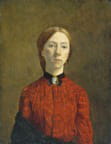 Gwen was also deft in drawing but she skirted the shadow of her younger brother, giving an early indication of her intention to develop a style uniquely her own. Their relationship was non-competitive and highly affectionate. Although critical of Gwen's evident unconcern about her health, Augustus was foremost in appreciating her art. What his own work owed in technical mastery, he felt that Gwen's pictures more than compensated in interior feeling and expressiveness.
After the Slade came a six-month stay at James McNeill Whistler's newly established, Académie Carmen in Paris. Whistler was the rage at the Slade School and Gwen John, upon arrival, was already painting in low tones with the intimate subject matter of which he approved. Augustus inquired of the celebrated man what he thought of Gwen's "feeling for character." "Character?" returned Whistler, "what's that? It's tone that matters. Your sister has a fine sense of tone." These low tones give to her paintings and gouaches a muted quality that suggests inwardness. For this reason, some have found her art disconcerting or difficult to view, yet she was oblivious to such comments. "As to whether I have anything worth expressing," she wrote to Ursula Trywhitt, "that is apart from the question. I may never have anything to express, except this desire for a more interior life."
Article Continued On Next Page
Page: 1 of 3
11/23/2010 5:00:00 AM
Catholic
Art
History
Media
Christianity
Roman Catholicism
more at patheos
1

What Is Chesed? The Bible's Word for God's Love
2

In the Beginning, Incest Was the Best
3

Ascension Sacred Artwork for the Liturgy of the Hours 2nd Ed
4
Body, Mind, and Soul: Why Christians Must Value Health
About
Patheos Explore the world's faith through different perspectives on religion and spirituality! Patheos has the views of the prevalent religions and spiritualities of the world.
Ad-Free & Subscriber Log-In Subscription Support
- About Us
- 2026 Calendar
- Videos
- Podcasts
- Library of World Religions
- Faith In Media Tracker
- Advertise With Us
- Write for Us
- Privacy Policy
- Terms of Service
- Do Not Sell My Data
- Contact Us
- Radiant Digital
- Manage Newsletter Subscriptions
- Unsubscribe From Notifications
- Sitemap
Copyright 2008-2026, Patheos. All rights reserved.
Subscription Support Ad-Free & Subscriber Log-In
Follow Patheos