
BuddhistCatholicContemplativeEvangelicalGeneral ChristianHinduJewishLatter-day SaintMuslimNew VisionsProgressive Christian
Beliefs
- Buddhist
- Catholic
- Contemplative
- Evangelical
- General Christian
- Hindu
- Jewish
- Latter-day Saint
- More Voices
- Muslim
- New Visions
- Pagan
- Progressive Christian
Topics
- Religion News
- Food and Religion
- Sports and Religion
- Religious Art
- Religious Music and Entertainment
- Religious Events
- History and Religion
- Style and Religion
- Politics and Religion
- Women in Religion
- Recreation Outdoors and Religion
- Business Finance and Religion
- Careers Workplace and Religion
- Education and Religion
- Family Parenting and Religion
- Health Fitness and Religion
- Home and Religion
- Relationships and Religion
- Technology and Religion
- Travel and Religion
Columnists
- Buddhist Columnists
- Business Finance and Religion Columnists
- Careers Workplace and Religion Columnists
- Catholic Columnists
- Contemplative Columnists
- Education and Religion Columnists
- Evangelists Columnists
- Family Parenting and Religion Columnists
- General Christian Columnists
- Health Fitness and Religion Columnists
- Hindu Columnists
- History and Religion Columnists
- Home and Religion Columnists
- Jewish Columnists
- More Voices Columnists
- Latter Day Columnists
- Muslim Columnists
- New Visions Columnists
- Nonreligious Columnists
- Pagan Columnists
- Politics and Religion Columnists
- Progressive Columnists
- Recreation Outdoors and Religion Columnists
- Relationships and Religion Columnists
- Religion News Columnists
- Religious Art Columnists
- Religious Events Columnists
- Religious Music and Entertainment Columnists
- Sports and Religion Columnists
- Style and Religion Columnists
- Technology and Religion Columnists
- Travel and Religion Columnists
- Women in Religion Columnists
Resource Library
- 2026 Calendar
- Library of World Religions
- The 100 Most Holy Places on Earth
- Patheos Answers
- Podcasts
- Videos
- Faith Leaders Database
- Anglican Episcopalian
- Bahai
- Baptist
- Buddhism
- Christianity
- Confucianism
- Eastern Orthodoxy
- Hinduism
- Holiness and Pentecostal
- ISKCON
- Islam
- Judaism
- Lutheran
- Methodist
- The Church of Jesus Christ of Latter-day Saints
- New Age
- Paganism
- Presbytarian and Reformed
- Protestantism
- Religion Behind the Scenes
- Roman Catholic
- Scientology
- Shia Islam
- Sikhism
- Sufism
- Sunni Islam
- Taoism
- Zen
- See all religions
Research Tools
 Ad-Free & Subscriber Log-In Subscription Support
Ad-Free & Subscriber Log-In Subscription Support
Follow Patheos 

- Trending:
- Forgiveness
- |
- Marriage
- |
- Consciousness
- |
- Death Penalty
- |
- Election
- |
- Halloween
God as Three Persons?
February 16, 2010
By the Rev. Sam Alexander
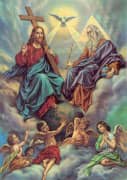 Our creeds agree; if it's not Trinitarian, it's not Christian, which is odd when you consider that we Christians pretty much ignore the Trinity. Why? Frankly, the doctrine doesn't make sense, which is probably good because you can't make arrogant theological claims if you don't comprehend God, which is probably why we ignore it. (Just guessing.)
To "understand" Trinity we need to examine its roots. Christianity was derived from Judaism when various social forces sought a more universal expression of their beautiful and imaginative, monotheistic faith. (With those roots, how can we possibly lay claim to an exclusive grasp on truth?)
That said, the early Christians experienced God in three ways. Taken together, their scriptures described God as "Father," the one from whom all things proceed, and as "Son," the incarnate expression of God, and as "Holy Spirit, "in whom we live and move and have our being" (Acts 17:28).
But, and this is key, because Christianity derived from monotheistic Judaism, we did not posit three gods. Instead, we paradoxically believe that each distinct "person" is the whole of God. Whatever is said about one "person" must also be said of all three. (The Nicene Creed is a classical expression of the Doctrine of the Trinity.)
Taking the three persons together we get an image of one God in an imaginative, generative dance, moving into union. This is God's nature, and it is expressed in God's engagement with creation. God desires union with us precisely because God is God.
Trinitarian belief offers three "access points" into divine life, which is great because some are drawn to one and not to others. Each of those access points leads into the whole of God. (This is a distinctive, but not necessarily unique perspective of Christianity.)
Christianity has tended to emphasize an "I-Thou" relationship to the incarnate "Son." But when that entry point does not also lead into the whole of God we become disconnected from God's generative power, and separated from all that is.
Modernity challenges the veracity of myth and so this "second person" relation to "the Son" is called (unnecessarily) into question. That's why mainline churches are emptying.
In view of that, many Christians are seeking union with the "first person," the one from whom all things proceed. We are rediscovering the contemplative streams of our tradition. But when that entry point does not also lead into the whole of God, we become disconnected from one another; faith becomes otherworldly, without basis for ethics.
The final entry point seems to me most apt for the modern mind. When we study the cosmos, contemplating its enormity, complexity, and beauty, until it almost shimmers with the life of God, we are engaging Holy Spirit, the one in whom we live and move and have our being. But when this entry point does not lead us into the whole of God, when we do not enter into relationship with it, or unite with the generative power that creates it, then we become entirely focused on this world and lose any sense of purpose.
Well there it is, the Trinity. If your head is spinning, you've got it.
 Rev. Sam Alexander is Pastor of First Presbyterian Church of San Rafael, California. He holds a B.A. from Sarah Lawrence College, and an M.Div. from Union Seminary in Virginia. Sam has served congregations in Maryland and in the San Francisco Bay area and serves as an Adjunct Instructor in Homiletics (Preaching) at San Francisco Theological Seminary. He blogs at www.gracecomesfirst.net.
2/16/2010 5:00:00 AM
Gods and Goddesses
God
History
Christianity
Presbyterian & Reformed
more at patheos
1

Wyndam Clarke Leads the U.S. Open Golf Tournament by Seven
2
3

On Misogyny, Aslan, and a Moral Panic
4

Will We Regain Lost Relational Opportunities in Heaven?
About
Patheos Explore the world's faith through different perspectives on religion and spirituality! Patheos has the views of the prevalent religions and spiritualities of the world.
Ad-Free & Subscriber Log-In Subscription Support
- About Us
- 2026 Calendar
- Videos
- Podcasts
- Library of World Religions
- Faith In Media Tracker
- Advertise With Us
- Write for Us
- Privacy Policy
- Terms of Service
- Do Not Sell My Data
- Contact Us
- Radiant Digital
- Manage Newsletter Subscriptions
- Unsubscribe From Notifications
- Sitemap
Copyright 2008-2026, Patheos. All rights reserved.
Subscription Support Ad-Free & Subscriber Log-In
Follow Patheos