
BuddhistCatholicContemplativeEvangelicalGeneral ChristianHinduJewishLatter-day SaintMuslimNew VisionsProgressive Christian
Beliefs
- Buddhist
- Catholic
- Contemplative
- Evangelical
- General Christian
- Hindu
- Jewish
- Latter-day Saint
- More Voices
- Muslim
- New Visions
- Pagan
- Progressive Christian
Topics
- Religion News
- Food and Religion
- Sports and Religion
- Religious Art
- Religious Music and Entertainment
- Religious Events
- History and Religion
- Style and Religion
- Politics and Religion
- Women in Religion
- Recreation Outdoors and Religion
- Business Finance and Religion
- Careers Workplace and Religion
- Education and Religion
- Family Parenting and Religion
- Health Fitness and Religion
- Home and Religion
- Relationships and Religion
- Technology and Religion
- Travel and Religion
Columnists
- Buddhist Columnists
- Business Finance and Religion Columnists
- Careers Workplace and Religion Columnists
- Catholic Columnists
- Contemplative Columnists
- Education and Religion Columnists
- Evangelists Columnists
- Family Parenting and Religion Columnists
- General Christian Columnists
- Health Fitness and Religion Columnists
- Hindu Columnists
- History and Religion Columnists
- Home and Religion Columnists
- Jewish Columnists
- More Voices Columnists
- Latter Day Columnists
- Muslim Columnists
- New Visions Columnists
- Nonreligious Columnists
- Pagan Columnists
- Politics and Religion Columnists
- Progressive Columnists
- Recreation Outdoors and Religion Columnists
- Relationships and Religion Columnists
- Religion News Columnists
- Religious Art Columnists
- Religious Events Columnists
- Religious Music and Entertainment Columnists
- Sports and Religion Columnists
- Style and Religion Columnists
- Technology and Religion Columnists
- Travel and Religion Columnists
- Women in Religion Columnists
Resource Library
- 2026 Calendar
- Library of World Religions
- The 100 Most Holy Places on Earth
- Patheos Answers
- Podcasts
- Videos
- Faith Leaders Database
- Anglican Episcopalian
- Bahai
- Baptist
- Buddhism
- Christianity
- Confucianism
- Eastern Orthodoxy
- Hinduism
- Holiness and Pentecostal
- ISKCON
- Islam
- Judaism
- Lutheran
- Methodist
- The Church of Jesus Christ of Latter-day Saints
- New Age
- Paganism
- Presbytarian and Reformed
- Protestantism
- Religion Behind the Scenes
- Roman Catholic
- Scientology
- Shia Islam
- Sikhism
- Sufism
- Sunni Islam
- Taoism
- Zen
- See all religions
Research Tools
 Ad-Free & Subscriber Log-In Subscription Support
Ad-Free & Subscriber Log-In Subscription Support
Follow Patheos 

- Trending:
- Forgiveness
- |
- Marriage
- |
- Consciousness
- |
- Death Penalty
- |
- Election
- |
- Halloween
Luke: The Gospel of Amazement: A Book Excerpt
March 01, 2011 by Michael Card
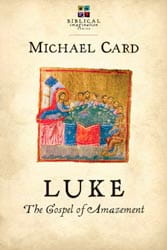
This month in the Patheos Book Club, we're discussing Michael Card's new book, Luke: The Gospel of Amazement. Read the Preface below, and join the conversation.
 Though seeing, they may not see; though hearing, they may not understand. ~ Luke 8:10 NIV, from Isaiah 6:9
When we hear these words of Jesus, something inside us shudders. We wince at the thought of someone—anyone—who has the ability to see and hear and yet stubbornly refuses to perceive and understand. Our greatest fear is that inwardly we might be just that person.
He had just told the parable of the sower. And we will learn in Luke that a parable demands the use of the imagination. If we are to take our place alongside the disciples as ones to whom these "secrets of knowledge" have been entrusted, then we too must learn what it means to read, to perceive, to understand the Bible with our imaginations.
It is impossible, when a seed is planted in you, to know just what sort of fruit it will eventually produce. Almost thirty years ago, when Dr. William Lane smiled at me over his crooked glasses and said, "I am going to teach you how I read Scripture," how could I have known that I would spend the rest of my life in pursuit of his stated goal: reading the Scriptures with my imagination.
"We must learn to read the Bible at the level of the informed imagination": this was how he encapsulated his approach to studying God's Word. In the years that followed, he never once explained how we were supposed to do this. Instead, he simply did it. That is, Bill incarnated for his students a deep interaction with the biblical text by means of his remarkably informed imagination. A Ph.D. from Harvard, he spoke fourteen languages. You saw his imagination when he simply opened the Bible; it seemed to tremble in his hands. You heard it when he read with his booming voice, usually from the New Testament. You saw it in your mind's eye when he used primary source backgrounds to paint the image of Jesus the rabbi. Sometimes you even smelled it when Bill recounted a scene like the anointing of Jesus' feet. "'The smell of the perfume filled the house' [Jn. 12:3]: now, why do you think John included that detail?" he would ask, his voice modulating for effect.
In our own way, those of us who studied with Bill in the religion department of Western Kentucky University adapted and adopted this luminous approach. We absorbed the primary sources for ourselves: Suetonius, Eusebius, Tacitus, Josephus and the rest. We learned to ask the same sort of questions he might ask of the text: "Why is this detail there?" "What does it mean?" "How would the first hearers of this document have understood this?" "Why did the writer leave that out?" In time, on our own, we would learn to ask even better questions . . . questions of our own.
Precisely because he neglected to present this method as a full-blown system, we were left to struggle on our own. His refusal to provide a systematic, didactic outline had a powerful purpose: we were left to engage with Scripture at the level of our imaginations, by ourselves.
And now, all these years later, I would like to show you how I read Scripture, to show you what I've come to understand about engaging with the Scriptures at the level of the informed imagination. I do not intend to present a system or an outline of my own, even if I could. In this new series of explorations of the Gospels, I would simply like to share some of the discoveries I've made along the way.
Disintegration/Reintegration and the Holy Spirit
We are a disintegrated people. The signs of it are all around us. Every bird that flees when you're taking a walk is a reminder that the integrated place we once had with creation has been violated. We experience this when we witness the disintegration of every human relationship while our souls tell us that wife belongs with husband, friend with friend, child with parent. Yet at every turn we find it almost impossible to fit the fragmented pieces of the puzzles of our lives together.
This disintegration affects the way we come to the Scriptures as well. Some of us embrace the Bible with our hearts, which is right to do, and yet we do not bring disciplined minds into the process. Sometimes the reverse is true: we apply first-rate minds to the Bible and yet fail to be sensitive to what the Word is whispering to our hearts. In the end, it is not a heart problem, nor is it a head problem. It is an integration problem. We must ask the Lord to help us bring our whole self to the task of listening to the Bible. How can we begin to reconnect what became disconnected at the Fall? How can the heart and mind become reintegrated?
Article Continued On Next Page
Page: 1 of 2
3/1/2011 5:00:00 AM
Book Club
Mainline Protestantism
Sacred Texts
Christianity
Evangelicalism
more at patheos
1

How to Build a Gen AI Portal Employees Will Actually Use
2

Some thoughts on Islam and terrorist violence
3

Finding God's Grace in ‘Project Hail Mary’
4

10 Catholic Finds at the Pride Festival
About
Patheos Explore the world's faith through different perspectives on religion and spirituality! Patheos has the views of the prevalent religions and spiritualities of the world.
Ad-Free & Subscriber Log-In Subscription Support
- About Us
- 2026 Calendar
- Videos
- Podcasts
- Library of World Religions
- Faith In Media Tracker
- Advertise With Us
- Write for Us
- Privacy Policy
- Terms of Service
- Do Not Sell My Data
- Contact Us
- Radiant Digital
- Manage Newsletter Subscriptions
- Unsubscribe From Notifications
- Sitemap
Copyright 2008-2026, Patheos. All rights reserved.
Subscription Support Ad-Free & Subscriber Log-In
Follow Patheos