
BuddhistCatholicContemplativeEvangelicalGeneral ChristianHinduJewishLatter-day SaintMuslimNew VisionsProgressive Christian
Beliefs
- Buddhist
- Catholic
- Contemplative
- Evangelical
- General Christian
- Hindu
- Jewish
- Latter-day Saint
- More Voices
- Muslim
- New Visions
- Pagan
- Progressive Christian
Topics
- Religion News
- Food and Religion
- Sports and Religion
- Religious Art
- Religious Music and Entertainment
- Religious Events
- History and Religion
- Style and Religion
- Politics and Religion
- Women in Religion
- Recreation Outdoors and Religion
- Business Finance and Religion
- Careers Workplace and Religion
- Education and Religion
- Family Parenting and Religion
- Health Fitness and Religion
- Home and Religion
- Relationships and Religion
- Technology and Religion
- Travel and Religion
Columnists
- Buddhist Columnists
- Business Finance and Religion Columnists
- Careers Workplace and Religion Columnists
- Catholic Columnists
- Contemplative Columnists
- Education and Religion Columnists
- Evangelists Columnists
- Family Parenting and Religion Columnists
- General Christian Columnists
- Health Fitness and Religion Columnists
- Hindu Columnists
- History and Religion Columnists
- Home and Religion Columnists
- Jewish Columnists
- More Voices Columnists
- Latter Day Columnists
- Muslim Columnists
- New Visions Columnists
- Nonreligious Columnists
- Pagan Columnists
- Politics and Religion Columnists
- Progressive Columnists
- Recreation Outdoors and Religion Columnists
- Relationships and Religion Columnists
- Religion News Columnists
- Religious Art Columnists
- Religious Events Columnists
- Religious Music and Entertainment Columnists
- Sports and Religion Columnists
- Style and Religion Columnists
- Technology and Religion Columnists
- Travel and Religion Columnists
- Women in Religion Columnists
Resource Library
- 2026 Calendar
- Library of World Religions
- The 100 Most Holy Places on Earth
- Patheos Answers
- Podcasts
- Videos
- Faith Leaders Database
- Anglican Episcopalian
- Bahai
- Baptist
- Buddhism
- Christianity
- Confucianism
- Eastern Orthodoxy
- Hinduism
- Holiness and Pentecostal
- ISKCON
- Islam
- Judaism
- Lutheran
- Methodist
- The Church of Jesus Christ of Latter-day Saints
- New Age
- Paganism
- Presbytarian and Reformed
- Protestantism
- Religion Behind the Scenes
- Roman Catholic
- Scientology
- Shia Islam
- Sikhism
- Sufism
- Sunni Islam
- Taoism
- Zen
- See all religions
Research Tools
 Ad-Free & Subscriber Log-In Subscription Support
Ad-Free & Subscriber Log-In Subscription Support
Follow Patheos 

- Trending:
- Forgiveness
- |
- Marriage
- |
- Consciousness
- |
- Death Penalty
- |
- Election
- |
- Halloween
The Church Is Flat: An Excerpt
January 03, 2012 by Tony Jones
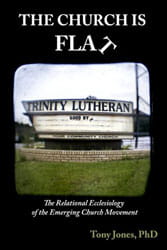 Now Featured in the Patheos Book Club:
The Church Is Flat: The Relational Ecclesiology of the Emerging Church Movement
By Tony Jones
Book Excerpt
Chapter 5: The Christological Office of "Friend" and Practices of Public Friendship
In adding the relational title, "friend," to the honorific titles, "prophet, priest, and king," Moltmann proposes that "there is no human hope" for a world free of class struggles and domination without "a classless society free of domination, without repression and without privileges."[i] And that comes only by friendship, characterized by "affection, loyalty, reliability, constancy in disaster, openness, freedom, sympathy, and noncompetitiveness."[ii] Moltmann also issues a corrective to the modern conception of friendship by insisting that the friendship for which he is calling not be private but public: "The friendship of Jesus cannot be lived and its friendliness cannot be disseminated when friendship is limited to people who are like ourselves and when it is narrowed down to private life."[iii]
"Friend" has been a core theological rubric in the emerging church movement since its inception. The leaders of Emergent Village, arguably the most significant organization in the ECM between 2001 and 2008, identify the organization as a "growing, generative friendship among missional Christian leaders."[iv] Supporters and funders of the organization go by the appellation, "Friend of Emergent Village," and the organization distributes iconographic web badges with that phrase that are common in the Christian blogosphere. In my book The New Christians: Dispatches from the Emergent Frontier, I proposed that, "Emergents believe that an envelope of friendship and reconciliation must surround all debates about doctrine and dogma."[v] Moltmann proposed "Friend" as a fifth christological office in 1975; Emergent Village's introduction of that term as the hallmark of their network in 2001 did not rely on Moltmann, but the connection is more than coincidental.
To some extent, the emerging church movement has exemplified the public friendship for which Moltmann advocates in his ecclesiology. The next step in the ECM's process of theological friendship will be to develop practices that explicitly encourage public friendship. One of these will be to engage in inter-religious dialogue, an area with which the ECM has little experience. Other than a meeting in 2005 with the leaders of Synagogue 3000, a Jewish think tank, the movement has done little to pursue public friendship with non-Christians. Some consider the inter-religious dialogues of the twentieth century disappointing in their results, but the ECM's emphasis on practices of public friendship may model an alternative of inter-religious conversation. The ECM has an opportunity to forge a type of inter-religious relation that, like Moltmann's theology, maintains a robust Christian identity while remaining truly open to the life of the other. These practices of public friendship with adherents of other religions-and no religion-should be pursued aggressively.[vi]
The concept of friendship can also be more fully operationalized within the movement itself. As J.L. Austin and other philosophers of language have conclusively shown, words do things.[vii] Thus, the words that are used to describe the adherents to the movement will necessarily shape the self-perception of those adherents and will shape the perception of the movement by those who observe it.
The adoption and use of the language of friendship will aid emerging church congregations in becoming the egalitarian fellowships that they long to be. These congregations have largely abdicated the traditional titles taken by clergy (Reverend, Pastor, Father), titles which sometimes serve to prop up traditional hierarchical structures and the attitudes of domination and submission that so often accompany them. Now, at a time when public distrust of clergy is on the rise due to the many public scandals of the past several decades, clergypersons may do well to relinquish antiquated and honorific titles in favor of a single designator, like "friend," that clearly communicates an equivalency between all members of a faith community. Practices that relocate ecclesial authority in language of trust-like the office of friend-communicate the equivalency of all members of the faith community before God and downplay the traditional power differential between clergy and laypeople.
[i] Moltmann, The Church in the Power of the Spirit: A Contribution to Messianic Ecclesiology, 116.
[ii] Scott and Cavanaugh, The Blackwell Companion to Political Theology, 237.
[iii] Moltmann, The Church in the Power of the Spirit: A Contribution to Messianic Ecclesiology.
[iv] Jones, The New Christians: Dispatches from the Emergent Frontier, xi.
[v] Jones, The New Christians: Dispatches from the Emergent Frontier, 77.
[vi] This is not unique to the emerging church movement. It is the very model being used by Interfaith Youth Core. But the ECM is uniquely poised within American Protestantism to catalyze a similar dialogue.
[vii] Austin, How to Do Things with Word
1/3/2012 5:00:00 AM
Book Club
Emerging Church
Ecclesiology
Jurgen Moltmann
Tony Jones
more at patheos
1

Lessons Learned While Traveling to Spiritual Events
2

Owning Things Without Being Owned: The 100 Thing Challenge
3

What Does "Faith" Mean in Non-Religious Spirituality?
4

Don’t Let Your Relationship With Jesus Slip
About
Patheos Explore the world's faith through different perspectives on religion and spirituality! Patheos has the views of the prevalent religions and spiritualities of the world.
Ad-Free & Subscriber Log-In Subscription Support
- About Us
- 2026 Calendar
- Videos
- Podcasts
- Library of World Religions
- Faith In Media Tracker
- Advertise With Us
- Write for Us
- Privacy Policy
- Terms of Service
- Do Not Sell My Data
- Contact Us
- Radiant Digital
- Manage Newsletter Subscriptions
- Unsubscribe From Notifications
- Sitemap
Copyright 2008-2026, Patheos. All rights reserved.
Subscription Support Ad-Free & Subscriber Log-In
Follow Patheos