
BuddhistCatholicContemplativeEvangelicalGeneral ChristianHinduJewishLatter-day SaintMuslimNew VisionsProgressive Christian
Beliefs
- Buddhist
- Catholic
- Contemplative
- Evangelical
- General Christian
- Hindu
- Jewish
- Latter-day Saint
- More Voices
- Muslim
- New Visions
- Pagan
- Progressive Christian
Topics
- Religion News
- Food and Religion
- Sports and Religion
- Religious Art
- Religious Music and Entertainment
- Religious Events
- History and Religion
- Style and Religion
- Politics and Religion
- Women in Religion
- Recreation Outdoors and Religion
- Business Finance and Religion
- Careers Workplace and Religion
- Education and Religion
- Family Parenting and Religion
- Health Fitness and Religion
- Home and Religion
- Relationships and Religion
- Technology and Religion
- Travel and Religion
Columnists
- Buddhist Columnists
- Business Finance and Religion Columnists
- Careers Workplace and Religion Columnists
- Catholic Columnists
- Contemplative Columnists
- Education and Religion Columnists
- Evangelists Columnists
- Family Parenting and Religion Columnists
- General Christian Columnists
- Health Fitness and Religion Columnists
- Hindu Columnists
- History and Religion Columnists
- Home and Religion Columnists
- Jewish Columnists
- More Voices Columnists
- Latter Day Columnists
- Muslim Columnists
- New Visions Columnists
- Nonreligious Columnists
- Pagan Columnists
- Politics and Religion Columnists
- Progressive Columnists
- Recreation Outdoors and Religion Columnists
- Relationships and Religion Columnists
- Religion News Columnists
- Religious Art Columnists
- Religious Events Columnists
- Religious Music and Entertainment Columnists
- Sports and Religion Columnists
- Style and Religion Columnists
- Technology and Religion Columnists
- Travel and Religion Columnists
- Women in Religion Columnists
Resource Library
- 2026 Calendar
- Library of World Religions
- The 100 Most Holy Places on Earth
- Patheos Answers
- Podcasts
- Videos
- Faith Leaders Database
- Anglican Episcopalian
- Bahai
- Baptist
- Buddhism
- Christianity
- Confucianism
- Eastern Orthodoxy
- Hinduism
- Holiness and Pentecostal
- ISKCON
- Islam
- Judaism
- Lutheran
- Methodist
- The Church of Jesus Christ of Latter-day Saints
- New Age
- Paganism
- Presbytarian and Reformed
- Protestantism
- Religion Behind the Scenes
- Roman Catholic
- Scientology
- Shia Islam
- Sikhism
- Sufism
- Sunni Islam
- Taoism
- Zen
- See all religions
Research Tools
 Ad-Free & Subscriber Log-In Subscription Support
Follow Patheos 

- Trending:
- Advent
- |
- Forgiveness
- |
- Thanksgiving
- |
- Election
- |
- Seasonal Holidays
- |
- Marriage
(Burnt) Siena: Musings of a Meandering Pilgrim
April 21, 2010
By Rebecca Cole-Turner
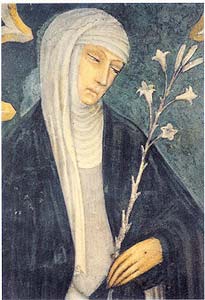 This is the fourth in our "Musings of a Meandering Pilgrim" series, in which spiritual director and poet Rebecca Cole-Turner shares reflections from pilgrimage to Italy.
(Translation into Italian: Pensieri di una pellegrina errante)
When I was a little girl, the most exotic name for a crayon in my big 64-Crayola box was "Burnt Sienna." For many years, I would pick up that color and wonder, Where in the world did this name come from and what does it mean? As anyone who's ever colored knows, Burnt Sienna is quite a lovely color. It works well to make bricks, patios, and houses. It's also a nice color for sunsets. In the past twenty years, this color has been very popular in home decoration: we once had our master bedroom painted Burnt Sienna.
In fifth-grade geography, I remember finding Siena on the map of Italy. So there really was a "Sienna," or at least a Siena. I wondered if all of the buildings in Siena were painted Burnt Sienna and if that is where Crayola got the name.
According to the Crayola.com website, the "personality traits" of Burnt Sienna are "earthy, dependable, comfortable, nature, simplicity, comfort, quality, harmony, hearth, home, security, sense of belonging, family life, down to earth." Under music associated with the color, the website lists "Brown-Eyed Girl" by Van Morrison, one of my all-time favorite songs. But nowhere does it say that "Burnt Sienna" and Siena, Italy, are connected.
So it was Wikipediato the rescue. "The name (‘Sienna') derives from the most notable Renaissance location for the earth, Siena, Italy, and is short for terra di Siena, ‘earth of Siena.'"
I decided I needed to check all this out for myself, so we took the bus from Florence through the hills to Siena, literally in search of the local color and of the local saint, Catherine. As we got off the bus, I looked out over the city and saw many shades of sienna. In fact, as the late afternoon sun reflected off its medieval walls, the city was awash in "Burnt Sienna"!
 Saint Catherine's home is on a cobblestoned side street, halfway down a steep incline. Walking out onto a cool balcony, I saw the city below. A more-than-life-size statue of the saint stands quietly in the loggia, arms outstretched as if she is blessing the city. There is the requisite gift shop and a large room filled with paintings about Catherine's eventful life. Actually, her "home" is now a series of small chapels.
 But it is the church at Casa di Santa Caterina that called to me. As we entered its peaceful coolness, I thought we were the only two people there. Then I heard two soft, muffled feminine voices coming from a door that was lightly ajar. I turned around and from where I sat, I could see that two women, one of them a nun, were engaged in spiritual direction. I thought, How appropriate in the "home" of a woman who counseled a pope, nobility, and everyday people almost 700 years ago.
Turning back to the altar, I spent some time studying the triptych there: Christ is on the cross in the center, with Catherine on the left. Then I looked up above it and saw a painting of the Holy Spirit as a dove. For a long time, I kept looking at the rendering of the Spirit, pondering its meaning in Catherine's life.
 Catherine was one of 25 children. Her twin sister died and then her mother, Lapa, gave birth to one final daughter. Catherine was a severe ascetic who was accepted into the Dominicans as a Tertiary and continued living in her parents' home. Canonized by Pope Pius II in 1461, St. Catherine's feast day is celebrated April 29. She was named, along with St. Francis, as a Patron Saint of Italy by the pope in 1940. Then in 1970, she and St. Theresa of Avila became the first women to be named Doctors of the Church. Finally, in 1999, John Paul II named her as one of the Patron Saints of Europe.
Article Continued On Next Page
Page: 1 of 2
4/21/2010 4:00:00 AM
History
Christianity
Roman Catholicism
more at patheos
1
St. Irenaeus: Defender of Christian Orthodoxy
2

A Pope, A President and A One-Sided Fight
3

The Father's Day Shirt That Explains Every Denomination
4

Twelve Steps to Becoming a Successful Published Author
About
Patheos Explore the world's faith through different perspectives on religion and spirituality! Patheos has the views of the prevalent religions and spiritualities of the world.
Ad-Free & Subscriber Log-In Subscription Support
- About Us
- 2026 Calendar
- Videos
- Podcasts
- Library of World Religions
- Faith In Media Tracker
- Advertise With Us
- Write for Us
- Privacy Policy
- Terms of Service
- Do Not Sell My Data
- Contact Us
- Radiant Digital
- Manage Newsletter Subscriptions
- Unsubscribe From Notifications
- Sitemap
Copyright 2008-2026, Patheos, part of the Radiant Digital network of media brands. All rights reserved.
Subscription Support Ad-Free & Subscriber Log-In
Follow Patheos