
BuddhistCatholicContemplativeEvangelicalGeneral ChristianHinduJewishLatter-day SaintMuslimNew VisionsProgressive Christian
Beliefs
- Buddhist
- Catholic
- Contemplative
- Evangelical
- General Christian
- Hindu
- Jewish
- Latter-day Saint
- More Voices
- Muslim
- New Visions
- Pagan
- Progressive Christian
Topics
- Religion News
- Food and Religion
- Sports and Religion
- Religious Art
- Religious Music and Entertainment
- Religious Events
- History and Religion
- Style and Religion
- Politics and Religion
- Women in Religion
- Recreation Outdoors and Religion
- Business Finance and Religion
- Careers Workplace and Religion
- Education and Religion
- Family Parenting and Religion
- Health Fitness and Religion
- Home and Religion
- Relationships and Religion
- Technology and Religion
- Travel and Religion
Columnists
- Buddhist Columnists
- Business Finance and Religion Columnists
- Careers Workplace and Religion Columnists
- Catholic Columnists
- Contemplative Columnists
- Education and Religion Columnists
- Evangelists Columnists
- Family Parenting and Religion Columnists
- General Christian Columnists
- Health Fitness and Religion Columnists
- Hindu Columnists
- History and Religion Columnists
- Home and Religion Columnists
- Jewish Columnists
- More Voices Columnists
- Latter Day Columnists
- Muslim Columnists
- New Visions Columnists
- Nonreligious Columnists
- Pagan Columnists
- Politics and Religion Columnists
- Progressive Columnists
- Recreation Outdoors and Religion Columnists
- Relationships and Religion Columnists
- Religion News Columnists
- Religious Art Columnists
- Religious Events Columnists
- Religious Music and Entertainment Columnists
- Sports and Religion Columnists
- Style and Religion Columnists
- Technology and Religion Columnists
- Travel and Religion Columnists
- Women in Religion Columnists
Resource Library
- 2026 Calendar
- Library of World Religions
- The 100 Most Holy Places on Earth
- Patheos Answers
- Podcasts
- Videos
- Faith Leaders Database
- Anglican Episcopalian
- Bahai
- Baptist
- Buddhism
- Christianity
- Confucianism
- Eastern Orthodoxy
- Hinduism
- Holiness and Pentecostal
- ISKCON
- Islam
- Judaism
- Lutheran
- Methodist
- The Church of Jesus Christ of Latter-day Saints
- New Age
- Paganism
- Presbytarian and Reformed
- Protestantism
- Religion Behind the Scenes
- Roman Catholic
- Scientology
- Shia Islam
- Sikhism
- Sufism
- Sunni Islam
- Taoism
- Zen
- See all religions
Research Tools
 Ad-Free & Subscriber Log-In Subscription Support
Ad-Free & Subscriber Log-In Subscription Support
Follow Patheos 

- Trending:
- Forgiveness
- |
- Marriage
- |
- Consciousness
- |
- Death Penalty
- |
- Election
- |
- Halloween
Catholic
Artificially Conceiving a Bad Romantic Comedy
September 30, 2010
By Mary Rose Somarriba
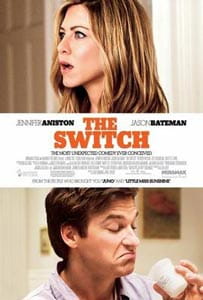 Jennifer Aniston’s big new movie made headlines last month -- for flopping. The Switch, a romantic comedy about a forty-year-old single woman who wants a baby and chooses to be artificially inseminated, brought in embarrassingly low-ticket sales of only $8.4 million on opening weekend. Hollywood reporters have tried to think of all number of reasons for why it flopped so badly, ranging from the myth of lazy August filmgoers to the theory that Aniston is a blockbuster buzzkill.
But the answer may be the story itself. Just four months ago, Jennifer Lopez’s film on the same subject, The Back-up Plan, which came out this week on DVD, opened to a low $12.2 million. As reporters Gregg Kilday and Kim Masters put it, “Artificial insemination, it turns out, is the new box-office poison.”
And they’re right: These movies are failing because the American public doesn’t like to laugh about artificial insemination. It doesn’t strike Americans as either romantic or comedy. Because it isn’t.
There’s something sad about forty-one-year-old Aniston playing the older woman who has no marriage prospects and wants a family. There’s something sad about hearing her say onscreen: “Why wait? I am getting older and my biological clock is ticking. . . . I am in the market for some semen.” There’s something sad about hearing Jennifer Lopez say, “Maybe this isn’t how I pictured it. . . . I thought I’d be married with kids by now, but that’s just not happening, so, guess it’s time for my back-up plan!”
What’s sad is that some real, deep aspects of the human experience -- such as the realization of one’s aging, the desire for love and family, and the sorrow of lost time -- are covered up with chipper confidence that none of these things matter anymore. Age doesn’t matter. Time is never lost.
Love and commitment aren’t necessary; in fact, they’re not even worth seeking. You can start a family all on your own. It’s a Do-It-Yourself Family! The biological bond required to conceive a child -- a male’s sperm and a female’s egg -- is all you need; you don’t need the metaphysical and the personal bond with another to make a family.
Surely they value love and commitment; they want love and commitment to be an essential part of their relationship with their children, don’t they? Nobody doubts it. But how does one expect these to translate into relationships with their kids if the parent doesn’t value love and commitment in their own lives to start with? It’s one of those questions that isn’t asked and is laughed off.
And they don’t quite pull it off. There’s something gross about hearing the doctor cheerfully tell Lopez, “I have a feeling that you and [sperm donor number] ‘CRM1014’ are going to have beautiful babies together.” There’s something jarringly real when we hear Lopez’s costar Alex O'Loughlin exclaim in horror: “You’re pregnant with some stranger’s child?”
In The Switch, it’s not some stranger’s child, it’s her friend Wally’s child, only she didn’t know he performed “the switch,” exchanging the sperm donor’s semen with his own. As Wally (played by Jason Bateman) later put it, “I hijacked her pregnancy.” “Ohh,” replies his friend Leonard (Jeff Goldblum), in a perfectly delivered line, “that was ill-advised.”
The truth is artificial reproductive technology is ill-advised, and not just because it separates love from family. Biologically, it’s a very bad idea.
Many women who undergo in vitro fertilization suffer the physical effects of unnatural hormonal manipulation before conceiving, and some suffer these effects and never conceive. Many women experience years of unsuccessful attempts, ectopic pregnancies, miscarriages, and premature birth, which can result in early death of the child. Many women, when they finally conceive, conceive multiple babies at once, sometimes more than they could healthily bring to term, and have the traumatic experience of having to decide which one of their long-wished-for children they will terminate.
Add all this suffering to the immeasurable emotional pain many women experience for being infertile in the first place. It’s a very hard road.
Further, the health risks to women who donate their eggs are many and are largely undocumented, as the recent documentary Eggsploitation, produced by the Center for Bioethics and Culture, reports. And we haven’t even gotten to the health risks to the child, provided he or she makes it out alive.
Article Continued On Next Page
Page: 1 of 2
9/30/2010 4:00:00 AM
Catholic
Media
Movies
Parenting
science
Roman Catholicism
more at patheos
1

Personal Evangelization: Your Faith Story Matters
2

Belmont Abbey College the American Semester
3
'The Coddling of the American Mind': Teaching Fragility
4

Called to Be a Pastor? Consider Bivocational Ministry
About
Patheos Explore the world's faith through different perspectives on religion and spirituality! Patheos has the views of the prevalent religions and spiritualities of the world.
Ad-Free & Subscriber Log-In Subscription Support
- About Us
- 2026 Calendar
- Videos
- Podcasts
- Library of World Religions
- Faith In Media Tracker
- Advertise With Us
- Write for Us
- Privacy Policy
- Terms of Service
- Do Not Sell My Data
- Contact Us
- Radiant Digital
- Manage Newsletter Subscriptions
- Unsubscribe From Notifications
- Sitemap
Copyright 2008-2026, Patheos. All rights reserved.
Subscription Support Ad-Free & Subscriber Log-In
Follow Patheos