
BuddhistCatholicContemplativeEvangelicalGeneral ChristianHinduJewishLatter-day SaintMuslimNew VisionsProgressive Christian
Beliefs
- Buddhist
- Catholic
- Contemplative
- Evangelical
- General Christian
- Hindu
- Jewish
- Latter-day Saint
- More Voices
- Muslim
- New Visions
- Pagan
- Progressive Christian
Topics
- Religion News
- Food and Religion
- Sports and Religion
- Religious Art
- Religious Music and Entertainment
- Religious Events
- History and Religion
- Style and Religion
- Politics and Religion
- Women in Religion
- Recreation Outdoors and Religion
- Business Finance and Religion
- Careers Workplace and Religion
- Education and Religion
- Family Parenting and Religion
- Health Fitness and Religion
- Home and Religion
- Relationships and Religion
- Technology and Religion
- Travel and Religion
Columnists
- Buddhist Columnists
- Business Finance and Religion Columnists
- Careers Workplace and Religion Columnists
- Catholic Columnists
- Contemplative Columnists
- Education and Religion Columnists
- Evangelists Columnists
- Family Parenting and Religion Columnists
- General Christian Columnists
- Health Fitness and Religion Columnists
- Hindu Columnists
- History and Religion Columnists
- Home and Religion Columnists
- Jewish Columnists
- More Voices Columnists
- Latter Day Columnists
- Muslim Columnists
- New Visions Columnists
- Nonreligious Columnists
- Pagan Columnists
- Politics and Religion Columnists
- Progressive Columnists
- Recreation Outdoors and Religion Columnists
- Relationships and Religion Columnists
- Religion News Columnists
- Religious Art Columnists
- Religious Events Columnists
- Religious Music and Entertainment Columnists
- Sports and Religion Columnists
- Style and Religion Columnists
- Technology and Religion Columnists
- Travel and Religion Columnists
- Women in Religion Columnists
Resource Library
- 2026 Calendar
- Library of World Religions
- The 100 Most Holy Places on Earth
- Patheos Answers
- Podcasts
- Videos
- Faith Leaders Database
- Anglican Episcopalian
- Bahai
- Baptist
- Buddhism
- Christianity
- Confucianism
- Eastern Orthodoxy
- Hinduism
- Holiness and Pentecostal
- ISKCON
- Islam
- Judaism
- Lutheran
- Methodist
- The Church of Jesus Christ of Latter-day Saints
- New Age
- Paganism
- Presbytarian and Reformed
- Protestantism
- Religion Behind the Scenes
- Roman Catholic
- Scientology
- Shia Islam
- Sikhism
- Sufism
- Sunni Islam
- Taoism
- Zen
- See all religions
Research Tools
 Ad-Free & Subscriber Log-In Subscription Support
Ad-Free & Subscriber Log-In Subscription Support
Follow Patheos 

- Trending:
- Forgiveness
- |
- Marriage
- |
- Consciousness
- |
- Death Penalty
- |
- Election
- |
- Halloween
After Shock: Reading Group Guide
January 04, 2011
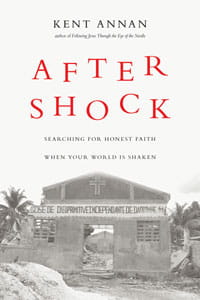 Are there questions or realities your faith can't handle? Consider these discussion questions for groups and individuals from the new book After Shock: Searching for Honest Faith When Your World Is Shaken. For more resources on the book, including an online discussion on faith and doubt, visit the Patheos Book Club.
***
Kent Annan's book very personally explores some of life's big questions—faith, doubt and suffering. For Annan, the reason for taking on these subjects is the devastating earthquake in Haiti, where he has been working for eight years. But the same questions about suffering and uncertainty are relevant to each of our lives wherever we live—whether in relation to a cancer diagnosis, a child's accident, the suffering of a loved one, the poverty so many people face around the world or a million other occasions. Many of us face crises of faith at different times. Can we make it through these "after shocks" without denying either reality (in both its beauty and cruelty) or God? This is an honest, engaging—and ultimately hopeful—look at a difficult subject. We hope you'll find After Shock meaningful in your own search for honest faith.
1. Do you find it hard or easy to discuss the big questions about God? Explain.
2. What kinds of events—whether they happened to you or to someone you know, or on a large scale like 9/11 or an earthquake—have caused you to feel something like "spiritual aftershocks"? Explain.
3. Which kind of suffering do you find it hardest to understand—what is caused by nature ("acts of God") or by humans (people's cruelty to each other)? Why?
4. Kent lists (in "An Annotated Wish List," right before the chapter "Accept Uncertainty") some changes he would propose for God. What do you think of writing something like that down? What would be on your own list of how you'd like to see God work differently in the world? And why do you think God didn't do differently the things on Kent's list and your own?
5. What are the clichés about God that you find yourself or people around you using? (Kent discusses a few in the chapter "Spiritual Aftershocks.") What element of truth do they have? Why are they inadequate? What would be better to say instead?
6. Kent writes that he considers this more a psalm than a theological book about suffering, faith and doubt. What is the difference between a psalm or poem and something that tries to explain the answers? does it make a difference in how you read if the author isn't claiming to "answer" the problem but is trying instead to wrestle honestly with the questions?
7. How can a personal crisis of faith or questions about suffering lead us toward working for more justice?
8. Kent is a Christian—but he expresses that some days he also feels like an atheist or an agnostic, or in conflict with or indifferent toward God. What do you think of talking about faith like this? Can you identify with having faith (or lack of it) that varies in a similar way?
9. Kent mentions a few of the most meaningful psalms to him. discuss which psalms—or poems, songs or books—are most meaningful to you on the topics of faith/doubt/God and why.
10. Do you experience God as near? Do you experience God as distant? How?
11. Have you ever left your faith—and if so, did you come back to it? Why or why not? If you did return to your faith, what helped bring you back, and how was your faith different?
12. Is Jesus part of suffering for you? Kent prays to Jesus on the cross and Jesus gone from the cross (in the chapter "Jesus [Crucifix Versus Cross]"). Do you find Jesus most connected to our lives when you consider him (a) with us in our suffering or (b) as the one who rescues us from our suffering?
13. Kent writes that his search is for "honest faith." Do you ever encounter in yourself or in others something that seems like less-than-honest faith? How would you define "honest faith"?
***
Taken from After Shock: Searching for Honest Faith When Your World Is Shaken by Kent Annan. Copyright(c) 2011 by Kent Annan. Used by permission of InterVarsity Press PO Box 1400 Downers Grove, IL 60515. www.ivpress.com.
1/4/2011 5:00:00 AM
Book Club
more at patheos
1

2

Does the Talmud Support Pedophilia? Debunking the Viral Lie
3

Has The Current Generation Been Borne On Three Great Lies?
4
Why are the Scriptures Holy? Dr. Thomas Robinson Responds
About
Patheos Explore the world's faith through different perspectives on religion and spirituality! Patheos has the views of the prevalent religions and spiritualities of the world.
Ad-Free & Subscriber Log-In Subscription Support
- About Us
- 2026 Calendar
- Videos
- Podcasts
- Library of World Religions
- Faith In Media Tracker
- Advertise With Us
- Write for Us
- Privacy Policy
- Terms of Service
- Do Not Sell My Data
- Contact Us
- Radiant Digital
- Manage Newsletter Subscriptions
- Unsubscribe From Notifications
- Sitemap
Copyright 2008-2026, Patheos. All rights reserved.
Subscription Support Ad-Free & Subscriber Log-In
Follow Patheos