
BuddhistCatholicContemplativeEvangelicalGeneral ChristianHinduJewishLatter-day SaintMuslimNew VisionsProgressive Christian
Beliefs
- Buddhist
- Catholic
- Contemplative
- Evangelical
- General Christian
- Hindu
- Jewish
- Latter-day Saint
- More Voices
- Muslim
- New Visions
- Pagan
- Progressive Christian
Topics
- Religion News
- Food and Religion
- Sports and Religion
- Religious Art
- Religious Music and Entertainment
- Religious Events
- History and Religion
- Style and Religion
- Politics and Religion
- Women in Religion
- Recreation Outdoors and Religion
- Business Finance and Religion
- Careers Workplace and Religion
- Education and Religion
- Family Parenting and Religion
- Health Fitness and Religion
- Home and Religion
- Relationships and Religion
- Technology and Religion
- Travel and Religion
Columnists
- Buddhist Columnists
- Business Finance and Religion Columnists
- Careers Workplace and Religion Columnists
- Catholic Columnists
- Contemplative Columnists
- Education and Religion Columnists
- Evangelists Columnists
- Family Parenting and Religion Columnists
- General Christian Columnists
- Health Fitness and Religion Columnists
- Hindu Columnists
- History and Religion Columnists
- Home and Religion Columnists
- Jewish Columnists
- More Voices Columnists
- Latter Day Columnists
- Muslim Columnists
- New Visions Columnists
- Nonreligious Columnists
- Pagan Columnists
- Politics and Religion Columnists
- Progressive Columnists
- Recreation Outdoors and Religion Columnists
- Relationships and Religion Columnists
- Religion News Columnists
- Religious Art Columnists
- Religious Events Columnists
- Religious Music and Entertainment Columnists
- Sports and Religion Columnists
- Style and Religion Columnists
- Technology and Religion Columnists
- Travel and Religion Columnists
- Women in Religion Columnists
Resource Library
- 2026 Calendar
- Library of World Religions
- The 100 Most Holy Places on Earth
- Patheos Answers
- Podcasts
- Videos
- Faith Leaders Database
- Anglican Episcopalian
- Bahai
- Baptist
- Buddhism
- Christianity
- Confucianism
- Eastern Orthodoxy
- Hinduism
- Holiness and Pentecostal
- ISKCON
- Islam
- Judaism
- Lutheran
- Methodist
- The Church of Jesus Christ of Latter-day Saints
- New Age
- Paganism
- Presbytarian and Reformed
- Protestantism
- Religion Behind the Scenes
- Roman Catholic
- Scientology
- Shia Islam
- Sikhism
- Sufism
- Sunni Islam
- Taoism
- Zen
- See all religions
Research Tools
 Ad-Free & Subscriber Log-In Subscription Support
Ad-Free & Subscriber Log-In Subscription Support
Follow Patheos 

- Trending:
- Forgiveness
- |
- Marriage
- |
- Consciousness
- |
- Death Penalty
- |
- Election
- |
- Halloween
RELIGION LIBRARY
Hinduism
Toggle navigation
Beliefs
Ultimate Reality and Divine Beings
One of the most commonly retold Hindu myths is that which describes the creation of the world involving the so-called "Hindu Trinity"—Brahma, Vishnu, and Shiva. There are many variations of this basic myth. Here is one of the most popular:
In the beginning the entire universe was pervaded by Brahman, the abstract divine force. There was no earth, no heaven, nothing. At a particular time—when the time was "right"—a vast ocean washed over the cosmos, and a huge serpent emerged from the waters. Vishnu appeared, sleeping on the serpent. As Vishnu slept, floating on the waters, the sound "om" began to vibrate throughout the universe. Vishnu awoke, and out of his navel grew a lotus. When the lotus opened, Brahma was sitting there. Vishnu said to him that it was time to create the world.
Brahma then set about creating the world. He broke the lotus into three pieces, and with the first made the heavens, with the second the skies, and with the third the earth. He then populated the earth with all living beings.
Shiva often does not appear in this myth, although in some versions he appears later when the world has been engulfed in chaos. He begins to dance, and in the process creates tremendous religious heat that engulfs the world in flames, destroying it but at the same time purifying it (much like what the sacrificial fire does). The cosmos is then once again void, until the waters reappear, and the whole cycle begins again. Just as human beings are born and reborn over and over again, so too is the cosmos. This is samsara.
Accordingly, Brahma is often understood to be the creator, Vishnu the preserver, and Shiva the destroyer. This, however, is only part of the story. The Hindu idea of the gods is complex. Though in one sense there is only one god, Brahman, this god is not really a single, manifest entity but the divine principle that animates the entire cosmos. Each of the individual gods, in this sense, is thus a manifestation of Brahman.
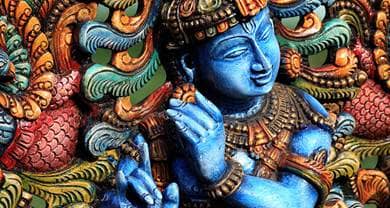
Vishnu, for instance, takes many, many forms. Sometimes he is just Vishnu, often depicted as a royal god who resides in the heavens with his consort, Lakshmi, and maintains the order, or dharma of the cosmos. But Vishnu also manifests himself in the human realm when dharma has broken down; he sends himself down to earth in the form of an avatara. Krishna is an avatara of Vishnu, as is Rama. But these forms of the gods are not understood to be "lesser" versions of Vishnu. They are each fully and completely Vishnu, as are all of the other manifestations of Vishnu or, for that matter, Shiva or Brahma (although he typically does not have multiple forms). This is related to the concept of Brahman. Brahman is the overarching, all-encompassing divine principle that contains all beings—all of the gods, all humans, all demons, and even all animals. Thus each individual god is at once a particular god with particular characteristics and "personality" traits, and at the same time a complete manifestation of Brahman.
Thus Hinduism is polytheistic in the sense that there are many, many different gods—classically there are said to be 330 million! Hindus often worship a particular form of the god or goddess, what is called an "ishtadevata" in Sanskrit, a chosen or personal god. Some of these forms are pan-Indian, such as Krishna or Shiva or Ganesh, while others are local, often only known at the village level.
There are thousands of goddesses in the Hindu pantheon: Lakshmi, Parvati, Saraswati, Kali, Durga, and so on. These goddesses can be quite distinct. Lakshmi, the embodiment of grace and good fortune, is a "cool" goddess, Vishnu's consort, who is motherly and utterly benign. Kali, in contrast, is often a ghastly figure with flaming eyes and a lolling tongue and earrings made of severed heads. Despite their very different personas, however, they are often understood to be different manifestations of Devi, the great goddess who is one.
Humans are often only able to see the outward form of the gods and goddesses, because our vision is limited and because we are enmeshed in the illusion that the world we see is the "real" world. This is the effect of maya, illusion.
It is maya that makes us think, for instance, that we are individual selves, or atmans. Certainly on one level we exist–we have bodies, we have feelings, thoughts, personalities. But ultimately all of these things are only just illusions. Ultimately, we are all part of Brahman (according to Advaita and Vishishtadvaita and other monist schools, but not Dvaita Vedanta and other dualist schools). Indeed, there is nothing that is "us" that is not Brahman. However, we are ignorant and deluded (by maya), and thus we think we think we are individuals.
The individual forms of the gods and goddesses are often understood to be simply the forms that we perceive, while the reality behind or beyond these forms is Brahman. Kali appears to be hideous and fierce, because our human vision is conditioned by maya; in reality, she is a benign, protecting, nurturing mother. And, on an even more ultimate level, she can be understood to be no different than Brahman. Again, when one worships an individual god or goddess, one is both worshipping that particular deity and, at the same time, interacting with the ultimate reality that is Brahman.
Study Questions:
1. Describe the most popular Hindu creation story.
2. How many Hindu gods exist?
3. What is the role of maya in interpreting the self?
Back to Religion Library
Editor's picks See all columnists

Evangelical
Before You Unplug or Sign Out for Good

Evangelical
What Is the Purpose of Spiritual Gifts, and How Do You Discover Yours?

New Visions
5 Ways to Hear What God is Telling You

Muslim
How Awake Are We? When Waking Up is Falling Asleep

Latter-day Saint
"The Church supports the use of vaccinations"

Evangelical
Luther and the Beauty of Christ

The Soul of Gospel Music Explored in New Netflix Series "Voices of Fire"

Seven Ways to Think About Christian Mysticism

Evangelical

Evangelical

Muslim
Imam Ali’s letter to the Governor- Everlasting Example of Good...

Progressive Christian
Patheos Explore the world's faith through different perspectives on religion and spirituality! Patheos has the views of the prevalent religions and spiritualities of the world.
Ad-Free & Subscriber Log-In Subscription Support
- About Us
- 2026 Calendar
- Videos
- Podcasts
- Library of World Religions
- Faith In Media Tracker
- Advertise With Us
- Write for Us
- Privacy Policy
- Terms of Service
- Do Not Sell My Data
- Contact Us
- Radiant Digital
- Manage Newsletter Subscriptions
- Unsubscribe From Notifications
- Sitemap
Copyright 2008-2026, Patheos. All rights reserved.
Subscription Support Ad-Free & Subscriber Log-In
Follow Patheos