
BuddhistCatholicContemplativeEvangelicalGeneral ChristianHinduJewishLatter-day SaintMuslimNew VisionsProgressive Christian
Beliefs
- Buddhist
- Catholic
- Contemplative
- Evangelical
- General Christian
- Hindu
- Jewish
- Latter-day Saint
- More Voices
- Muslim
- New Visions
- Pagan
- Progressive Christian
Topics
- Religion News
- Food and Religion
- Sports and Religion
- Religious Art
- Religious Music and Entertainment
- Religious Events
- History and Religion
- Style and Religion
- Politics and Religion
- Women in Religion
- Recreation Outdoors and Religion
- Business Finance and Religion
- Careers Workplace and Religion
- Education and Religion
- Family Parenting and Religion
- Health Fitness and Religion
- Home and Religion
- Relationships and Religion
- Technology and Religion
- Travel and Religion
Columnists
- Buddhist Columnists
- Business Finance and Religion Columnists
- Careers Workplace and Religion Columnists
- Catholic Columnists
- Contemplative Columnists
- Education and Religion Columnists
- Evangelists Columnists
- Family Parenting and Religion Columnists
- General Christian Columnists
- Health Fitness and Religion Columnists
- Hindu Columnists
- History and Religion Columnists
- Home and Religion Columnists
- Jewish Columnists
- More Voices Columnists
- Latter Day Columnists
- Muslim Columnists
- New Visions Columnists
- Nonreligious Columnists
- Pagan Columnists
- Politics and Religion Columnists
- Progressive Columnists
- Recreation Outdoors and Religion Columnists
- Relationships and Religion Columnists
- Religion News Columnists
- Religious Art Columnists
- Religious Events Columnists
- Religious Music and Entertainment Columnists
- Sports and Religion Columnists
- Style and Religion Columnists
- Technology and Religion Columnists
- Travel and Religion Columnists
- Women in Religion Columnists
Resource Library
- 2026 Calendar
- Library of World Religions
- The 100 Most Holy Places on Earth
- Patheos Answers
- Podcasts
- Videos
- Faith Leaders Database
- Anglican Episcopalian
- Bahai
- Baptist
- Buddhism
- Christianity
- Confucianism
- Eastern Orthodoxy
- Hinduism
- Holiness and Pentecostal
- ISKCON
- Islam
- Judaism
- Lutheran
- Methodist
- The Church of Jesus Christ of Latter-day Saints
- New Age
- Paganism
- Presbytarian and Reformed
- Protestantism
- Religion Behind the Scenes
- Roman Catholic
- Scientology
- Shia Islam
- Sikhism
- Sufism
- Sunni Islam
- Taoism
- Zen
- See all religions
Research Tools
 Ad-Free & Subscriber Log-In Subscription Support
Ad-Free & Subscriber Log-In Subscription Support
Follow Patheos 

- Trending:
- Forgiveness
- |
- Marriage
- |
- Consciousness
- |
- Death Penalty
- |
- Election
- |
- Halloween
RELIGION LIBRARY
Hinduism
Toggle navigation
Beliefs
Afterlife and Salvation
In the earliest strata of Hinduism, the Vedas, there is very little discussion of the afterlife, and really only a vague notion of salvation. Some texts, such as the Rig Veda, suggest that different people go to different places after they die, but there is little detail regarding the matter. This was simply not the focus of the religion. Rather, the concern was the proper performance of rituals that would keep the gods satisfied, and thus keep the cosmos in order.
List of "principal" Upanishads
(there are over 100 others)
- Aitareya
- Brhadaranyaka
- Taittiriya
- Chandogya
- Kena
- Isa
- Svetasvatara
- Katha
- Mundaka
- Mandukya
- Prasna
Some in the Vedic world eventually rejected this sacrificial emphasis and set out to find a new path, a path that would lead to eternal salvation. This path is among the focus of the Upanishads. In these texts, there is much discussion of what happens after death. In a famous passage from the Katha Upanishad, a sage named Nachiketas wins a boon from the god of death, Yama, and asks the god what happens to humans after they die. Yama at first refuses to answer, and then, after Nachiketas persists, tells the sage that if he wishes to know the answer to this question, he must study the nature of the self, and in the process he will be able to leave both joy and sorrow behind.
This is a typically cryptic message from the Upanishads, but it points to a basic understanding of salvation articulated there: human beings continue to be reborn because they continue to generate karma, and they continue to generate karma because they are ignorant. They are ignorant of the true nature of the self. According to the Upanishads, the individual self, or atman, is no different than the ultimate reality of Brahman. However, human beings are deluded, and think they are different. They think "I am," and thus they grasp on to the things of the material world. "I want . . . that is mine," and so on. But there is nothing that is not encompassed by the ultimate, by Brahman. According to the Upanishads, if one knows the true nature of the self—that it does not, in any ultimate sense, exist—then one will stop grasping. If one stops grasping, then one stops generating karma. And when there is no karma, there is no rebirth. One is released.
This release, called moksha, is ultimate salvation. The individual is absorbed in the ultimate, Brahman, in the same manner that a stream or a river (a metaphor for the individual atman) is absorbed into the ocean (Brahman). When one attains this state, rebirth stops. One is released, forever. The individual is one with Brahman.
This path, the jnana marga or path of knowledge, is not the only means to attain ultimate salvation. Indeed, Hinduism very much holds that there are many paths to reach the same destination.
PATHS (MARGAS) Karma marga Path of action
(especially ritual action) Vedas Jnana marga Path of knowledge
(meditation and analysis) Upanishads Bhakti marga Path of devotion
(especially towards Krishna) Bhagavadgita
The Bhagavad Gita introduces the path of devotion, or bhakti marga. One can attain salvation, in the context of this path, through selfless loving devotion to a chosen god. In the Bhagavad Gita this god is Krishna, although because all of the gods in Hinduism are ultimately encompassed by the overarching divine powerhouse Brahman, bhakti directed at any god can lead to salvation.
Bhakti is often discussed in distinctly human terms, using human love as the model. A parent's love for a child, for instance, is the model for the devotee's love of the god; a parent's love is utterly selfless, absolute. Likewise, the love of a devotee for a god is also described in amorous terms.
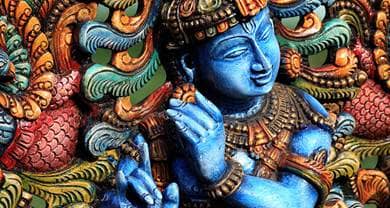
Some of the best-known and most beloved stories in Hinduism involve the love "affair" between Krishna and Radha (a particularly beautiful example is the Gita Govinda, by the poet Jayadeva). Krishna in these stories is a lovely young man who plays a bewitching flute. Radha is a beautiful young woman. She is, however, a human being. She abandons her worldly duty to be with Krishna. The point of these stories is that although worldly duties are importance for the maintenance of society, love of the divine (here specifically Krishna) transcends the worldly dharma. Through such absolute love, one attains salvation through the grace of the god.
Study Questions:
1. What are a few of the varying Hindu beliefs about afterlife?
2. What is moksha?
3. How does one attain salvation?
Back to Religion Library
Editor's picks See all columnists

Evangelical
Before You Unplug or Sign Out for Good

Evangelical
What Is the Purpose of Spiritual Gifts, and How Do You Discover Yours?

New Visions
5 Ways to Hear What God is Telling You

Muslim
How Awake Are We? When Waking Up is Falling Asleep

Latter-day Saint
"The Church supports the use of vaccinations"

Evangelical
Luther and the Beauty of Christ

The Soul of Gospel Music Explored in New Netflix Series "Voices of Fire"

Seven Ways to Think About Christian Mysticism

Evangelical

Evangelical

Muslim
Imam Ali’s letter to the Governor- Everlasting Example of Good...

Progressive Christian
Patheos Explore the world's faith through different perspectives on religion and spirituality! Patheos has the views of the prevalent religions and spiritualities of the world.
Ad-Free & Subscriber Log-In Subscription Support
- About Us
- 2026 Calendar
- Videos
- Podcasts
- Library of World Religions
- Faith In Media Tracker
- Advertise With Us
- Write for Us
- Privacy Policy
- Terms of Service
- Do Not Sell My Data
- Contact Us
- Radiant Digital
- Manage Newsletter Subscriptions
- Unsubscribe From Notifications
- Sitemap
Copyright 2008-2026, Patheos. All rights reserved.
Subscription Support Ad-Free & Subscriber Log-In
Follow Patheos