
BuddhistCatholicContemplativeEvangelicalGeneral ChristianHinduJewishLatter-day SaintMuslimNew VisionsProgressive Christian
Beliefs
- Buddhist
- Catholic
- Contemplative
- Evangelical
- General Christian
- Hindu
- Jewish
- Latter-day Saint
- More Voices
- Muslim
- New Visions
- Pagan
- Progressive Christian
Topics
- Religion News
- Food and Religion
- Sports and Religion
- Religious Art
- Religious Music and Entertainment
- Religious Events
- History and Religion
- Style and Religion
- Politics and Religion
- Women in Religion
- Recreation Outdoors and Religion
- Business Finance and Religion
- Careers Workplace and Religion
- Education and Religion
- Family Parenting and Religion
- Health Fitness and Religion
- Home and Religion
- Relationships and Religion
- Technology and Religion
- Travel and Religion
Columnists
- Buddhist Columnists
- Business Finance and Religion Columnists
- Careers Workplace and Religion Columnists
- Catholic Columnists
- Contemplative Columnists
- Education and Religion Columnists
- Evangelists Columnists
- Family Parenting and Religion Columnists
- General Christian Columnists
- Health Fitness and Religion Columnists
- Hindu Columnists
- History and Religion Columnists
- Home and Religion Columnists
- Jewish Columnists
- More Voices Columnists
- Latter Day Columnists
- Muslim Columnists
- New Visions Columnists
- Nonreligious Columnists
- Pagan Columnists
- Politics and Religion Columnists
- Progressive Columnists
- Recreation Outdoors and Religion Columnists
- Relationships and Religion Columnists
- Religion News Columnists
- Religious Art Columnists
- Religious Events Columnists
- Religious Music and Entertainment Columnists
- Sports and Religion Columnists
- Style and Religion Columnists
- Technology and Religion Columnists
- Travel and Religion Columnists
- Women in Religion Columnists
Resource Library
- 2026 Calendar
- Library of World Religions
- The 100 Most Holy Places on Earth
- Patheos Answers
- Podcasts
- Videos
- Faith Leaders Database
- Anglican Episcopalian
- Bahai
- Baptist
- Buddhism
- Christianity
- Confucianism
- Eastern Orthodoxy
- Hinduism
- Holiness and Pentecostal
- ISKCON
- Islam
- Judaism
- Lutheran
- Methodist
- The Church of Jesus Christ of Latter-day Saints
- New Age
- Paganism
- Presbytarian and Reformed
- Protestantism
- Religion Behind the Scenes
- Roman Catholic
- Scientology
- Shia Islam
- Sikhism
- Sufism
- Sunni Islam
- Taoism
- Zen
- See all religions
Research Tools
 Ad-Free & Subscriber Log-In Subscription Support
Ad-Free & Subscriber Log-In Subscription Support
Follow Patheos 

- Trending:
- Forgiveness
- |
- Marriage
- |
- Consciousness
- |
- Death Penalty
- |
- Election
- |
- Halloween
Catholic
Metaphysical Annealing: Empirical Science, Suffering, and God
April 07, 2013 by Scott Hebert
If my title seems nonsensical, a definition is in order. I am an engineer, trained in empirical science, which means, among other things, that I know how to conduct experiments in an efficient manner; in my case, that means building empirical experiments in optimization.
Please don't run away. All of that—like the title—sounds harder than it is to understand. Metaphysics is, well, metaphysics. Annealing is a metallurgical process where the microstructure of the metal is erased by high temperatures, so it can be remolded into another form. This is when a blacksmith heats up metal to a high heat (popularly, to a "red heat").
Beating is optional, as a microstructure will develop in any event, and quenching—casting the beaten iron into water with a hiss—halts the growth process. If you stay with me, we're going to move from the metallurgical concept to the empirical concept, and then use both to expand upon an analogy of God and suffering, or, the metaphysical concept.
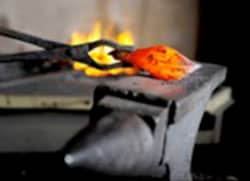 Long before we could see microstructure, blacksmiths knew how to manipulate it. They learned, through trial and error, that heated metal did different things than cold metal, and that it was a lot easier to change the structure of a metal if it were hot. Thus, creating a barrel hoop, or wagon wheel, is easier if you can heat the metal first. The scientific reason for this is that (most) metals are crystalline. Therefore what might look like a solid bar of iron is actually made up of multiple crystals, and the boundaries between those crystals create barriers to working the metal. Annealing "melts" the different crystals together and removes those barriers.
Interesting, right? I promised you a move to empiricism, and we're headed there now. But if this starts to sound too geeky, remember that all of this is back-loading that will bring us to some pretty interesting God-talk. So here we go: My own work centers on the question of optimization. How do you optimize something?
First, this requires a definition of the optimum. In my field, typical optima definitions are "maximal profit," "minimal cost," and "highest customer satisfaction." Optima are, by their nature, superlative.
The phrase "finding the optimum" necessarily implies a search, and that is one of the primary questions of empirical science: efficient searching mechanisms. Specifically, we want to search the "space" of possible solutions for that optimum. In the case of a problem that can be cast in three dimensions, this space can be seen as a surface or even landscape, and the optimum as the highest point on the surface.
 Now, there are techniques for finding the absolute best solution (called "the global optimum"), but many techniques are sometimes fooled into thinking one "high point" is in fact the "highest point." (In the picture above, some techniques may say the peak on the left is the global optimum, when the peak on the right actually is.) High points that are not the highest are called "local optima."
So, how do we get around this issue of mistaking local optima (our will, our ideas) for the global optimum of God's will, God's ideas? One technique is called simulated annealing, and it works as an analogy to metallurgical annealing. Basically, it boils down to "heating" the solution so that the search mechanism doesn't get "stuck" as easily on local optima.
If you're wondering why we're using scientific analogies to explore religious concepts, "blame" Leah Libresco. Leah writes a blog here at Patheos called Unequally Yoked. She wrote in 2010—and I read, last week—"Instead of a utopia, we require a crucible."
This immediately pulled together my knowledge of annealing and simulated annealing and processed it into "like gold that's tested in fire."
And thus was born full-formed, like Pallas Athena, the notion of Metaphysical Annealing.
Here comes the suffering and God part.
Consider, first, that we are all on a metaphysical search for purpose. Since we are on a search, and that search is for an optimum, the mechanisms of empirical science and optimization I've explained above apply in full.
 What space are we searching? The infinite possibilities of experience. Not just the universe, but the entire chain of experience that has created the moment where I'm typing this, and all the universes that can possible lead from this moment into eternity.
Article Continued On Next Page
Page: 1 of 2
12/2/2022 9:05:39 PM
Year of Faith
Catholic
Christianity
Roman Catholicism
more at patheos
1
What Was American Religion Like in 1776? What Came Next?
2
Should We Believe that Muhammad Split the Moon?
3
4
Finding God In The Great Outdoors
About
Patheos Explore the world's faith through different perspectives on religion and spirituality! Patheos has the views of the prevalent religions and spiritualities of the world.
Ad-Free & Subscriber Log-In Subscription Support
- About Us
- 2026 Calendar
- Videos
- Podcasts
- Library of World Religions
- Faith In Media Tracker
- Advertise With Us
- Write for Us
- Privacy Policy
- Terms of Service
- Do Not Sell My Data
- Contact Us
- Radiant Digital
- Manage Newsletter Subscriptions
- Unsubscribe From Notifications
- Sitemap
Copyright 2008-2026, Patheos. All rights reserved.
Subscription Support Ad-Free & Subscriber Log-In
Follow Patheos